Introduction
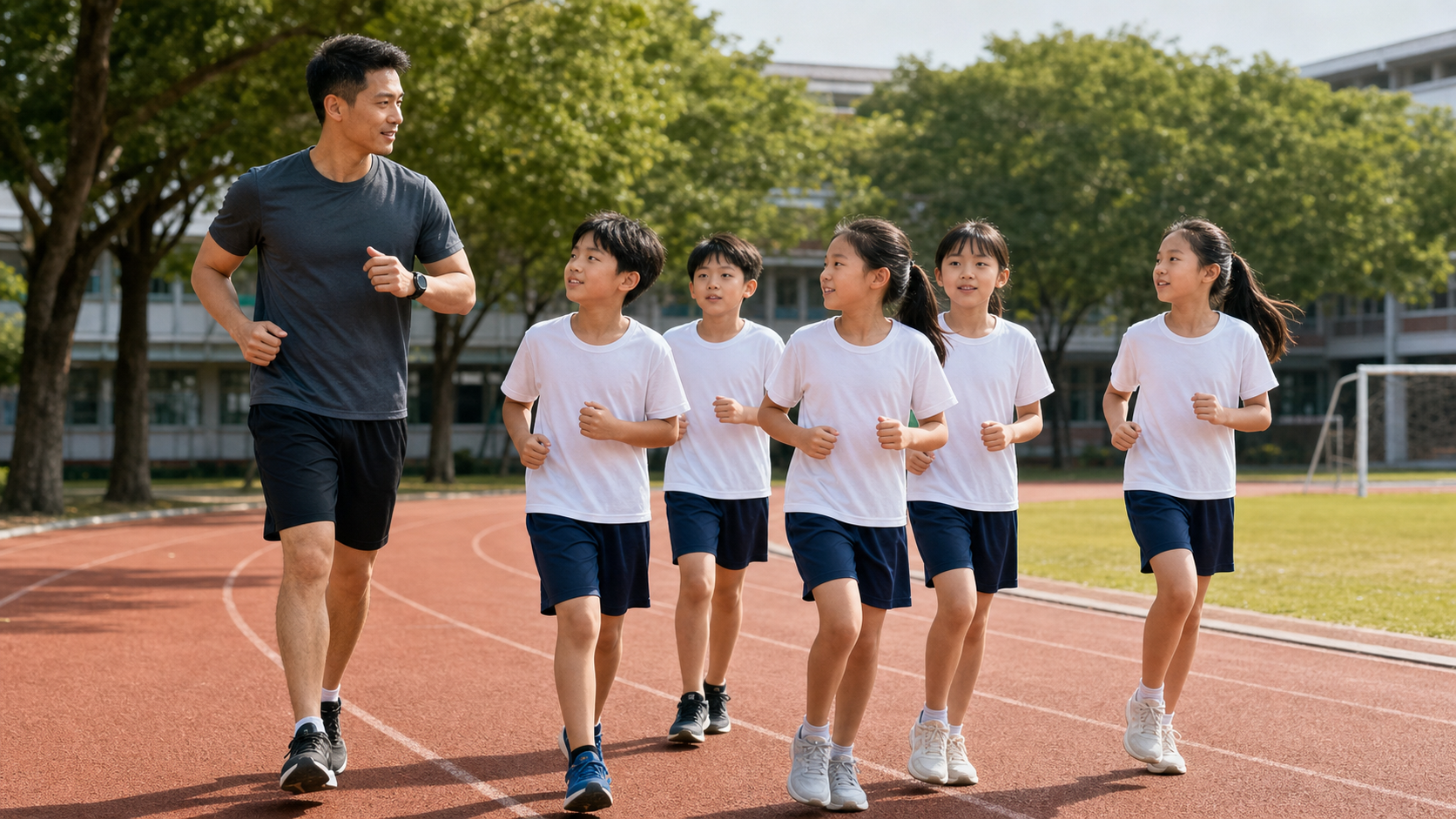
“Run five laps around the track, and you’re not going back until you do!” — This scene is all too familiar in PE classes or morning activities at many schools in Taiwan. Running, as one of the most convenient physical activities, has long been widely used on Taiwanese campuses, but it is often presented as a form of “punishment” or “mandatory target achievement” rather than cultivated as an enjoyable sport skill.
The long-term consequence of this teaching approach is that many Taiwanese adults hold a negative impression of running, viewing it as painful torment rather than an enjoyable sport. Changing this perception must start on campus, starting with the design of PE classes. This article provides a framework for proper campus running education for PE teachers and parents in Taiwan.
Common Problems in Current Campus Running Education
Problem 1: Using Punishment to Reinforce Negative Associations with Running
When running is used as a punishment—“arrive late, run two extra laps” or “break the rules, go run five laps”—children’s emotional connection to running becomes one of fear and rejection. Even if children are physically capable of completing these distances, a conditioned response of “running = painful punishment” is already formed on a psychological level.
Problem 2: Uniform Standards That Ignore Individual Differences
The common “timed 800-meter test for the whole class” in PE classes places enormous psychological pressure on children with weaker fitness levels or those who are overweight. Publicly comparing results can also cause disadvantaged children to develop a self-label of “I’m just bad at running.”
Problem 3: Lack of Technical Instruction, Only Distance Requirements
Many PE teachers assign “run three laps around the track” without teaching proper running form, breathing techniques, or pacing concepts. Children accumulate mileage using incorrect methods—this is both unsafe and fails to teach proper running skills.
A Proper Framework for Campus Running Education
Design Thinking: Replacing “Distance” with “Time”
Children of different fitness levels all run for 10 minutes, emphasizing the ability to keep moving continuously rather than comparing speed. The benefits of this design are:
| Traditional Distance-Oriented | Time-Oriented Design |
|---|---|
| Emphasizes speed, with winners and losers | Emphasizes endurance, no hierarchy |
| Disadvantaged children are clearly exposed | Individual differences are accommodated |
| Running = competition results | Running = personal progress |
| Easily breeds avoidance mentality | Reduces feelings of rejection |
Running Course Design Incorporating Game Elements
Below are reference running activity designs suitable for elementary and middle school PE classes:
Lower Elementary Grades (Ages 6–9)
- “Cops and Robbers” chase game: naturally incorporates sprinting and directional changes
- Animal imitation running: bear crawls, crab walks, frog jumps—activates multi-directional movement
- Relay races (short distances of 20–50 meters): builds team spirit
Upper Elementary to Middle School (Ages 10–15)
- Orienteering runs: use a map to find marked points around the track, running to complete tasks
- Fartlek runs: freely choose acceleration points during easy running—unstructured but fun
- Personal record challenges: compare against one’s own previous results, not against classmates
Basic Running Technique Instruction
Even in PE class, teachers should spend 5–10 minutes helping children understand the following fundamentals:
- Foot strike: Midfoot landing rather than heavy heel striking
- Arm swing: Swing forward and backward, not crossing side to side
- Breathing rhythm: The “inhale-inhale-exhale” three-step breathing method, or inhale through the nose and exhale through the mouth
- Pace awareness: An easy intensity where “you can talk while running”
Reforming Assessment Methods
Traditional PE running assessments center on “how fast you ran.” It is recommended to shift to the following multi-dimensional assessment methods:
- Personal improvement: How much has running speed or endurance improved this semester compared to last semester
- Movement quality scoring: Whether running form is standard and breathing is stable
- Participation attitude: Actively trying, not giving up, encouraging peers
- Knowledge test: Correctly explaining warm-up methods before running or self-pacing techniques
Practical Recommendations
- PE teachers should promote “running is not punishment”, unifying this concept school-wide so that individual classroom teachers’ habits don’t undermine the overall atmosphere
- Design morning runs with fun elements, incorporating music and pedometers to give children something to look forward to
- Invite parents to understand the school’s running education philosophy—family support is crucial in shaping children’s attitudes
- Regularly hold fun class road runs rather than formal timed races, allowing children to experience the community atmosphere of road running
- Teachers should run themselves: PE teachers who have a running habit see significantly more positive attitudes toward running among their students
Conclusion
Campus is where children first encounter running. If this relationship is marked by negative impressions from the very beginning, repairing it later requires multiple times the effort. PE teachers play a pivotal role—through proper course design, inclusive assessment methods, and their own passion for sports, they can ignite children’s love for running. This is not just about PE grades; it is a key investment in the lifelong health habits of every child.
Related Reading
- Cultivating Running Motivation in Teenagers: Ways to Help Kids Fall in Love with Running
- The Psychology of Teenage Running: Balancing Competitive Pressure and Enjoying the Sport
- Road Running Special Feature | Notes on Children and Teenagers Participating in Road Running (R056)
- Road Running Special Feature | Notes on Children and Teenagers Participating in Road Running (R035)
一日北高常見問題大集合 | 攻略 | 路線 | 訓練 | 補給 | 自行車 單車 | 一日雙城 | 雙塔 | TWB北高360 | 屁股痛
6 年前
一日北高/長距離團騎 常見問題補充篇 / 組團或跟團的眉角 / 壯車友容易被瘦車友慢性拉爆 / 原來屁股痛可能是這個原因...? / 風場配速法 / 公路車 / CT Yeh
2 年前
2025 海鷗團體繞圈賽 網路直播 超激烈裁判長視角 / EIPC 李廷威、Waypoint 等眾多高手競爭 / feat. 卡密兒主持 / 海鷗繞圈賽
9 個月前
#PUSHBIKE 原來這麼好玩! 小朋友 滑步車 初體驗 超可愛
6 年前
一日北高前的高裝檢 | 北高 360 | 挑戰11小時的裝備 | 一日雙塔 | 補給
6 年前
一個測試有沒有認真練車的方法😂 #公路車
10 個月前
Live) 備戰2019彰化經典百K 賽前攻略 (已完賽請看新影片
7 年前
2019 柯P 超越北高 第一集團實錄 (11小時實錄請參考另一部影片) 一日雙城 一日北高 NeverStop Taiwan Long Distance Cycling Challenge
7 年前