Preventing Running Injuries in Adolescents: Distinguishing Growing Pains from Training Injuries
Introduction
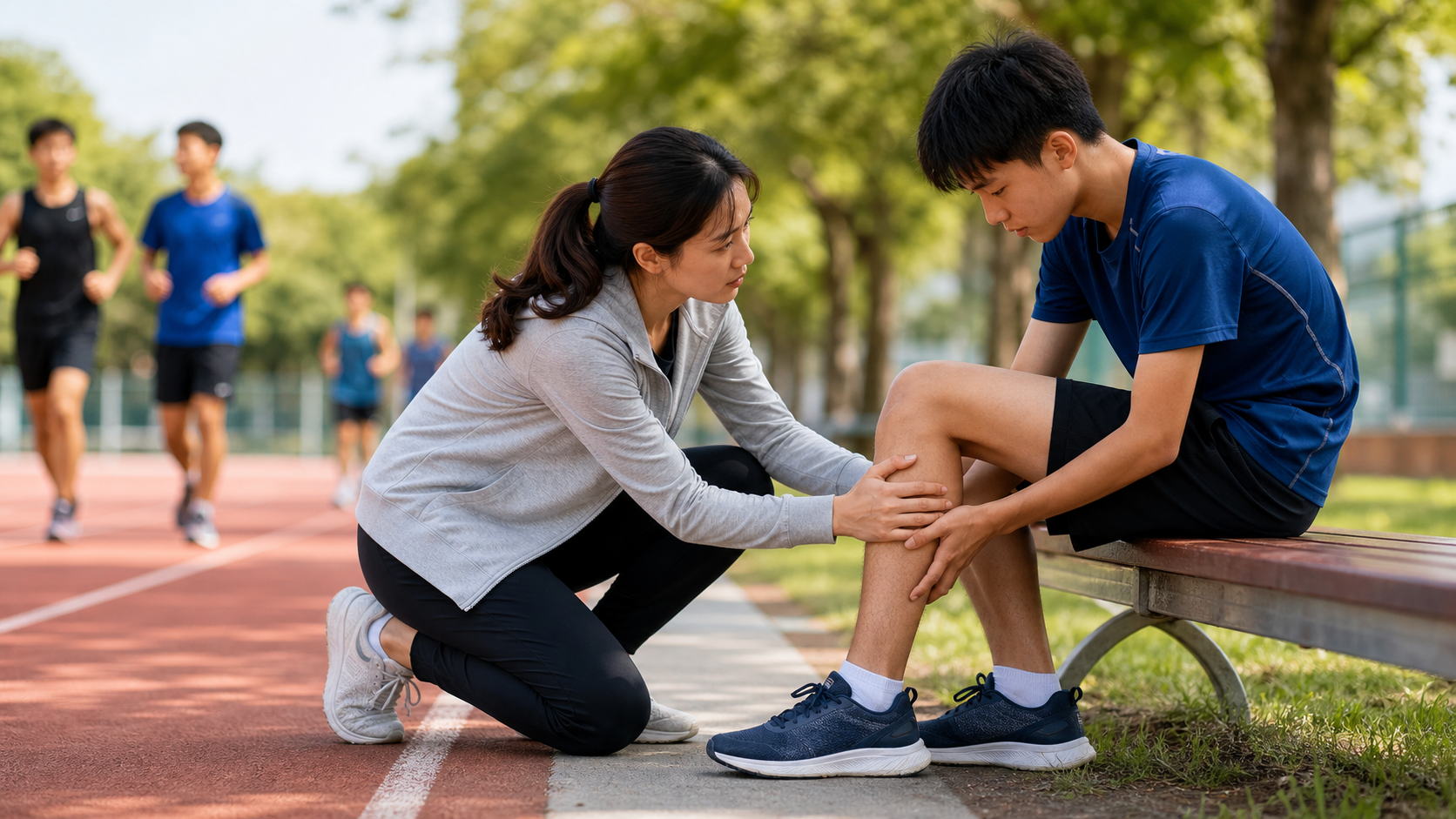
“My knee hurts, can I skip running practice?” — every parent with a child in track training has probably heard this. The question is: what lies behind this statement — a real sports injury that needs active attention, an excuse to avoid training, or just harmless growing pains?
Distinguishing the nature of the pain is often the most challenging task for parents. Ignoring a real injury could let a child train while hurt, leading to long-term problems; being overly anxious about normal growing pains could let a child avoid the exercise they need. This article provides parents with key guidelines for telling the two apart, as well as a systematic strategy for preventing running injuries in teenagers.
The Characteristics and Nature of Growing Pains
What Are Growing Pains?
“Growing pains” refer to a benign, intermittent limb pain that occurs in children and adolescents, usually appearing between ages 3–12 (sometimes continuing into puberty). Their exact nature is still not fully understood medically, but they are generally believed to be related to the rapid musculoskeletal development during growth periods, and are not caused by the physical stretching of bones as they grow.
Typical Characteristics of Growing Pains
- Timing: Most commonly occur from late afternoon to nighttime, often waking the child from sleep crying
- Location: Usually in the front of the thigh or front of the shin (muscle belly area), bilateral and symmetrical
- Nature: Deep soreness or cramping pain, not in a specific joint
- Duration: Usually resolves on its own within 15 minutes to 2 hours
- Daytime behavior: Completely normal, does not affect running or activity
- Palpation: Pressing the muscle usually provides relief, and does not sharply worsen with pressure
Key indicator: Growing pains do not affect daytime running ability. If a child experiences pain or limited movement while running during the day, it is almost certainly not growing pains, but an injury that needs evaluation.
Common Types of Training Injuries in Teenage Runners
Comparison Table: Growing Pains vs. Training Injuries
| Criterion | Growing Pains | Training Injuries |
|---|---|---|
| Timing of pain | Evening/night | During or after running |
| Daytime activity | Completely normal | Affected, limping or avoidance |
| Duration | Usually disappears within days | Lasts more than a week |
| Location | Bilateral, symmetrical, in muscles | Unilateral, in a specific joint or bone |
| Response to palpation | Pressing provides relief | Pressing markedly worsens pain |
| Swelling or heat | None | Possible |
| Relation to mileage | No clear relation | Worsens when mileage increases |
Common Training Injuries in Teenage Runners
1. Tibial Stress Fracture
- Symptoms: Severe pain when pressing a specific point on the front of the shin, worsens after running, eases with rest but does not fully resolve
- Risk factors: Sudden increase in mileage, training on hard surfaces, insufficient calcium intake
- Management: Stop running immediately, seek medical confirmation, rest for 6–12 weeks
2. Iliotibial Band Syndrome (IT Band Syndrome)
- Symptoms: Sharp pain on the outside of the knee, appears after running a certain distance, eases after stopping
- Risk factors: Heavy uphill/downhill training, poor running form
- Management: Reduce mileage, strengthen the gluteal muscles, physical therapy
3. Plantar Fasciitis
- Symptoms: Heel pain on the first step out of bed in the morning, worsens after long-distance runs
- Risk factors: Excessive mileage, flat feet, severely worn shoe soles
- Management: Stretch the plantar fascia and calves, replace shoes, reduce mileage
4. Osgood-Schlatter Disease (see also the article on growth plate injuries)
- Symptoms: Bony bump and tenderness at the tibial tuberosity below the knee
- Characteristics: A growth plate-related condition that eases with rest but may recur repeatedly until growth is complete
Systematic Strategies for Preventing Running Injuries in Teenagers
Training Plan Level
- The 10% Rule: Increase weekly mileage by no more than 10%
- Periodized training: Schedule a “cutback week” every 3–4 weeks (reduce mileage by 20–30%)
- Intensity management: Follow high-intensity sessions with easy recovery days
Strength Training Level
- Hip and core strengthening: Squats, bridges, side-lying leg raises to prevent knee and ankle problems
- Calf eccentric training: Standing on the edge of a step and slowly lowering the heels to prevent Achilles tendinitis
- Plantar intrinsic muscle training: Towel scrunches, single-leg balance to strengthen the arch
Practical Advice
- Build a pain-scoring habit: After each training session, have the child rate their pain (0–10); if it is 4 or higher for 3 consecutive days, reduce training or see a doctor
- Photograph the painful area: If there is swelling or visible abnormality, take photos to help the doctor assess
- Choose sports medicine or orthopedics rather than a general practitioner’s “wait and see” approach
- Return to training gradually after injury; do not resume full-speed training just because “it doesn’t hurt anymore”
- Teach children to express pain: “Saying you’re in pain isn’t weak” — educate children to honestly report how their body feels
Conclusion
Distinguishing growing pains from training injuries is essential knowledge for every parent of a teenage runner. Understanding the difference is not just about making the right decision in the moment — it is about building a child’s ability to manage their own body. When children learn to listen to their body’s signals, knowing which pains require rest and which allow them to keep running, they gain the most important running wisdom that will stay with them for life.
Related Reading
- The Complete Guide to Preventing Running Injuries and Returning: A Coach Explains Causes, Management, and Safe Return to Racing
- Bone Development and Mileage Limits in Teenagers: How to Avoid Growth Plate Injuries
- Teenage Running Safety: Training Volume, Intensity, and Long-Term Development
- The Psychology of Pain in Running: Cognitive Training to Distinguish “Good Pain” from “Bad Pain”
一日北高/長距離團騎 常見問題補充篇 / 組團或跟團的眉角 / 壯車友容易被瘦車友慢性拉爆 / 原來屁股痛可能是這個原因...? / 風場配速法 / 公路車 / CT Yeh
2 年前
一日北高常見問題大集合 | 攻略 | 路線 | 訓練 | 補給 | 自行車 單車 | 一日雙城 | 雙塔 | TWB北高360 | 屁股痛
6 年前
西進武嶺 免費訓練分析服務 Intervals | 練不夠還是練過頭?你哪一種類型選手?AI模型告訴你! | 備戰神器 | 公路車 訓練 | CT Yeh
4 年前
Never Stop 西進武嶺 前後雙機 完整全程錄影 訓練台 實境
8 年前
滑雪新手們慘摔學習全紀錄(請開字幕),滑雪好好玩 | Snowboard + Ski | 岩原 スキー場 | 滑雪APP使用 | GoPro Max
6 年前
#PUSHBIKE 原來這麼好玩! 小朋友 滑步車 初體驗 超可愛
6 年前
大禹嶺 到 武嶺牌樓 全程前後實況錄影 | 北進武嶺 | 東進武嶺 | KOM | 訓練台 | 坡度分析 | Taiwan KOM Last 10 km HARD | 公路車
6 年前
單車 一日北高 ( 雙城 ) 肥宅雙人瘋狂行 紀錄片 REACTO
10 年前