Portable Lactate Analyzer: Practical Operation and Training Applications for Road Running Lactate Threshold Testing
Introduction
Lactate Threshold is one of the most important physiological metrics in endurance training, and it predicts marathon finish times better than VO2max. Traditionally, lactate testing required a university sports science laboratory, costing thousands of dollars with long appointment wait times. However, with the advent of portable lactate analyzers such as the Lactate Scout 5, Nova Biomedical, and Edge Lactate Analyzer, runners can now perform lactate threshold testing on their own at the track, significantly reducing both cost and barriers to entry. This article teaches you how to conduct field lactate testing and apply the results.
The Exercise Physiology Foundation of Lactate
What is lactate?
Lactate is a byproduct produced when muscles undergo anaerobic metabolism using glucose. Previously considered a “fatigue waste product,” modern exercise physiology has revealed that lactate is actually an important energy source that can be reused by the cardiac muscle and slow-twitch muscle fibers.
The significance of lactate threshold:
| Intensity Stage | Blood Lactate Concentration | Metabolic Characteristics |
|---|---|---|
| Easy run | 1–2 mmol/L | Fully aerobic, lactate clearance faster than production |
| LT1 (aerobic threshold) | ~2 mmol/L | Lactate begins to accumulate slightly |
| LT2 (anaerobic threshold) | ~4 mmol/L | Critical point of rapid lactate accumulation |
| High-intensity intervals | 8–15+ mmol/L | Massive lactate accumulation |
LT2 (commonly referred to as the “anaerobic threshold” or “maximal lactate steady state”) is the most important metric in marathon training, and its corresponding pace is approximately equal to or slightly faster than marathon race pace.
Introduction to Portable Lactate Analyzers
Main options:
| Model | Features | Test Strip Cost | Suitable For |
|---|---|---|---|
| Lactate Scout 5 | Lightweight, one-hand operation, results in 15 seconds | Approx. US$1.5–2/strip | Coaches and serious amateur athletes |
| Nova Max Plus | US brand, stable data | Approx. US$1/strip | Entry-level choice |
| Edge Lactate Analyzer | Bluetooth connection to app | Approx. US$2/strip | Tech-oriented users |
Sampling method:
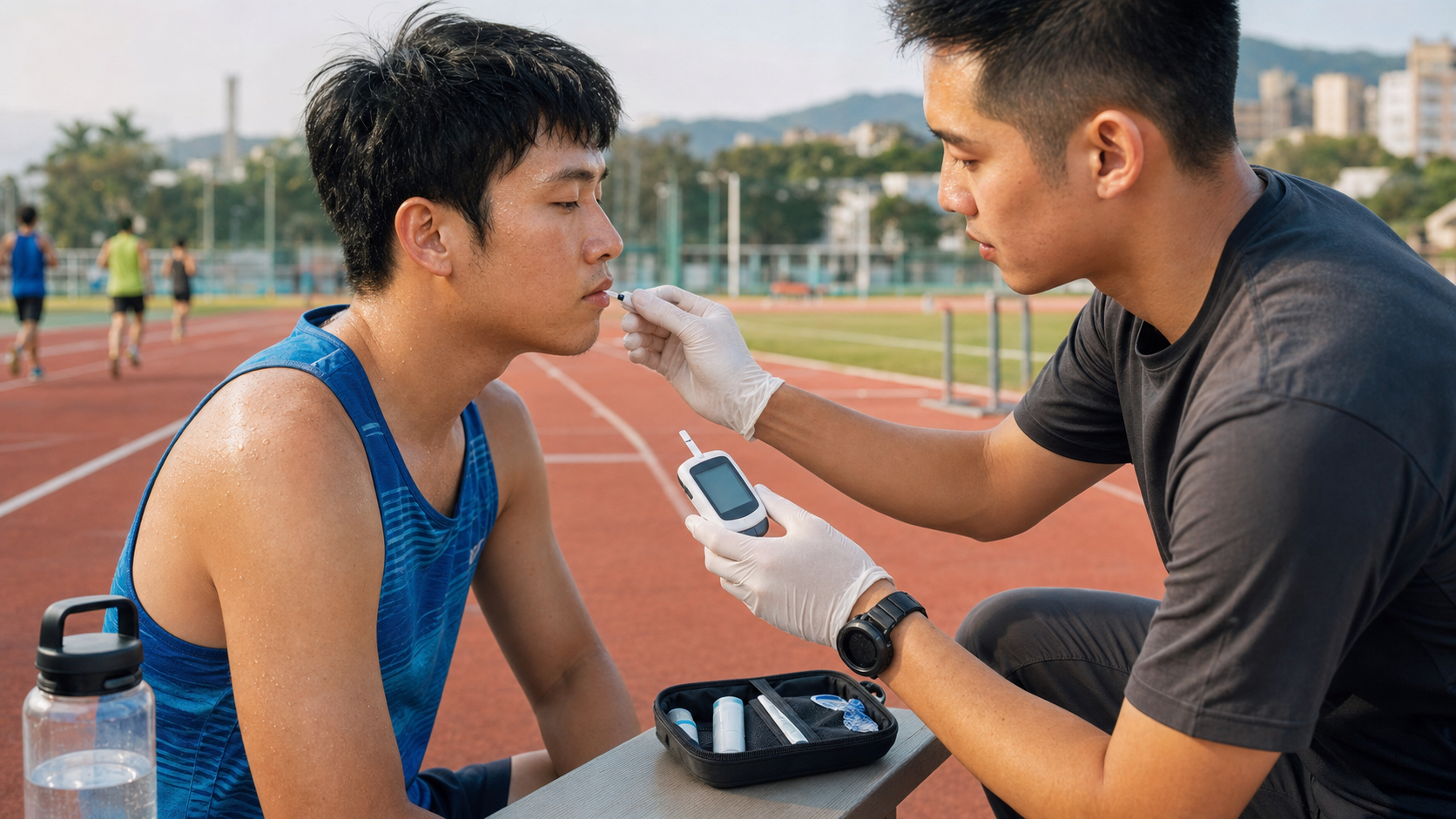
The most commonly used sampling sites are the earlobe (common in Taiwan) or the fingertip. The earlobe has abundant blood flow, making sampling easier during exercise, and it correlates well with arterial blood lactate.
Required equipment:
- Portable lactate analyzer + test strips
- Lancet
- Alcohol swabs
- Gauze balls for stopping bleeding
- Timer (stopwatch or phone)
Field Lactate Threshold Testing Protocol
Preparation conditions:
- No high-intensity training for 24 hours prior to testing
- No large carbohydrate intake 3–4 hours before testing (to avoid affecting metabolism)
- Choose a flat track or a flat course with a known distance
Standard incremental load test (5 × 5 minutes):
- Warm-up: 10 minutes of easy jogging
- Segment 1: Run 5 minutes at a pace 60 seconds slower than your estimated marathon pace, then take a blood sample within 30 seconds to measure lactate
- Segment 2: Increase pace by 15 sec/km, run 5 minutes, take blood sample
- Segment 3: Increase pace by another 15 sec/km, run 5 minutes, take blood sample
- Segment 4: Increase pace by another 15 sec/km, take blood sample
- Segment 5: Increase pace by another 15 sec/km, take blood sample
- Plot a “pace vs. lactate value” curve and identify the pace at which the curve shows a clear inflection point (sharp rise), which is LT2
Example test results:
| Segment | Pace | Lactate Value |
|---|---|---|
| Segment 1 | 5:30/km | 1.3 mmol/L |
| Segment 2 | 5:15/km | 1.8 mmol/L |
| Segment 3 | 5:00/km | 2.5 mmol/L |
| Segment 4 | 4:45/km | 3.9 mmol/L |
| Segment 5 | 4:30/km | 7.2 mmol/L |
In this example, LT2 is approximately between 4:45–5:00/km (the inflection point where lactate jumps from 2.5 to 3.9).
Training Applications of Lactate Test Results
- LT2 pace = target pace for tempo runs
- LT1 pace (the pace corresponding to approximately 2 mmol/L) = the upper limit of easy runs/Z2 aerobic running
- Marathon goal pace ≈ LT2 pace or slightly slower (depending on individual endurance characteristics)
Practical Recommendations
- Repeat testing every 6–8 weeks to track improvements in LT2 pace
- Given Taiwan’s hot and humid summers, it is recommended to test in the early morning or on an indoor treadmill to ensure environmental consistency
- For your first self-administered test, it is recommended to have an experienced running buddy or coach accompany you to ensure correct blood sampling technique
- Test strips have expiration dates; after opening, store them according to the instructions to avoid inaccurate data
Conclusion
Portable lactate analyzers have made lactate threshold testing no longer exclusive to elite athletes. Through regular lactate testing, you can precisely set your training zones, track improvements in your aerobic base, and ensure that every hour of training investment has a clear physiological basis.
Related Reading
- Running Lactate Threshold Training: The Scientific Method to Break Through the LT Speed Wall
- Running Lactate Threshold Training: The Physiological Basis of Marathon Pace
- Cycling Lactate Testing: Applications of Blood Lactate Concentration in Training Zone Setting
- Lactate Threshold Testing Methods: Accuracy Comparison Between Laboratory and Field Testing
#公路車 #Vo2Max #最大攝氧量 測驗 體驗 | 心肺測試
6 年前
西進武嶺 免費訓練分析服務 Intervals | 練不夠還是練過頭?你哪一種類型選手?AI模型告訴你! | 備戰神器 | 公路車 訓練 | CT Yeh
4 年前
一個測試有沒有認真練車的方法😂 #公路車
10 個月前
2021 96聯賽 桃園市長盃 4K多視角實況 當天選手瓦數/推力比/均速/時間 即時數據分析 | 公路車 | CT Yeh
5 年前
#PUSHBIKE 原來這麼好玩! 小朋友 滑步車 初體驗 超可愛
6 年前
單車AI教練!全新 ChatGPT4o 幫你分析訓練成果!排武嶺課表,分析騎車姿勢! 太神了! / 公路車 / CT Yeh / feat. 緯緯
2 年前
大家都在開箱的...單車用藍芽對講耳機真的有幫助嗎? SENA BiKom 20 長距離旅遊 & 海鷗繞圈賽 實際體驗心得 / 公路車 / CT Yeh
9 個月前
全台首發神車錶! iGPSPORT iGS630 兩趟一日北高的續航! 超強導航、功率訓練、超人性APP! Garmin & Bryton 有對手了嗎? | 公路車 |CT Yeh
3 年前