Introduction
The World Health Organization (WHO) defines drowning as “the process of experiencing respiratory impairment from submersion or immersion in liquid,” whether the outcome is death (non-fatal drowning) or only temporary asphyxiation (fatal drowning). WHO data shows that approximately 236,000 people drown globally each year, and drowning is one of the most common accidental causes of death among children aged 1–14. Taiwan is surrounded by sea, with abundant rivers, valleys, and coastline, and with frequent summer water activities, drowning prevention is especially critical. According to statistics from Taiwan’s Ministry of Health and Welfare, the annual number of drowning deaths ranges between 300–500, with a considerable proportion occurring in natural waters that are not designated swimming areas.
The Dangerous Characteristics of Drowning in Taiwan’s Waters
Types of Hazardous Waters and Risk Analysis
| Water Type | Main Risk Factors | High-Risk Groups |
|---|---|---|
| Beach surf zones | Strong rip currents, undertows | Teenagers, tourists |
| Streams / river valleys | Flash floods, slippery rocks, deep pools | River tracers, campers |
| Reservoirs / lakes | Unknown depth, entanglement in weeds, boats | Children, illegal swimmers |
| Swimming pools | Inadequate supervision, swimming fatigue | Young children, the elderly |
| Harbors / piers | Strong currents, high drop-offs | Accidental fall victims |
Rip Currents Are the Leading Cause of Beach Drownings
Rip currents are fast-moving channels of water flowing from the shore out to sea, reaching speeds of up to 2.5 meters per second, and are the primary trigger for beach drownings. The typical pattern of many drowning incidents is: a swimmer is carried away from shore by a rip current, then panics and continuously fights against the current, exhausting their energy before drowning.
How to correctly respond to a rip current:
- Do not fight the current head-on: Swimming directly back to shore is futile and only accelerates fatigue
- Swim parallel to the shore: Rip currents are usually no wider than 30 meters, so swimming sideways can get you out of the current
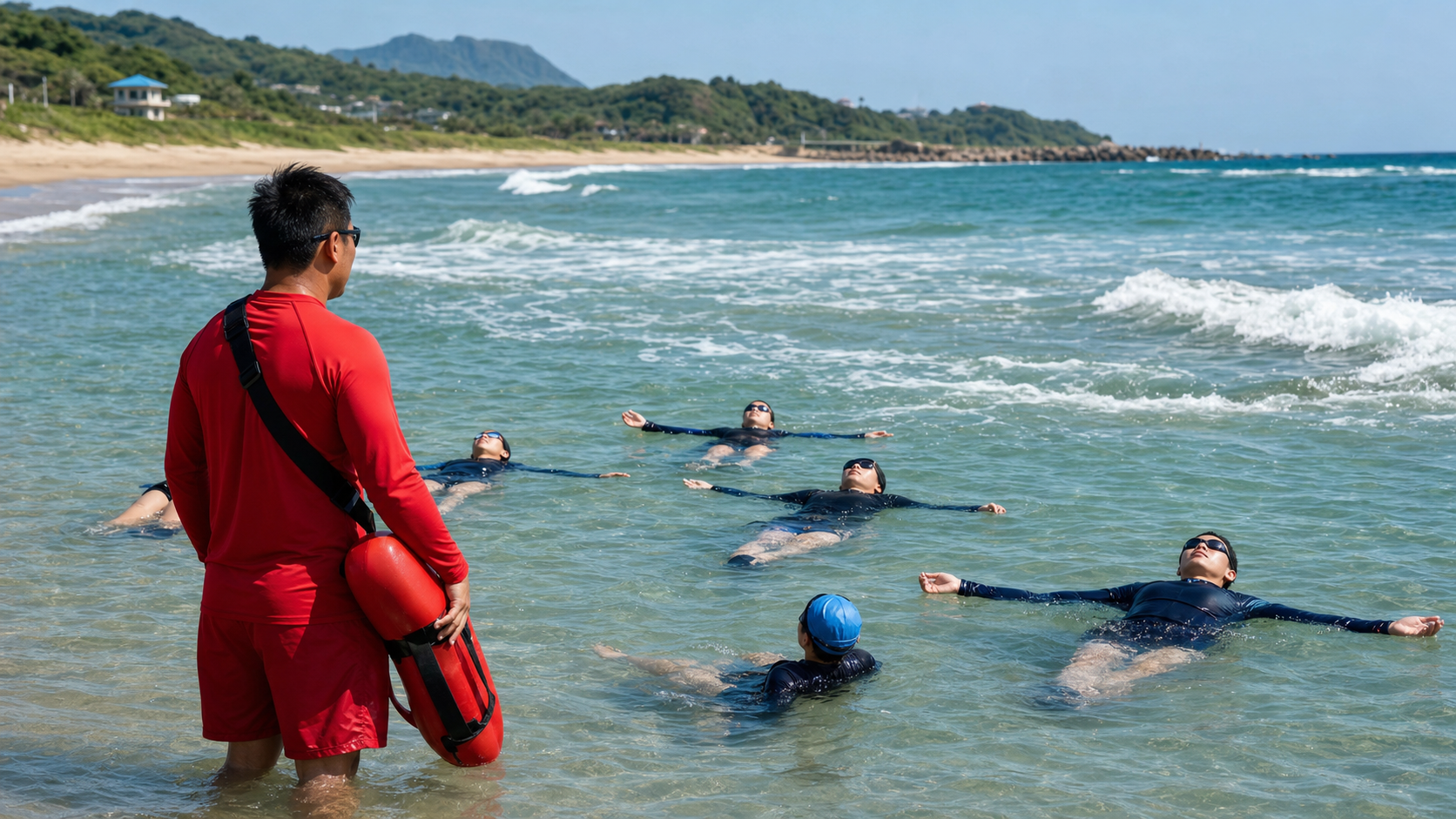
- Stay calm, float on your back and wait: If you cannot escape, use a back-float position to conserve energy and wave for help
The Protective Effect of Swimming Skills Against Drowning
Research consistently shows that having basic swimming ability is the most effective protective factor against drowning. However, the current state of children’s swimming education in Taiwan still shows significant gaps:
- Although the Ministry of Education’s “Student Swimming Ability Assessment” has been promoted for years, urban-rural resource disparities leave students in remote areas with generally lower swimming abilities
- “Knowing how to swim” does not equal “water safety” — students who can complete 25 meters in a pool do not necessarily possess the self-rescue skills needed in complex environments such as ocean waves or rivers
- Water Safety Education should include: recognizing water hazards, understanding rip currents, learning back-float self-rescue, and knowing when not to enter the water
The Golden Rescue Principles for Drowning
For bystanders (non-lifeguards): Remember the four-character mnemonic “Reach, Throw, Row, Go”
- Reach: Use buoyant objects (kickboards, plastic bottles, instant noodle cups) to extend toward the victim for them to grab
- Throw: Throw ropes, clothing, or belts for the victim to grasp and be pulled back
- Row: Approach using watercraft such as boats or kayaks
- Go: Only as a last resort for those with lifesaving training; ordinary people should never enter the water to rescue (which may result in two deaths)
First aid after drowning:
- Check for breathing: If the victim is not breathing, begin cardiopulmonary resuscitation (CPR) immediately
- Drowning CPR differs from standard CPR: Give 2 rescue breaths first (because oxygen deprivation is the primary cause), then perform chest compressions
- Even if the victim regains consciousness, they still need to be taken to the hospital for observation, as “Secondary Drowning” can occur within 24 hours after the incident
Key Priorities for Promoting Water Safety Education in Taiwan
- Comprehensive swimming education: Ensure every junior high school student can complete at least 200 meters of swimming and receive water safety courses
- Promoting back-float skills: “Flip, Float, Follow” is the three-step self-rescue mnemonic promoted by international water safety organizations
- Mandatory training before river tracing: Participants should receive water safety courses before river-tracing activities and wear certified life jackets
- Beach warning flag education: Recognition of red-yellow flags (safe swimming zones) and red flags (dangerous, swimming prohibited) should be incorporated into school curricula
Practical Advice
- Learn to back-float: This is the most important water self-rescue skill — lie on your back on the water surface, relax, and maintain buoyancy with minimal effort while waiting for rescue
- Enroll children in formal swimming lessons: Swimming lessons should include self-rescue skills, not just stroke instruction
- Do not swim in prohibited areas: Behind such bans are often lessons written in blood and tears
- Do not swim alone in natural waters: Swim with at least three people, with one person monitoring from shore
- Understand local water conditions: Ask local lifeguards or people familiar with the water before entering
- Strengthen supervision of young children at home: A young child can drown silently in 30 seconds; caregivers must not be distracted
Conclusion
Drowning tragedies are often preventable. From acquiring personal swimming skills to water safety education at the societal level, from the deployment of beach lifeguard stations to the implementation of river-tracing safety regulations, improvements at every link can actually save lives. Taiwan’s water resources are abundant and beautiful, and only through comprehensive water safety education can every person who approaches the water return home safely.
Related Reading
- Water Safety for Senior Swimmers: Drowning Risk Assessment and the Swim Buddy System
- The Best Age for Children to Learn Swimming and Course Selection: The Current State of Swimming Education in Taiwan
- Taiwan’s Beach Culture and Swimming Safety: Understanding Wave Conditions and Rip Currents
- Open Water Swimming Safety Guidelines: Buddy System, Current Reading, and Emergency Response
2023桃園團體繞圈賽 / 海鷗繞圈賽 | 全程空拍數據版 | 公路車 | CT Yeh
2 年前
秘境雪場 日本 八甲田 冰樹探險與滑雪體驗 ft. Q老師 & 運動生活
7 年前
抖肩舞 台灣x日本交流版 (台灣 vs 前橋) 赤城山登山賽 coincidance
8 年前
2025 海鷗團體繞圈賽 網路直播 超激烈裁判長視角 / EIPC 李廷威、Waypoint 等眾多高手競爭 / feat. 卡密兒主持 / 海鷗繞圈賽
9 個月前
CT暗黑廚房) 車友必備 宇宙無敵鮮蚵湯 幫助訓練恢復 天然食補 好市多 超肥鮮蚵 破PR
7 年前
2023桃園團體繞圈賽/環台賽等級拍攝/賽事精華/ 10人一隊缺一不可!50隊廝殺大場面 / 第三屆 海鷗繞圈賽 /公路車/CT Yeh
2 年前
水金九不厭五分 10度寒流冷到不願停!feat. 卡卡 / 公路車 / CT Yeh
6 個月前
山港 環東台北160K 自行車約騎活動
9 年前