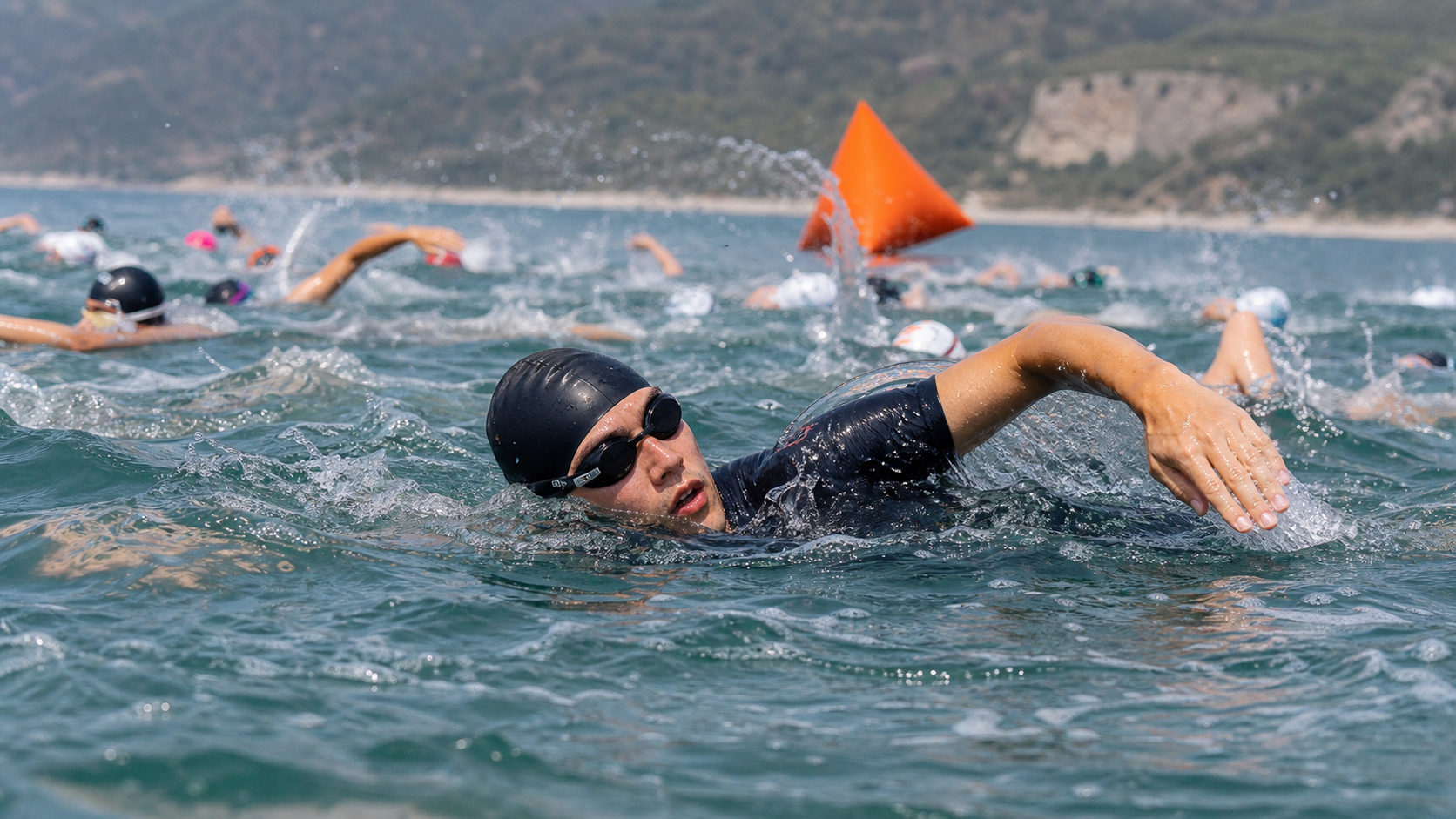
Open-Water Crowd Management: Staying Calm When Hands and Feet Collide in a Pack Swim
Introduction
For many athletes competing in a large open-water event for the first time, the biggest fear is not the distance—it’s the crowd. With hundreds of swimmers moving through a limited body of water at once, kicks, elbows, and head bumps are nearly unavoidable in the first few minutes after the start. This chaos makes many technically skilled swimmers’ hearts race, causes hyperventilation, and even leads some to stop mid-race in tears or calling for help.
Managing a pack swim is not just a technical issue—it’s a psychological one. Learning to stay calm in a crowd is an essential skill for open-water racing.
1. Why Is Pack Swimming Especially Dangerous?
| Risk Factor | Description |
|---|---|
| Obstructed vision | Surrounded on all sides, unable to see ahead, prone to panic |
| Accidental collisions | Uncontrolled kicks and hits trigger a fear response |
| Disrupted breathing | Turning to breathe just as someone blocks the way, unable to get air |
| Water turbulence | The wash created by multiple swimmers nearby disrupts your rhythm |
| Psychological pressure | A sense of confinement and loss of control triggers anxiety |
2. Mental Preparation: Accept That Contact Is Normal
The most important mental preparation for open-water pack swimming is this: Contact is not a malicious attack—it is an unavoidable physical phenomenon.
- Before the race, visualize being kicked and preset your response: “This is normal, and I will keep swimming.”
- During group training, deliberately swim close to teammates to get used to swimming at close range.
- Learn the mental framework that “contact does not equal danger.”
3. Positioning Strategy
Starting position (the most important decision):
- Front-center: The most competitive, suited for fast, mentally strong swimmers
- Front-outside: Fast but avoids the densest crowd; the downside is a slightly longer route
- Back of the pack: Wait for the crowd to spread out before moving up; conservative but safer
- Starting outside on the same side as the buoy: You can take a curved line to avoid the crowd at the first buoy
Position management while swimming:
- Actively keep up with the lead pack and use the “drafting effect” to save energy (following 30–50 cm behind another swimmer’s feet can save 10–15% of your effort)
- When feeling pressured, slowly drift 2–3 meters to the outside to break away from the densest group
4. Immediate Response After Being Hit
Kicked in the face/head:
- Stop stroking for a moment and check whether you are injured (bleeding, blurred vision)
- If it’s not serious, adjust your position and keep going
- If you feel severe discomfort, raise your hand to signal for help and wait for the support boat
Goggles knocked off:
- Stop swimming immediately, flip onto your back, and use both hands to find your goggles
- Do not dive underwater to look for them—keep your body floating on the surface
- If you cannot find them, take a deep breath and continue swimming with your eyes half-open (saltwater stings but is safe)
Breathing blocked:
- Flip onto your back and float for 2–3 seconds to catch your breath and settle your heart rate
- Do not force a breath when someone is blocking your way
- Learn “emergency breathing”: lift your face out of the water to breathe, without worrying about stroke aesthetics
5. Technical Moves to Protect Yourself
- Extend your lead arm to guard your face: In dense crowds, keep one arm extended forward as a buffer to protect your head
- Shorten your stroke length: Reduce your stroke range in the crowd to lower the chance of colliding with others
- Increase your kick tempo: Keep your legs moving—this both propels you forward and creates a protective barrier that makes it harder for others to get close
- Avoid grabbing others: Do not grab another swimmer’s ankles or clothing—it is a rule violation and dangerous
6. Special Situation: Panic Attack
If you experience difficulty breathing or an overwhelming sense of fear during a pack swim, immediately follow these steps:
- Flip onto your back, spread your arms wide, and take 5–10 deep breaths
- Confirm that you are still floating (most of the time, panic is mental—your body is still safe)
- If symptoms do not subside, raise one hand to signal for help from the staff
- Never force yourself to keep swimming forward while struggling to breathe
7. Practical Advice
Pack-swim training:
- Regularly do “pack-swim training” with your swim club—8–15 people in the same lane, deliberately creating contact situations
- Practice “tight drafting drills” with a friend: one leads, one follows 20 cm behind, getting used to being hit by the wash
Conclusion
Pack swimming is the most unpredictable and mentally demanding part of an open-water race. Enter the water with the mindset that “contact is part of the race,” combined with concrete positioning strategies and collision-response techniques, and you will find that pack swimming gradually transforms from a source of fear into a stage where you can showcase the results of your training.
Related Reading
- Handling Pack-Swim Conflicts: Staying Calm and Recovering After Being Kicked or Pushed
- Solo Swimming in Open Water: Mental and Technical Adjustments After Losing the Main Pack
- Pack Swimming: Drafting and Strategies for Dealing with Kicks
- Open-Water Team Training: Pace Groups and Protection Strategies
[教學] Premiere 影片 手震 修正 教學 防抖 單眼 影像 GoPro 穩定 Video Stabilization
8 年前
備戰 戀戀197 賽前關門點分析 西濱團練 #公路車 4K高畫質
6 年前
FTL 與 SYB 車隊專訪 西進武嶺 實用攻略分享! 2小時 如何練?!你不知道的眉角!新手準備武嶺必看 EP1 | 實力派女車友 | 精華版 | 公路車 | CTYeh
4 年前
一日北高/長距離團騎 常見問題補充篇 / 組團或跟團的眉角 / 壯車友容易被瘦車友慢性拉爆 / 原來屁股痛可能是這個原因...? / 風場配速法 / 公路車 / CT Yeh
2 年前
#PUSHBIKE 原來這麼好玩! 小朋友 滑步車 初體驗 超可愛
6 年前
西進武嶺 免費訓練分析服務 Intervals | 練不夠還是練過頭?你哪一種類型選手?AI模型告訴你! | 備戰神器 | 公路車 訓練 | CT Yeh
4 年前
CT Talk) 數據面窺看 武嶺大神們 平時的備戰 共通點 (娛樂性質XD)
7 年前
2025 海鷗團體繞圈賽 網路直播 超激烈裁判長視角 / EIPC 李廷威、Waypoint 等眾多高手競爭 / feat. 卡密兒主持 / 海鷗繞圈賽
9 個月前