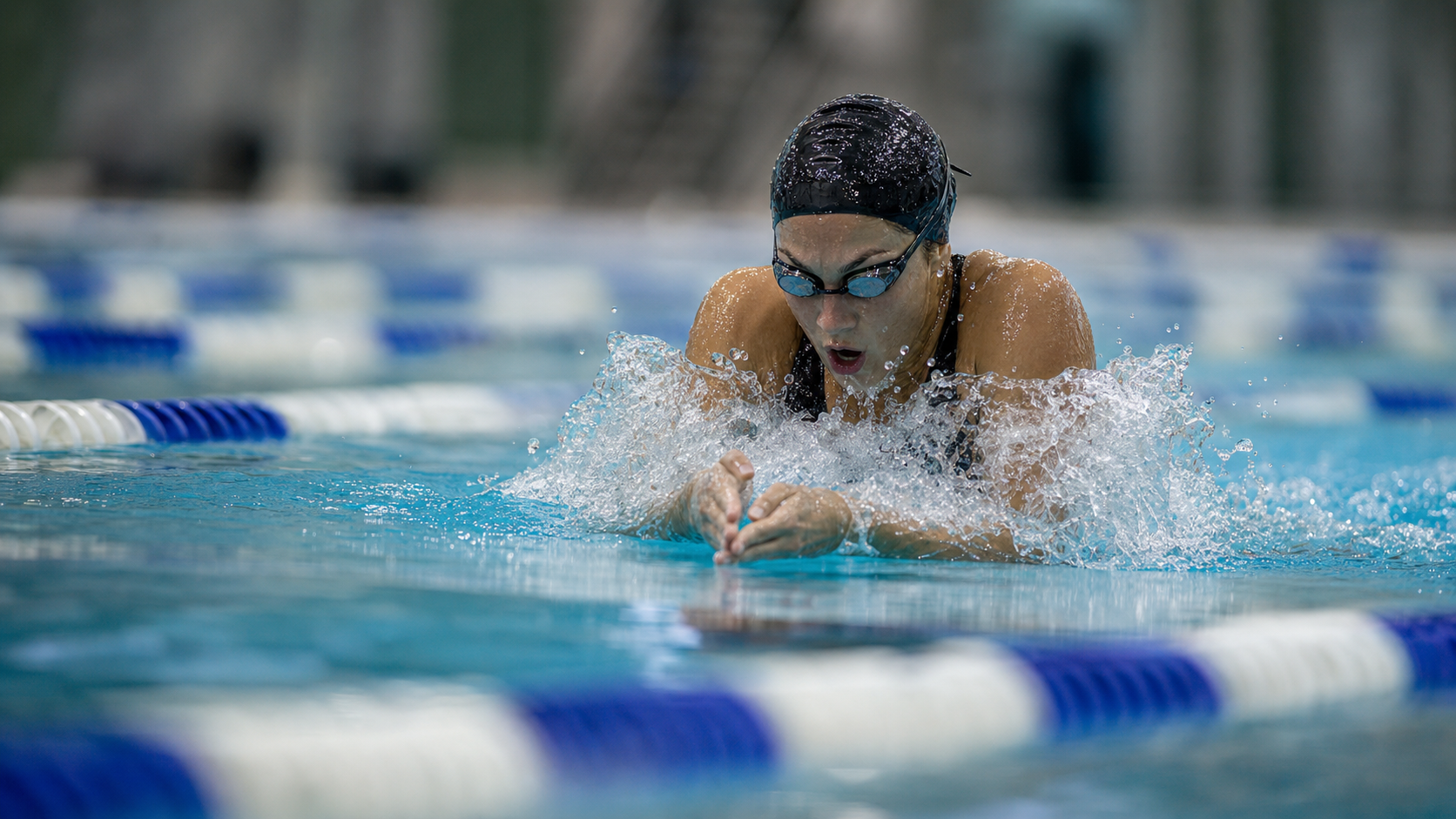
200m Breaststroke Technique Retention Strategy: The Key to Maintaining Stroke Quality Under Fatigue
Introduction
Breaststroke is the most technically complex of the four competitive strokes, and the one most prone to technical breakdown under fatigue. Elite male 200m breaststroke times range from approximately 2:05 to 2:10, while accomplished amateurs typically finish between 2:30 and 3:00. This distance is enough for swimmers to fully experience breaststroke technique collapsing under fatigue: “legs kicking unevenly, shortened glide, upper body rising too high” — these problems are not caused by insufficient training, but by premature fatigue resulting from poor pacing strategy.
1. How Breaststroke Technique Breaks Down Under Fatigue
Understanding how fatigue disrupts breaststroke technique is the first step in building a strategy:
| Technical Element | Normal State | Degradation Under Fatigue | Impact on Speed |
|---|---|---|---|
| Leg kick spread angle | Symmetrical legs, 45–55 degrees | Asymmetrical, one leg cheating | Propulsion drops 20–30% |
| Glide position | Streamlined, arms extended forward | Body sinks, head lifts up | Drag increases 15% |
| Pull depth | Appropriate (below shoulder line) | Too deep, pulling outside the head | Pull efficiency decreases |
| Breathing motion | Head lifts naturally | Upper body rises significantly out of water | Breaks streamline |
2. Technical Strategy Allocation Across Four Laps
First Lap (0–50m): Establishing the Glide Rhythm
Breaststroke’s greatest propulsive advantage comes from the “glide” — maintaining a streamlined body position moving forward after each kick. The first lap should deliberately emphasize the glide duration after each kick (approximately 0.8–1.2 seconds), setting the rhythmic foundation for the entire race.
- Control speed at 90–93% of your personal best 200m breaststroke pace
- Ensure full body extension after each kick, with both arms stretched forward to the ears
- Breathe once (approximately every full breaststroke cycle); do not sacrifice glide for breathing
Second Lap (50–100m): Maintaining Technical Quality
This lap is the most important window of opportunity for maintaining technical quality — the body is fully warmed up but not yet severely fatigued.
- Pay special attention to the symmetry of the leg kick spread angle, avoiding a “lazy leg” (one leg cheating with a weaker kick)
- Keep the pull path below the shoulder line, avoiding elbows passing outside the shoulder line
- On turns, breaststroke rules require both hands to touch the wall simultaneously; the push-off and turn must be clean and quick
Third Lap (100–150m): The Dual Challenge of Mind and Technique
The third lap is typically the segment where breaststroke technique deteriorates fastest. The body’s fatigue causes swimmers to unconsciously shorten their glide time (the “I want to get to the finish faster” mentality), which ironically reduces propulsive efficiency.
- Deliberately slow down the stroke rate, ensuring each glide duration is no shorter than in the first lap
- Use “counting the glide” to maintain rhythm: after each kick, silently count “one, two” before starting the next pull
- Feel the symmetry of both legs during the kick; any sensation of asymmetry is a warning sign of fatigue
Fourth Lap (150–200m): Controlled Sprinting
Entering the final lap, you can begin to increase stroke rate, but the increase should come from “shortening the glide time” rather than “increasing the kick amplitude.”
- From the 170m mark, shorten each glide duration to 0.5–0.8 seconds
- Kick with full power output, but ensure both legs remain symmetrical
- In the final 10 meters, skip breathing and drive with both arms and legs at full effort until both hands touch the wall simultaneously
3. The Strategic Importance of Breaststroke Turns
A 200m breaststroke race includes three turns, and the efficiency of each turn can impact the final time by 0.3–0.5 seconds.
Key Turn Techniques:
- Do not shorten the final kick when approaching the turn wall; touch the wall with full propulsive force
- Both hands must touch the wall simultaneously (breaststroke rule); any one-handed touch results in disqualification
- Maintain the streamlined position after push-off for at least 3–4 meters before starting the underwater breaststroke kick
- The underwater breaststroke kick (one underwater pull-down and kick is permitted before surfacing) must be powerful to maximize momentum from the dive
4. Training Recommendations
For maintaining technical quality under fatigue, the following training methods are most effective:
- “Technique-first” slow practice: Swim 200m breaststroke at 70% intensity, focusing entirely on consistency of glide duration to develop technical awareness
- Over-distance training: Regularly practice 300–400m breaststroke to accustom the body to breaststroke technique under fatigue, making the 200m race feel “not that long”
- Leg kick symmetry training: Hold a kickboard for pure breaststroke leg kick practice, with a coach or partner observing whether the left and right legs maintain the same spread angle
- Breathing timing training: Practice “low-frequency breathing breaststroke” (breathing only once every two cycles) to develop streamline awareness
Conclusion
Maintaining technique in the 200m breaststroke is a prolonged battle against fatigue. True experts are not those who “can still swim fast while fatigued,” but those who “precisely control when fatigue arrives,” ensuring technical breakdown occurs only after they have touched the wall. If Taiwanese breaststroke swimmers can establish “glide awareness” and “symmetry awareness” from the training stage, the point at which technique deteriorates during competition will be significantly delayed, and final results will naturally improve.
Related Reading
- Breaststroke 100m/200m Race Strategy: Glide Efficiency and Rhythm Control
- Losing Control in the Final Stretch: How to Maintain Technical Quality Under Fatigue
- Maintaining Technique When Fatigued: Strategies for Preserving Form After High-Intensity Intervals
- Rebuilding Breaststroke Technique: How the Three-Phase Timing of Streamline, Catch, and Recovery Determines Your Efficiency
CT 喇低賽) 武嶺牽車 才是王道 西進牽車四小時內秘訣 攝手位置 如何判斷 防抽筋小秘訣
7 年前
實景訓練台) 彰化經典百K 高強度喵團 90分鐘 跟著一起練功 2019 Indoor workout Changhua Classic 100 Taiwan
7 年前
[教學] Premiere 影片 手震 修正 教學 防抖 單眼 影像 GoPro 穩定 Video Stabilization
8 年前
西進武嶺 免費訓練分析服務 Intervals | 練不夠還是練過頭?你哪一種類型選手?AI模型告訴你! | 備戰神器 | 公路車 訓練 | CT Yeh
4 年前
Live) 備戰2019彰化經典百K 賽前攻略 (已完賽請看新影片
7 年前
CT趣訪 西進武嶺 2小時組 EP2 全村的希望 蔣緯緯! 訓練菜單&技巧公開 |公路車 |CT Yeh
4 年前
教學) 如何做出專業 慢動作 影片 Slow Motion 120fps GoPro 7 ActionCam AX700 A99II
7 年前
戰略) Zwift Race 如何咬在第一集團 如何評估自己要開多少推力 (請開1.5倍速看)
7 年前