The 200m Individual Medley's Four-Stroke Transition Strategy: The Art of Order Advantage and Energy Distribution
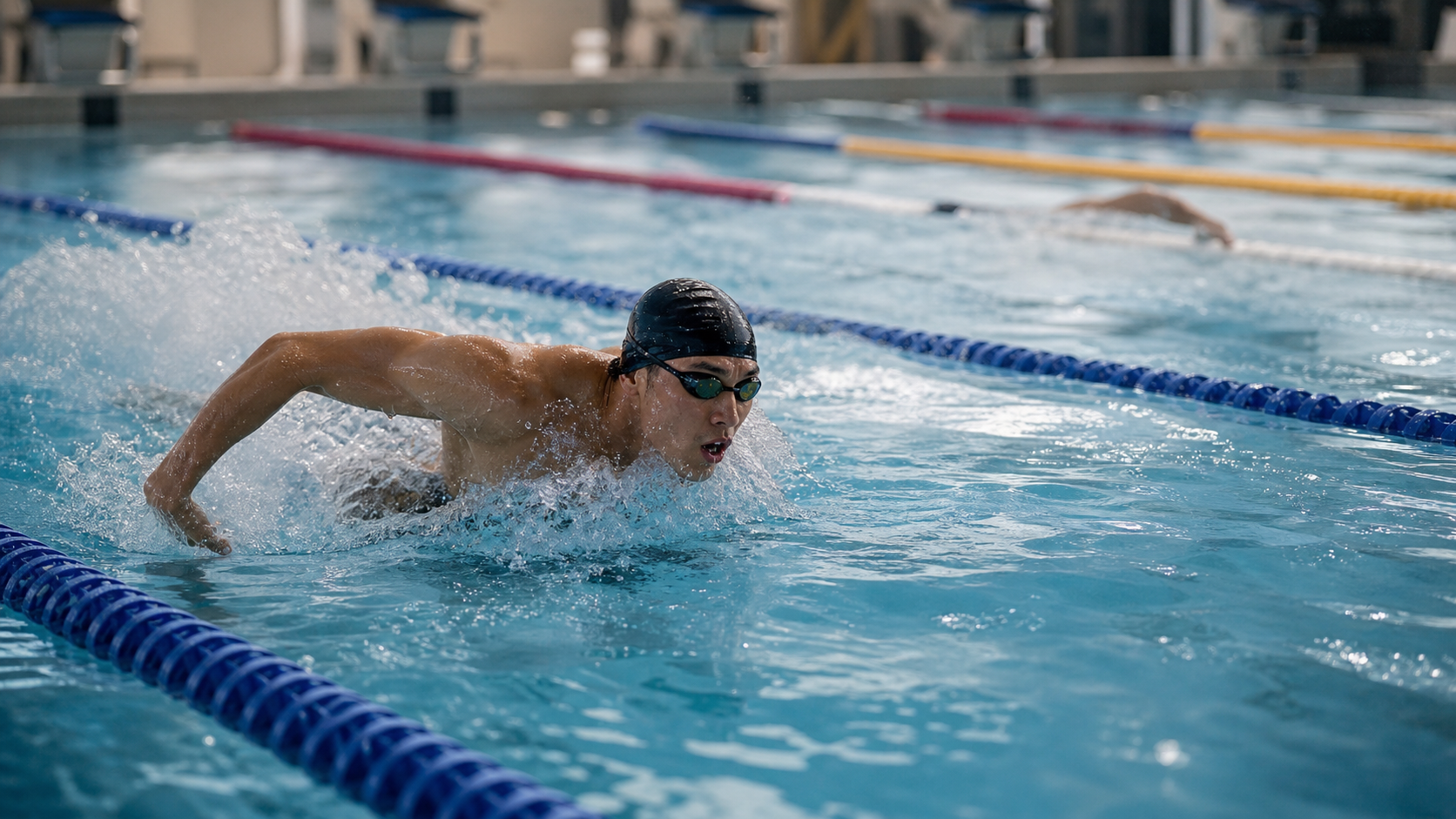
The Four-Stroke Transition Strategy in the 200m Individual Medley: The Art of Stroke Order Advantage and Energy Distribution
Introduction
The 200m Individual Medley (IM) is the event in competitive swimming that best showcases all-around ability. Athletes must swim 50m butterfly, 50m backstroke, 50m breaststroke, and 50m freestyle in sequence, with each stroke presenting different energy demands, technical challenges, and pacing logic. Elite male swimmers post times around 1:54 to 1:56, while accomplished amateurs typically range from 2:10 to 2:40. What makes this event unique lies in the transition strategy between strokes, and how to maximize speed in the fourth stroke (freestyle) after fatigue has accumulated over the first three.
1. The Logic Behind the Stroke Order: Why Butterfly, Backstroke, Breaststroke, Freestyle?
The stroke order in the individual medley is not arbitrary but is based on optimal energy metabolism design:
| Stroke | Order | Primary Reason |
|---|---|---|
| Butterfly (1st) | Swim first | Most energy-demanding; complete it while energy is at its peak |
| Backstroke (2nd) | Second | Provides an opportunity for “passive recovery” (the supine position is relatively economical) |
| Breaststroke (3rd) | Third | A rhythm-based stroke; technique can compensate when energy is half-depleted |
| Freestyle (4th) | Last | Most efficient stroke; can maintain speed even under fatigue |
This order allows athletes to tackle the most difficult stroke (butterfly) when energy is highest, and finish with a sprint using the most economical stroke (freestyle).
2. The Butterfly Leg (0 to 50m): Control the Explosion, Preserve Transition Energy
The butterfly leg is the “energy decision point” of the 200m IM. Many swimmers go all-out in the butterfly leg, leaving the remaining three strokes in a state of excessive lactate accumulation, ultimately producing results worse than ideal.
Butterfly Leg Strategy:
- Control speed at 93 to 95% of your personal best 50m butterfly time, rather than going all-out
- Breathing strategy: breathe every 2 strokes; no breathing in the final 5m, touch the wall in a streamlined position
- Turn (butterfly to backstroke): after touching the wall with both hands simultaneously, quickly rotate into a supine position
- Mindset: “Butterfly is the start, not the finish—don’t burn everything here”
3. The Backstroke Leg (50 to 100m): Make the Most of the Recovery Effect
Backstroke is the relatively economical stroke among the four, because the supine position reduces respiratory resistance, and heart rate typically drops 5 to 8% after the butterfly leg. This is the most important “moving recovery” opportunity in the IM.
Backstroke Leg Strategy:
- Start: Make full use of the underwater dolphin kick off the backstroke start (allowed up to 15m) to maximize entry momentum
- Pace control: 88 to 92% of your personal best backstroke speed—don’t slow down drastically just to “recover”
- Breathing: No breathing pressure in backstroke; breathe naturally, allowing the cardiorespiratory system to regulate during this leg
- Mindset: “These 50m are my chance to replenish energy—swim smart, don’t coast”
- Turn (backstroke to breaststroke): After the final backstroke kick, rotation to touch the wall is permitted; turn efficiency is key
4. The Breaststroke Leg (100 to 150m): The Battle of Rhythm
The breaststroke leg is usually the weakest segment for IM swimmers. After the high-intensity explosion of butterfly and the rhythm transition of backstroke, leg power is already noticeably depleted. The key to this segment is “letting technique compensate for energy.”
Breaststroke Leg Strategy:
- Emphasize the glide after each kick (slightly longer than in standalone breaststroke training), using a streamlined position to reduce drag
- Pay special attention to symmetry when the legs sweep outward—fatigued legs tend to “cheat” by favoring one side
- Keep the breath after the first pull subtle—only the head needs to break the surface; avoid excessive lift that breaks the streamline
- Turn (breaststroke to freestyle): After touching the wall with both hands simultaneously, transition into the freestyle flip-turn pattern
5. The Freestyle Leg (150 to 200m): Full Release
The final 50m freestyle is the “deciding segment” of the entire IM. Though the body is fatigued, the high efficiency of freestyle allows swimmers to significantly accelerate in this segment.
Freestyle Leg Strategy:
- The first 5 strokes after leaving the wall should be fast but technically sound, establishing freestyle rhythm
- Breathing: Breathe every 2 strokes to ensure oxygen supply
- Increase stroke rate from the 170m mark; stop breathing from the 190m mark and sprint all-out to the wall
- Touch: Any touch is acceptable (freestyle); touch with one hand while executing a synchronized sprint finish
6. Reference Proportions for Energy Distribution Across Segments
Using a time of 2:20 (reference for amateur swimmers) as an example:
| Stroke | Target Time | Percentage of Personal Best in Standalone Event |
|---|---|---|
| Butterfly | 33 seconds | 105–108% |
| Backstroke | 35 seconds | 105–110% |
| Breaststroke | 37 seconds | 103–108% |
| Freestyle | 35 seconds | 108–115% |
(Note: A percentage above 100% indicates a slower time than the standalone best, which is normal because each stroke in the IM is affected by fatigue from the preceding segments)
7. Training Recommendations
- Transition-specific training: Practice butterfly-to-backstroke, backstroke-to-breaststroke, and breaststroke-to-freestyle turns, with at least 20 transition practice repetitions per week
- Weak-stroke strengthening: Identify your weakest stroke and increase the volume of standalone training for that stroke
- IM pace training: 4×200m IM, recording split times for each leg on every repetition, and analyzing whether each segment’s pacing matches the plan
- Freestyle sprint under fatigue: After completing the first three strokes of a 200m IM, time the final 50m freestyle to develop the sensation of sprinting while fatigued
Conclusion
The essence of the 200m individual medley is “the harmonious coexistence of four strokes.” The wise restraint of the butterfly leg, the moving recovery of the backstroke leg, and the technical defense of the breaststroke leg ultimately make the all-out sprint of the freestyle leg possible. If Taiwanese IM swimmers can systematically analyze pacing strategies for each segment and target their weaker strokes with specific training, they will find significant room for improvement in this all-around event.
Related Reading
- Individual Medley (IM) Strategy: Energy Distribution Across the Four-Stroke Order
- Energy Distribution in the 200m IM: Energy Management Across the Four-Stroke Order
- Race Strategy for IM Events: Four-Stroke Order and Pacing Distribution
- Energy Distribution in the Individual Medley (IM): Strength and Weakness Planning Across the Four-Stroke Order
西進武嶺 免費訓練分析服務 Intervals | 練不夠還是練過頭?你哪一種類型選手?AI模型告訴你! | 備戰神器 | 公路車 訓練 | CT Yeh
4 年前
西進武嶺 自製新版AI配速表產生器 x 賽前攻略 抱佛腳! 沒有功率計也可以產生配速表嗎?有什麼其他眉角賽前要注意的呢? | 西進武嶺 / 東進武嶺 KOM 攻略 | 公路車 | CT Yeh
4 年前
2024桃園團體自由車邀請賽!4K環台賽等級拍攝 全賽事精華!/ 集團大摔車 / 60隊菁英好手衝線 / 公路車 CT Yeh
1 年前
CT 喇低賽) 武嶺牽車 才是王道 西進牽車四小時內秘訣 攝手位置 如何判斷 防抽筋小秘訣
7 年前
Live) 備戰2019彰化經典百K 賽前攻略 (已完賽請看新影片
7 年前
2019 夏季KOM 5小 完賽心得 準備攻略 東進武嶺 夏季登山王之路 Taiwan KOM Challenge
7 年前
2026 輪霸西濱200K 挑戰VLOG / 第一集團 / 首次參加..經驗不足、膀胱不足 /死守6H內 / AI戰鬥力顯示系統 / 公路車 / CT Yeh
4 個月前
武嶺配速表最佳使用方式 #bike
1 年前