Swimming Heat and Lane Assignments: A Psychological Analysis of How Lane Choice Affects Performance
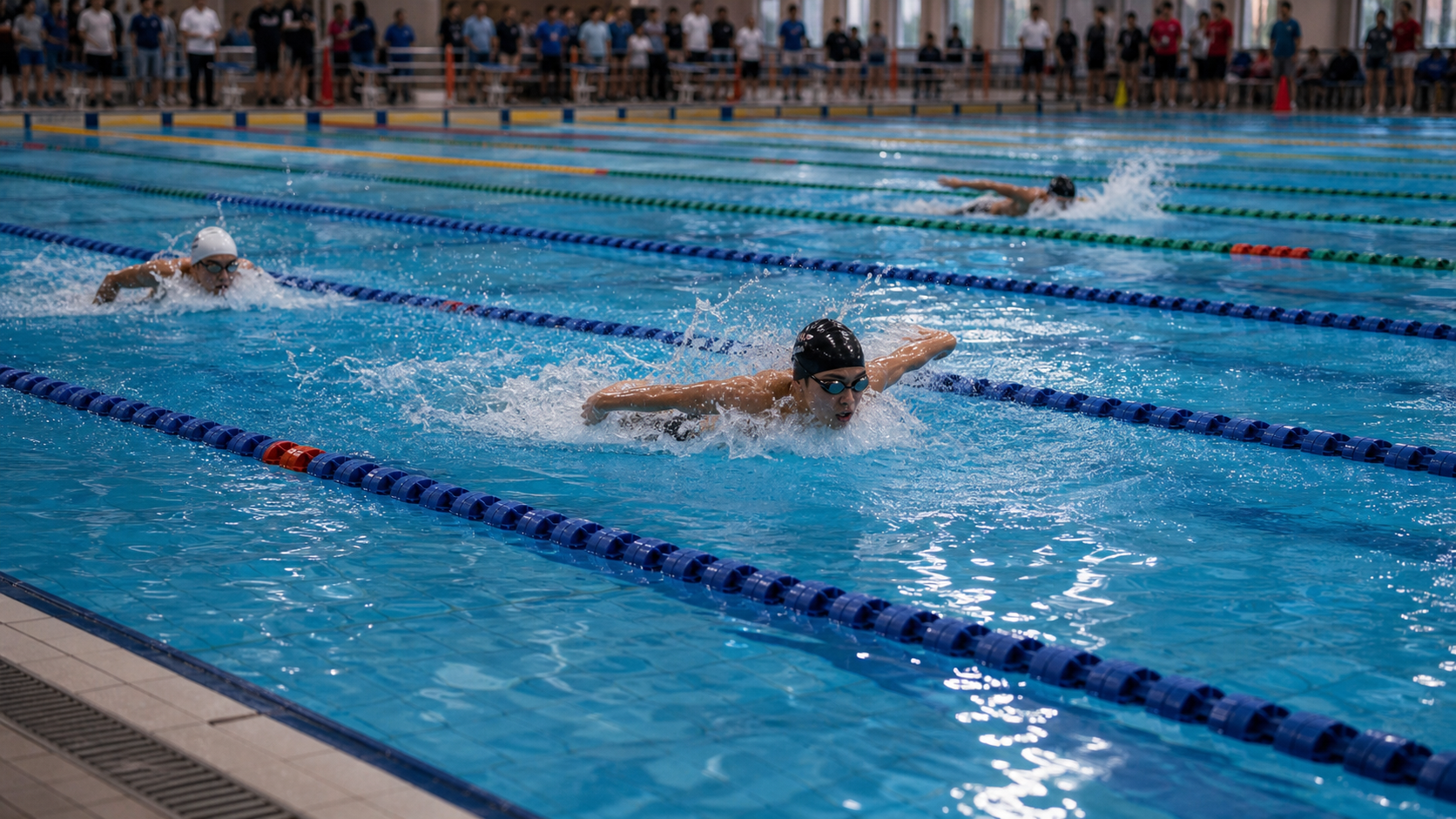
Swimming Lane Assignment: The Psychological Impact of Lane Choice on Performance
Introduction
In swimming competitions, a swimmer’s lane position (commonly referred to as “lane”) is assigned based on declared entry times: the fastest swimmers are typically placed in the center lanes (lanes 4 or 5), while slower swimmers are assigned to the outer lanes (lanes 1 or 8). This arrangement has its basis in hydrodynamics, but the psychological impact of lane assignment on swimmers is equally significant. For Taiwanese swimmers, understanding the psychological effects of lane placement is an important part of enhancing race performance.
1. The Physical Basis of Lane Assignment
| Lane Position | Physical Characteristics | Impact on Swimmers |
|---|---|---|
| Center lanes (4–5) | Waves come from both sides, cancel each other out, calmer water flow | Less drag, conducive to maintaining a steady pace |
| Near-center lanes (3, 6) | Slight lateral wave interference | Minimal impact, still considered favorable lanes |
| Outer lanes (1, 2, 7, 8) | Waves rebound off pool walls, one-sided wave interference | Increased drag, estimated impact of approximately 0.2 to 0.5 seconds |
In a standard 8-lane pool, the physical environment is indeed slightly disadvantageous for swimmers in outer lanes, but at the amateur level, this gap is often outweighed by psychological factors.
2. The Psychological Advantages and Pressures of Center Lanes
Swimmers assigned to center lanes (typically the fastest in their heat) enjoy the following psychological advantages:
- High visibility: They can observe opponents on both sides simultaneously, aiding in pacing decisions
- The drive of being chased: Awareness of leading the heat creates positive psychological pressure to “hold the advantage”
- Attention from spectators and coaches: Center lanes are also typically the focal point of cameras and spectator attention, increasing performance drive
However, center lanes also carry potential psychological pressures:
- Being viewed as the “strongest” in the heat means greater disappointment if performance falls short of expectations
- Over-focusing on opponents’ positions on both sides may disrupt one’s own pacing rhythm
- Knowing all eyes are on you may lead to nervous start errors
3. Psychological Challenges of Outer Lanes and How to Cope
Swimmers assigned to outer lanes (typically slower in their heat) face specific psychological challenges:
- Asymmetric visual information: They can only see opponents on one side, limiting pacing references
- Reinforced “falling behind” feeling: If the declared entry times of other swimmers in the heat differ significantly, it is psychologically easy to concede defeat prematurely
- Wave interference from pool walls: Unstable water flow may create a subjective feeling that “it’s harder to swim”
Coping strategies for outer-lane swimmers:
- Shift the “comparison framework”: Outer-lane swimmers should change their race target from competing against others in the heat to “personal performance,” making a PR (personal record) the sole goal
- Leverage the focus advantage of outer lanes: With less interference from both sides, outer-lane swimmers can actually focus more on their own stroke rhythm and breathing
- Don’t look at the adjacent lane at the start: Tell yourself, “I only need to look at the T-mark on the pool bottom and swim my own race”
4. How Lane Impact Varies by Race Distance
The degree of lane impact differs depending on race length:
| Race Distance | Degree of Lane Impact | Explanation |
|---|---|---|
| 50 meters | High | Every 0.1 second matters; wave interference and psychological factors are amplified |
| 100 meters | Medium-high | High need for pacing references; lane impact is significant |
| 200 meters | Medium | Waves become relatively more uniform over multiple laps |
| 400 meters and above | Low | Aerobic pacing dominates; lane impact is relatively small |
For sprint events (50 to 100 meters), the physical and psychological effects of lane assignment are most pronounced, and swimmers should pay particular attention.
5. How to Perform at Your Best in Any Lane
Regardless of which lane you are assigned, the following psychological strategies can help maintain optimal performance:
Pre-race preparation:
- Accept lane assignment as part of the race environment, rather than judging it as favorable or unfavorable
- During pre-race warm-up, pay special attention to “how this lane feels” to build familiarity
Race execution:
- Before the start, set a mental command to “swim only your own race,” regardless of lane
- On turns, you may quickly glance at opponents’ positions (as a pacing reference), but do not exceed 0.5 seconds
- If in an outer lane, focus on whether your hand placement at each turn is correct (to avoid wall interference disrupting your turn)
Post-race review:
- Do not use lane assignment as an excuse for poor performance (the physical disadvantage of outer lanes is no more than 0.5 seconds)
- Analyze whether focusing on opponents during the race disrupted your pacing plan
Conclusion
Lane assignment in swimming is an inevitable part of competitive racing; each lane has its own characteristics and psychological challenges. True competitive strength lies not in always securing the best lane, but in executing the best race strategy no matter which lane you are in. If Taiwanese swimmers can establish a mental framework of “lane doesn’t matter, I just swim my own race,” they can find their optimal competitive state in any environment—that is true racing maturity.
Related Reading
- Mental Preparation for Swimming Races: Lane Selection and Opponent Analysis
- Swimming Lane Draw Strategies: The Science of Center-Lane Advantage
- Managing Race-Day Nerves in Swimming: Lane Selection Psychology and Start Reaction
- Swimming Downshifting Strategy: The Psychological and Competitive Considerations of Racing in Lower Heats
一日北高/長距離團騎 常見問題補充篇 / 組團或跟團的眉角 / 壯車友容易被瘦車友慢性拉爆 / 原來屁股痛可能是這個原因...? / 風場配速法 / 公路車 / CT Yeh
2 年前
備戰 戀戀197 賽前關門點分析 西濱團練 #公路車 4K高畫質
6 年前
崇越盃武嶺冠軍高手 賽前JJSC 群峰會精華!對應大數據分析,會有落差嗎?/ feat. JJSC中部公路車約騎 /公路車 / CT Yeh
2 年前
CT 喇低賽) 武嶺牽車 才是王道 西進牽車四小時內秘訣 攝手位置 如何判斷 防抽筋小秘訣
7 年前
西進武嶺 免費訓練分析服務 Intervals | 練不夠還是練過頭?你哪一種類型選手?AI模型告訴你! | 備戰神器 | 公路車 訓練 | CT Yeh
4 年前
live) 超越北高 之一日北高12小時 策略
7 年前
西進武嶺 自製新版AI配速表產生器 x 賽前攻略 抱佛腳! 沒有功率計也可以產生配速表嗎?有什麼其他眉角賽前要注意的呢? | 西進武嶺 / 東進武嶺 KOM 攻略 | 公路車 | CT Yeh
4 年前
2026 輪霸西濱200K 挑戰VLOG / 第一集團 / 首次參加..經驗不足、膀胱不足 /死守6H內 / AI戰鬥力顯示系統 / 公路車 / CT Yeh
4 個月前