The Science of Collective Cycling Tactics: A Quantitative Aerodynamic Study of Drafting in a Peloton
文章導覽
/no_think
Introduction
In the final stage of the 1989 Tour de France, a time trial, Greg LeMond overturned a 8-second deficit to beat Laurent Fignon and claim his second title. This epic race reminded the world: the time trial is the only stage in cycling where drafting benefits cannot be exploited, and riders must battle air resistance alone.
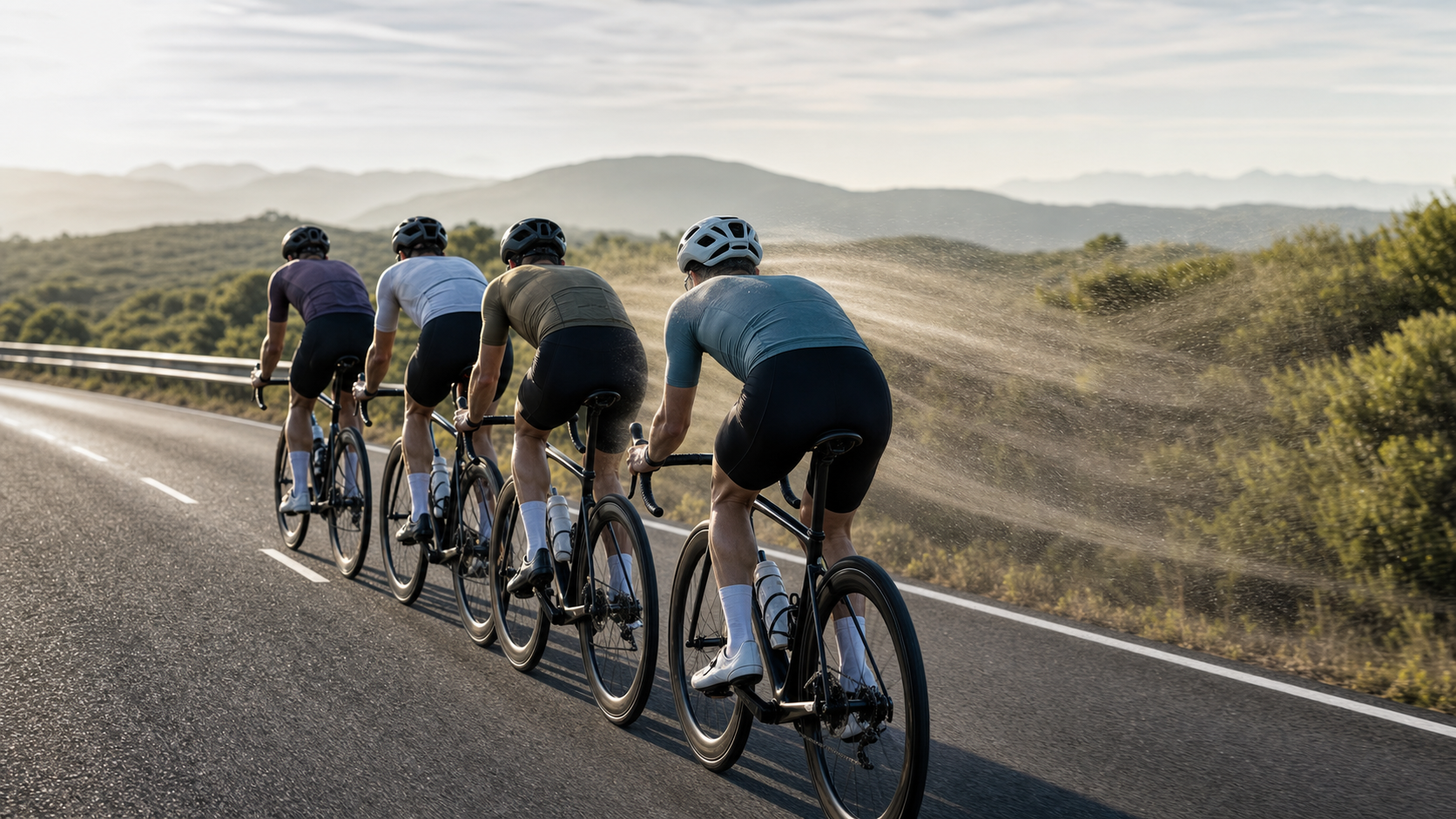
In regular road stages, drafting benefits often decide the outcome of a race. Riding closely behind the rider ahead can significantly reduce the air resistance the following rider must overcome, saving as much as 30–40% of energy. But how exactly does the “drafting effect” work from a physical standpoint? What is the optimal following distance? Based on aerodynamic research, this article systematically breaks down the scientific foundation of group riding.
The Fluid Dynamics of the Wake Region
The Pressure Wake Principle
Any object moving through air creates a low-pressure wake region behind it. The leading rider’s body and bicycle form a “shield umbrella,” producing behind them:
- Reduced static pressure: The air pressure behind is lower than ambient pressure, creating a backward thrust on the front rider (increasing their drag)
- Reduced dynamic pressure: The airflow behind is slower than in front, so the following rider moves through relatively still air, effectively lowering drag
Distance Decay of Drafting Benefits
Research (Blocken et al., 2013 CFD study) shows that drafting benefits decay non-linearly with distance:
| Following Distance | Drag Reduction % | Estimated Power Savings (250W Baseline) |
|---|---|---|
| 0.1 m (extremely close) | 38–45% | ~100W |
| 0.5 m | 32–38% | ~85W |
| 1.0 m | 28–32% | ~75W |
| 2.0 m | 20–25% | ~60W |
| 3.0 m | 15–18% | ~45W |
| 5.0 m | 8–12% | ~25W |
| 10.0 m | 3–5% | ~10W |
Note: Actual values are affected by rider size, speed, and yaw angle; the figures above are estimates for typical conditions
The Effect of Lateral Offset
In actual group riding, the following rider is not always directly behind the rider ahead. Research shows:
- Directly behind: Maximum drag reduction, but vision is obstructed
- Half-bike offset (side drafting): Drag reduction of 15–25% (less than directly behind), but may be more advantageous in crosswind conditions
- Fully to the side (adjacent lane): Almost no drafting benefit, but in crosswinds the front rider can provide “crosswind shelter” for those behind and to the side
Tactical Applications in Group Riding
Team Rotation (Paceline / Echelon)
In professional racing, teams use rotating pacelines so each rider takes turns bearing the maximum drag while the others recover by drafting. Physical analysis shows:
Efficiency gains from a 3-rider rotating paceline
- Each rider only leads 1/3 of the time and drafts 2/3 of the time
- Assuming drafting saves 30% of power, overall average power expenditure drops by roughly 20%
- At the same power output, group speed is significantly higher than solo riding
The Echelon Formation
When there is a crosswind, the benefit of drafting directly behind decreases, and the optimal drafting position shifts to the rear-side of the rider ahead, forming an “echelon” formation. Research (Barry et al., 2015) quantified the optimal echelon angle under different yaw angles:
| Crosswind Yaw Angle | Optimal Drafting Direction | Estimated Drag Reduction |
|---|---|---|
| 5° | Slightly to the windward side | 25–30% |
| 10° | Clearly to the windward side | 20–25% |
| 15° | Strongly to the windward side | 15–20% |
The width limitation of the echelon tactic (road width) exposes larger teams to the “gutter” risk in crosswinds, making it the most tactically significant terrain in professional racing.
Applications of Quantitative Research: The Power Meter Revolution
Analysis of Actual Race Data
The proliferation of power meters has allowed researchers to precisely quantify drafting benefits. Comparative studies of power data from road races and time trials show:
- At the same speed (40 km/h), drafting (group riding) requires approximately 180–220W
- A solo time trial at the same speed requires approximately 280–330W
- The difference is about 25–35%, closely matching CFD model predictions
The Scientification of Tactical Decisions
Modern professional teams use power meters and aerodynamic data to formulate precise tactical plans:
- Calculating breakaway timing: Estimating the individual aerodynamic power demand after escaping the peloton, compared with the power required by the chasing group
- Energy allocation on key climbs: Drafting at the base of a climb to conserve energy, waiting for a favorable moment to attack
- Timing the final sprint: Sprinters must leave their drafting position in the final 200–300m, which requires precise timing judgment
Practical Recommendations
- Maintain an appropriate following distance: For amateur racing, a following distance of 0.5–1.0m is recommended, providing full benefit while retaining reaction distance
- Learn the rhythm of rotating pacelines: Practice taking short pulls and quickly drifting back to the rear of the group to keep the collective pace steady
- Watch for echelons on crosswind sections: On mountain roads or open plains with crosswinds, proactively find the optimal lateral offset for drafting
- Do not over-rely on drafting: After prolonged drafting, “cold legs” can set in, leaving you without explosive power when you attack
Conclusion
The drafting benefit in group riding is one of the most scientifically profound tactical tools in cycling. From fluid mechanics to power meter data, research has precisely quantified the benefits under different conditions. Understanding these numbers allows riders to make more scientific energy allocation decisions in competition, truly converting aerodynamic knowledge into a racing advantage.
Related Reading
- A Complete Analysis of Professional Cycling Team Tactics: Formations, Drafting Effects, and the Final Sprint Launch
- Research Review: Fluid Dynamics Drag Savings Report on Drafting Techniques in Road Cycling Group Riding: A Study of Elite Rider Physiological Characteristics (Article 905)
- Research Review: Fluid Dynamics Drag Savings Report on Drafting Techniques in Road Cycling Group Riding: A Study of Elite Rider Physiological Characteristics (Article 1121)
- Research Review: Fluid Dynamics Drag Savings Report on Drafting Techniques in Road Cycling Group Riding: A Study of Elite Rider Physiological Characteristics (Article 1196)