Introduction
Breathing is the part of freestyle technique most likely to “break streamline.” Every time you breathe, the rotation of your head affects your body’s balance and drag, and the mistakes many amateur swimmers make at the moment of breathing are enough to drop overall speed by 10%–15%. This article will discuss the optimal range of breathing rotation angles from a fluid dynamics perspective, and how to build a low-drag breathing technique through training.
The Physics of Breathing
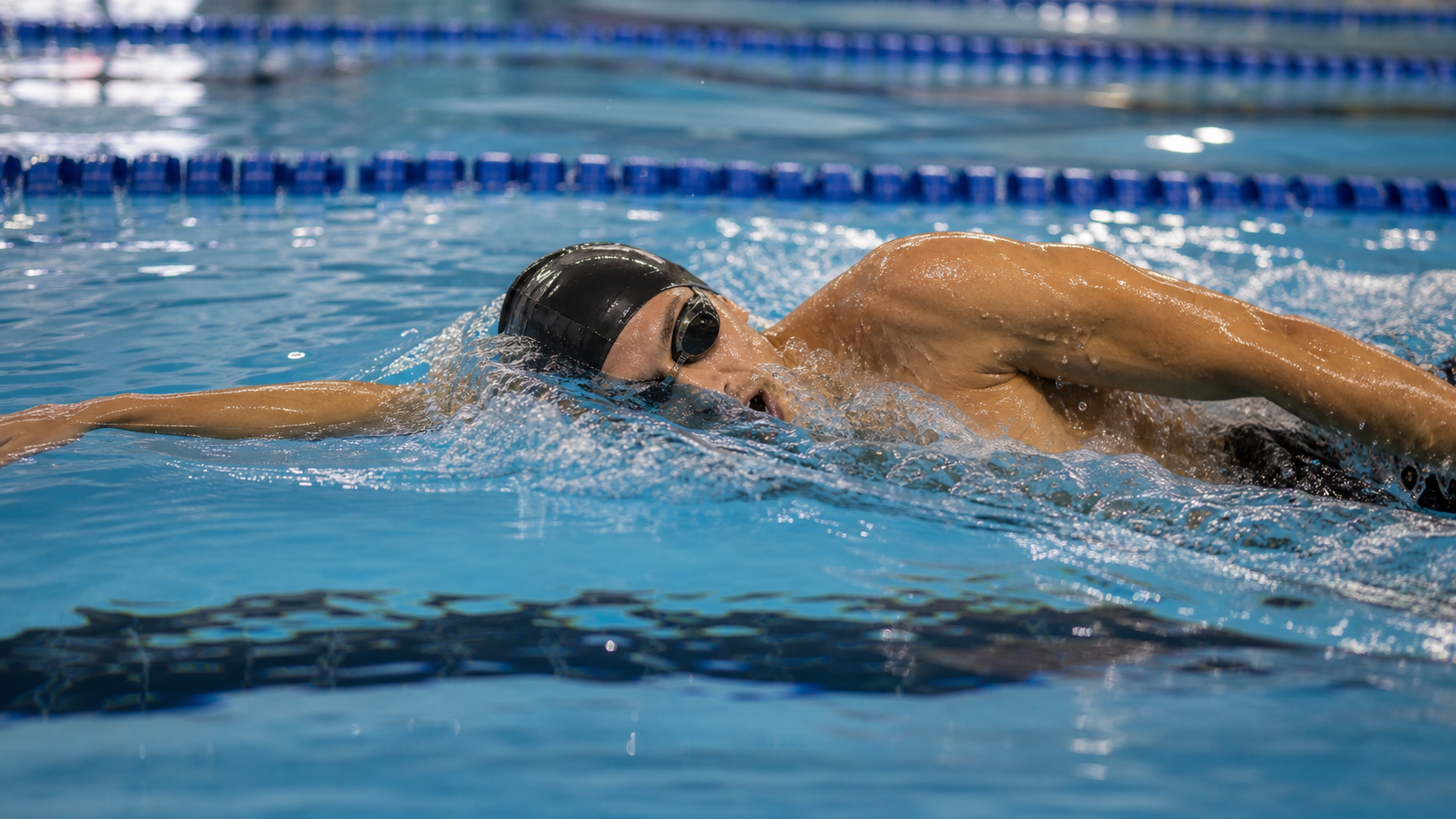
In freestyle swimming, the body rotates around the torso as its axis (Roll), and this rotational movement creates the natural conditions for breathing. When the body rotates upward on the stroke side, the corner of the mouth on the breathing side is already carried above the water surface—at this point, only minimal head rotation is needed to complete the inhalation, rather than lifting the head significantly.
The problem is that many swimmers do not fully utilize body rotation, instead relying on lifting the head or over-rotating the head to complete the breath. Both of these approaches significantly increase drag.
Research on Optimal Breathing Rotation Angle
According to biomechanical research, the relationship between head rotation angle and drag is as follows:
| Head Rotation Angle | Mouth Clearance Above Water | Drag Increase | Notes |
|---|---|---|---|
| 30–45 degrees | Just clears the water | Minimal (baseline) | Ideal range |
| 45–60 degrees | Excessive clearance | ~8% increase | Acceptable |
| Over 60 degrees | Noticeable head lift | 15–20% increase | Should be avoided |
| Head-lift breathing | Face fully out of water | 25%+ increase | Serious error |
In the ideal breathing position, one eye should be below the water surface while the other eye is just near the surface. The mouth should be positioned in the “body wave”—the low-pressure zone formed at the side of the head as the body moves forward. This low-pressure zone makes breathing easier and reduces drag.
Common Breathing Errors
Error 1: Head-Lift Breathing (Most Common)
Lifting the head upward instead of rotating it to the side causes the hips to sink and greatly increases leg drag. Many beginners habitually lift their heads out of a sense of insecurity, and need to fundamentally build confidence in trusting buoyancy in the water.
Error 2: Stopping the Kick While Breathing
The legs stop kicking at the moment of breathing, causing the body to lose propulsion and sink. You need to train the ability to “breathe without interrupting the kick.”
Error 3: Returning the Head Too Slowly After Breathing
The head takes too long to return to the midline position after breathing, prolonging the rotation time and effectively increasing drag continuously. It is recommended to return the head to the “looking at the pool bottom” position immediately after finishing the breath.
Error 4: Incomplete Exhalation
Many swimmers do not exhale thoroughly in the water, so when they breathe they need to exhale and inhale simultaneously, leaving an insufficient breathing window. The correct approach is to exhale steadily and continuously in the water, so that when breathing you only need to inhale.
Error 5: Breathing Only on One Side
Long-term breathing to only one side can cause asymmetric body rotation, which in turn affects the balance of the arm stroke. It is recommended to train bilateral breathing ability.
Breathing Technique Training Methods
Head Position Awareness Training:
- While swimming, imagine a thin line connecting the top of your head to the front, keeping your head pulled forward rather than upward
- When breathing, feel it as a “turn” rather than a “lift”—the chin should not rise above the waterline
Body Wave Practice:
- Swim at a slow pace and deliberately feel the body wave position at the side of the head
- Inhale at the deepest point of the body wave (where the low-pressure zone is greatest)—this requires precise timing training
Single-Arm Breathing Drill:
- Extend the non-stroking arm forward while the other arm strokes, breathing once with every stroke
- This allows you to clearly feel the coordination between body rotation and head rotation
Exhalation Rhythm Training:
- Practice continuous exhalation in the water using breaststroke or backstroke to build the habit of relaxed exhalation in the water
- Both strokes before breathing in freestyle should involve steady exhalation through the nose
The Importance of Bilateral Breathing
Bilateral breathing (breathing every 3 strokes, alternating sides) has the following advantages:
- Ensures symmetry of body rotation
- Allows you to observe both sides of the environment in open-water swimming
- Avoids muscle imbalances caused by long-term unilateral breathing
The disadvantage of bilateral breathing is a reduced breathing frequency. For high-intensity training or sprint segments in races that require high oxygen intake, you can temporarily switch to unilateral breathing (every 2 strokes).
Practical Advice
- In the early stages of training, practice the head rotation movement in still water (without swimming forward) to feel the timing of the mouth corner clearing the water
- Use an underwater camera or ask a coach to observe the head angle on the breathing side—this is the most effective diagnostic method
- If you feel that breathing is “rushed,” it is usually not a breathing technique problem, but rather a stroke tempo that is too fast or incomplete exhalation
Conclusion
Improving breathing technique requires patience and extensive feel-for-the-water training, but the payoff is well worth it. Correct breathing posture not only reduces drag and increases speed, but also makes long-distance swimming more relaxed and effortless. Building the muscle memory of “rotating to breathe rather than lifting the head to breathe” is a fundamental technical investment that every serious swimmer should make.
Related Reading
- Excessive Body Roll During Freestyle Breathing: Corrective Training for Bilateral Breathing
- Freestyle Roll Breathing: Core Technique Analysis for Swimming 30% More Efficiently
- Swimming Breathing Technique: Pros and Cons of Side Breathing vs. Bilateral Breathing
- Head Movement in Breathing: The Destructive Impact of Excessive Head-Lift Breathing
CT 喇低賽) 武嶺牽車 才是王道 西進牽車四小時內秘訣 攝手位置 如何判斷 防抽筋小秘訣
7 年前
如何把 GoPro 影片 翻轉 批次 轉正?
6 年前
風櫃嘴 衝刺慢動作回放!
8 年前
#公路車 #Vo2Max #最大攝氧量 測驗 體驗 | 心肺測試
6 年前
西進武嶺 自製新版AI配速表產生器 x 賽前攻略 抱佛腳! 沒有功率計也可以產生配速表嗎?有什麼其他眉角賽前要注意的呢? | 西進武嶺 / 東進武嶺 KOM 攻略 | 公路車 | CT Yeh
4 年前
2025崇越「西進武嶺」挑戰VLOG / 賽前改短成165曲柄會如何? / 選手昏倒? / 公路車 / CT Yeh
1 年前
碟煞公路車 優缺點?換車一年半實際經驗分享 / 公路車 / CT Yeh
2 年前
下雨天就是要改車 #ceramicspeed #bike
1 年前