Patellofemoral Pain Syndrome (Runner's Knee): A Complete Guide to Quadriceps Strengthening and Scientific Running Form Correction
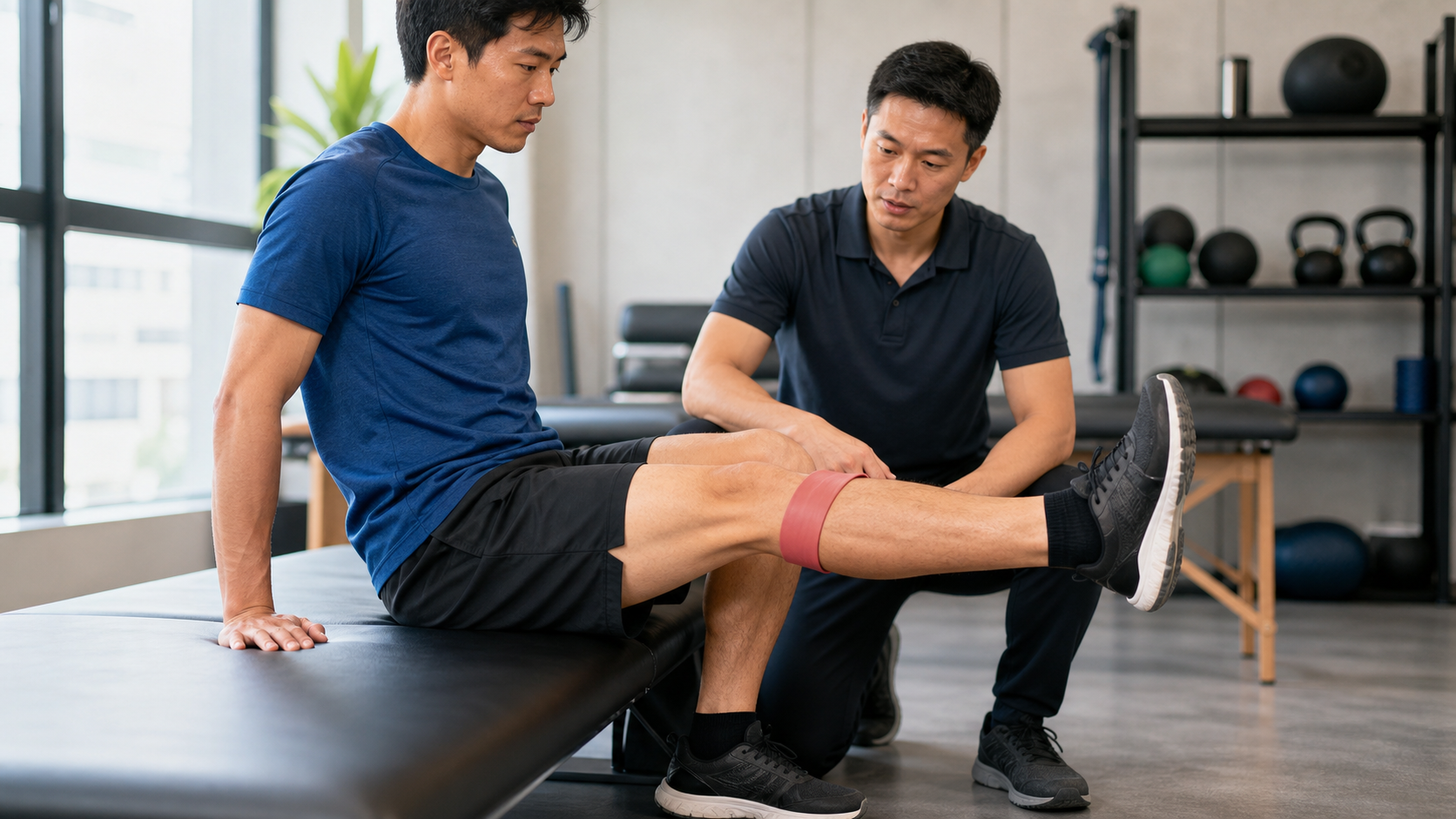
What is Patellofemoral Pain Syndrome?
Knee pain when standing up after prolonged sitting, a dull ache in the front of the knee when going downstairs, and a feeling of pressure in the knee after running—these are all common manifestations of Patellofemoral Pain Syndrome (PFPS), which is why it is also known as “Runner’s Knee.” PFPS accounts for approximately 25% of running injuries and is one of the most common sources of knee pain seen in clinical practice.
Patellar Tracking Mechanism
The patella sits within the trochlear groove of the femur, and during normal activity it should glide smoothly up and down along this groove. Factors that affect tracking include:
- Imbalance between the medial and lateral quadriceps: The vastus lateralis is overly strong while the vastus medialis oblique (VMO) is relatively weak, causing the patella to shift laterally
- Tight iliotibial (IT) band: Pulls the patella outward through the lateral retinaculum
- Weak gluteus medius: The pelvis collapses during running, causing the femur to internally rotate and increasing lateral pressure on the patella
- Excessive foot pronation: Alters the lower extremity kinetic chain, secondarily affecting patellar tracking
PFPS Risk Factor Assessment
| Assessment Item | Positive Finding | Clinical Significance |
|---|---|---|
| Single-leg squat | Knee collapses inward (Knee Valgus) | Weak gluteus medius |
| VMO palpation | Delayed contraction timing | Vastus medialis atrophy |
| IT band tension | Positive Ober Test | Excessive lateral tension |
| Arch assessment | Excessive pronation | Kinetic chain abnormality |
| Running cadence | < 165 steps/min | Increased knee joint loading |
Diagnostic Confirmation
Clarke Test: In a seated position with the leg extended, the therapist applies light pressure to the superior pole of the patella and asks the patient to contract the quadriceps. A positive test reproduces pain.
Grind Test: Light pressure is applied to the patella while it is compressed and moved side to side. Pain or a grinding sensation indicates a positive result.
Differential diagnosis should rule out:
- Meniscal pathology (joint line tenderness, McMurray Test)
- Patellar tendinopathy (tenderness at the inferior pole of the patella)
- Patellar chondropathy (confirmed by MRI)
Strengthening Program
Phase 1: VMO Priority Strengthening (Weeks 1–4)
Terminal Knee Extension (TKE):
- Place a resistance band behind the knee, stand, and perform only the final 20 degrees of knee extension
- 3 sets × 15 reps, focusing on feeling the vastus medialis contract
Wall Sit:
- Knee flexion at 60–80 degrees (avoid deeper flexion to prevent increased patellar pressure)
- Hold for 30–60 seconds, 3–5 sets
Split Squat:
- Weight on the front leg, rear leg lightly touching the ground, lower slowly over 4 seconds and rise over 2 seconds
- 3 sets × 10 reps
Phase 2: Gluteal Muscle Integration (Weeks 3–8)
Side Plank with Hip Abduction:
- Lie on your side with the body in a straight line, raise the top leg 20 degrees and hold for 2 seconds
- 3 sets × 12 reps
Bulgarian Split Squat:
- Rear foot placed on a bench, perform a single-leg squat with the front leg
- 3 sets × 8 reps, controlling the knee to track over the second toe
Hip Thrust:
- Shoulders resting on a bench, single-leg bridge with the pelvis pushed up horizontally
- 3 sets × 12 reps
Phase 3: Running Integration (From Week 7)
- Single-leg jump landing control: hop on one leg and land quietly in a knee-flexed position
- Cadence training: run with a metronome set to 170–180 steps/min
Running Form Correction Strategies
For PFPS, the following running form adjustments have the strongest evidence base:
1. Increase cadence (most important)
For every 10% increase in cadence, patellofemoral joint contact force decreases by approximately 16%. It is recommended to train using a smartphone metronome app (such as MetroTimer).
2. Lean the trunk forward 5–10 degrees
A slight forward trunk lean shifts the center of mass forward, reducing the impact moment when the front foot lands.
3. Visual feedback training
Use a mirror or video recording to observe whether the knee collapses inward during single-leg landing, and consciously train pelvic stability.
4. The “Three Thoughts” cue during running: fast cadence, light foot strike, knees aligned
Daily Activity Adjustments
- Avoid prolonged sitting with knees flexed beyond 90 degrees; get up and move every 30 minutes
- When going up and down stairs, focus on “keeping the knee aligned with the center of the toes” and do not let the knee collapse inward
- Avoid cycling when the knee is painful (unless the saddle is raised to an appropriate height)
Conclusion
The fundamental solution to Runner’s Knee lies in a “top-down” systematic assessment: from gluteal strength to quadriceps coordination, and then to foot mechanics—an imbalance at any link can become a source of patellar pressure. Combined with running form correction and targeted strength training, the prognosis for PFPS is quite favorable—most runners can fully return to their normal running volume after 8–12 weeks of systematic training.
Related Reading
- Runner’s Knee: Management of Patellofemoral Pain Syndrome
- Runner’s Knee (PFPS) Explained: A Strength Prescription for Pain Around the Kneecap
- Runner’s Knee (Patellofemoral Pain Syndrome): A Complete Prevention and Treatment Guide
- Runner’s Knee (Patellofemoral Pain Syndrome): Causes, Self-Assessment, and Evidence-Based Rehabilitation Pathways
一日北高常見問題大集合 | 攻略 | 路線 | 訓練 | 補給 | 自行車 單車 | 一日雙城 | 雙塔 | TWB北高360 | 屁股痛
6 年前
一日北高/長距離團騎 常見問題補充篇 / 組團或跟團的眉角 / 壯車友容易被瘦車友慢性拉爆 / 原來屁股痛可能是這個原因...? / 風場配速法 / 公路車 / CT Yeh
2 年前
白沙屯媽祖進香在家走!UREVO 坡度自調走步機 / 可連接訓練遊戲APP MyWhoosh / 邊看直播邊走起來 / CT Yeh
11 個月前
2019 柯P 超越北高 第一集團實錄 (11小時實錄請參考另一部影片) 一日雙城 一日北高 NeverStop Taiwan Long Distance Cycling Challenge
7 年前
摔車後補裝備: 好市多新款單車安全帽& Specialized Romin 北高整路屁股都不痛的坐墊 | 一千元居然有MIPS | CT Yeh | 公路車
4 年前
iPhone內建一秒變長腿🤣 車友必備#cycling
2 年前
#公路車 #Fitting 靠人工智慧APP 幫你調整單車
6 年前
爬陡坡被爆胎的車友跑步超車 #cycling #里佳部落
9 個月前