The End of the RICE Era
“Got injured? Remember RICE: Rest, Ice, Compression, Elevation.” This phrase has been the first principle of sports injury management since the 1970s, ingrained in the memory of every physical education student. However, starting in 2012, the sports science community gradually recognized the fundamental limitations of the RICE principle and proposed the POLICE principle, which better aligns with the physiology of tissue healing.
Interestingly, Dr. Gabe Mirkin, who originally proposed RICE, formally retracted his recommendation for ice application in 2014, pointing out that prolonged icing actually delays the normal inflammatory healing response of tissues.
Why Isn’t RICE Enough Anymore?
Problems with Traditional RICE:
- Rest (Complete Immobilization): Prolonged immobilization leads to muscle atrophy, joint stiffness, and proprioceptive decline, which is detrimental to long-term recovery
- Ice: Provides short-term pain relief, but excessive icing suppresses the necessary inflammatory response (macrophage activity), actually slowing down tissue repair
- Lacks the concept of “active rehabilitation”
| Comparison Item | RICE | POLICE |
|---|---|---|
| Immobilization Principle | Complete rest | Protection + Optimal Loading |
| Inflammatory Perspective | Suppress inflammation | Guide normal inflammation |
| Early Activity | Not mentioned | Explicitly encouraged |
| Applicable Timing | Acute phase | Throughout acute to subacute phases |
Breakdown of the POLICE Principle
P — Protection
Purpose: To prevent the injury from worsening, not to completely immobilize
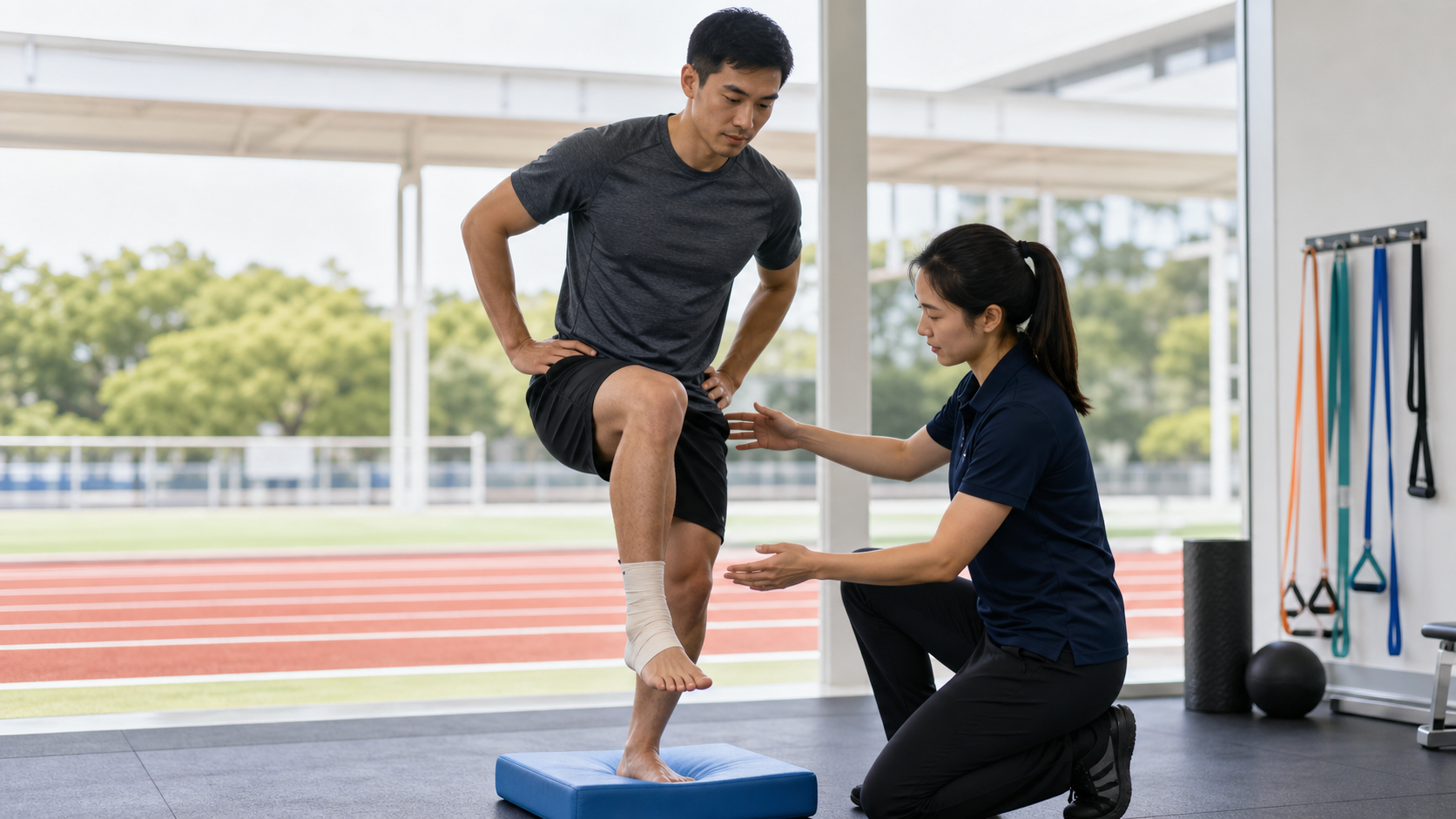
- 24–72 hours post-injury: Use braces, elastic bandages, or assistive devices to reduce unnecessary stress
- The protection period should be as short as possible; once pain allows, begin progressive loading
- The shorter the period of complete immobilization, the better (unless there is a fracture or complete ligament tear)
Practical Application: After an ankle sprain, wear an ankle brace and walk in shoes rather than using crutches with zero weight-bearing
O — Optimal Loading
The most core and revolutionary concept of POLICE
“Optimal Loading” means providing sufficient mechanical stimulation to the tissue to promote healing without causing further damage. The inflammatory response itself is a necessary step in tissue repair, and appropriate loading can:
- Guide collagen alignment along mechanical stress lines, forming stronger scar tissue
- Maintain muscle and nerve function, preventing disuse atrophy
- Stimulate bone remodeling (especially important for stress fracture healing)
How to Determine “Optimal”?
- Continue activity when pain VAS ≤ 4/10
- Pain 24 hours after activity should not be worse than before
- Swelling should not increase
L — Ice
The role of ice has shifted from “accelerating healing” to a “pain management tool”:
- Appropriate use: When acute pain is unbearable, or for pain management before optimal loading training
- Not recommended: Continuous icing for more than 20 minutes after injury, or prolonged repeated icing during rest periods
- Standard protocol: 10–15 minutes per session, with a cloth barrier, every 2–4 hours, only during the first 48 hours post-injury
C — Compression
Compression effectively controls soft tissue edema and is an element retained by both RICE and POLICE:
- Use an elastic bandage wrapping from the distal end (toes/fingers) toward the proximal end
- Avoid wrapping too tightly, which can cause circulatory issues (exposed knuckles should maintain normal skin color)
- During the acute phase, continuous compression for 24 hours is acceptable; it can be loosened moderately during sleep
E — Elevation
Using gravity to assist venous and lymphatic return, reducing swelling:
- The affected limb should be elevated above heart level
- Most effective for lower extremity injuries (ankle sprains, calf strains)
- Recommended to accumulate 2–4 hours of elevation time daily
POLICE Applications for Various Running Injuries
Ankle Sprain (Grade I–II):
- 1–6 hours post-injury: Ankle brace protection + ice + compression + elevation
- 6–24 hours post-injury: Begin ankle alphabet exercises (non-weight-bearing active range of motion)
- 24–48 hours post-injury: Weight-bearing walking with ankle brace protection
Muscle Strain (Grade I–II):
- First 6 hours post-injury: Light compression protection
- 24 hours post-injury: Begin active movement within pain-free range
- Avoid the erroneous practice of “aggressive stretching after warming up”
Medial Tibial Stress Syndrome:
- Reduce impact loading (replace running with swimming, cycling)
- Perform daily low-impact strengthening exercises (application of optimal loading)
Modern Advanced Principle: PEACE & LOVE
In 2019, the British journal BMJ proposed the PEACE & LOVE framework, further refining acute injury management:
PEACE (Acute Phase): Protection, Elevation, Avoid anti-inflammatories, Compression, Education
LOVE (Subacute to Chronic Phase): Load, Optimism, Vascularization, Exercise
Among these, “Avoid anti-inflammatories” and “Optimism” represent the biggest differences from RICE.
Conclusion
The core philosophy of the POLICE principle is: the goal after injury is not to “wait for healing” but to “guide optimal healing.” Appropriate early activity and mechanical stimulation are the keys to rebuilding tissue stronger and recovering faster. The next time a running injury occurs, remember to upgrade your mindset from “complete rest” to “optimal loading”—this single conceptual shift could save you weeks of recovery time.
Related Reading
- RICE vs MEAT vs PEACE & LOVE: The Latest Recommendations for Acute Sports Injury Management
- New Guidelines for Acute Sports Injury Management: Why PEACE & LOVE Is Replacing the RICE You Know
- RICE vs MEAT vs PEACE & LOVE: The Evolution of Acute Sports Injury Management
- Modern Updates to Cold Therapy and Compression Recovery (RICE): The PEACE & LOVE Framework
摔車後補裝備: 好市多新款單車安全帽& Specialized Romin 北高整路屁股都不痛的坐墊 | 一千元居然有MIPS | CT Yeh | 公路車
4 年前
3D 列印車褲墊 / 舒適改善? / 無痕 x 分區壓縮 / ATK & Decider系列 / JE22黑科技 / #公路車 #CTYEH
11 個月前
爬陡坡被爆胎的車友跑步超車 #cycling #里佳部落
9 個月前
下次拍照前要查清楚啦🤣 #cycling
7 個月前
#PUSHBIKE 原來這麼好玩! 小朋友 滑步車 初體驗 超可愛
6 年前
[教學] Premiere 影片 手震 修正 教學 防抖 單眼 影像 GoPro 穩定 Video Stabilization
8 年前
把帶被我推爛,換新的防推爛款💪 #cycling #公路車 #曜越單車
2 年前
武嶺配速表最佳使用方式 #bike
1 年前