Strength Training for Runners: Injury Prevention Benefits and Execution Details of Glute Bridges, Single-Leg Squats, and Hip Abduction
Why Do Runners Need Strength Training?
Many runners believe that with limited training time, they’d rather log extra kilometers than spend it in the weight room. This intuition makes sense, yet it contradicts the conclusions of sports science research. A systematic review (Lauersen et al.) showed that strength training can reduce overall sports injury risk by 50–66%; studies on runners also show that lower-limb strength training twice a week can reduce the incidence of knee pain by approximately 40%.
More importantly, appropriate strength training can also improve Running Economy—consuming less oxygen at the same pace, allowing runners to be faster, more efficient, and more durable.
Anatomical Foundations of the Three Core Movements
Movement 1: Hip Bridge
Target Muscles: Gluteus maximus (primary), hamstrings (synergist), deep core muscles (stabilizers)
Injury-Prevention Benefits:
- Strengthening the gluteus maximus provides hip extension power during the stance phase of running, reducing lumbar spine compensation
- Enhances push-off efficiency, improving stride length
- Reduces the risk of excessive anterior pelvic tilt while running (associated with lower back pain)
Standard Execution:
- Lie supine with knees bent at approximately 90 degrees, feet flat on the floor
- Engage the core lightly, lift the pelvis until the shoulders, hips, and knees form a straight line
- Squeeze the glutes at the top and hold for 2 seconds, then lower slowly (4 seconds)
- Avoid excessive lumbar extension (a back bridge rather than a hip bridge)
Advanced Variations:
- Single-leg hip bridge: extend the non-supporting leg straight or lift it upward
- Add a resistance band (above the knees): increases glute external rotation challenge
- Hip Thrust (shoulders on a bench, loaded with a barbell or dumbbells)
| Level | Movement | Sets × Reps |
|---|---|---|
| Beginner | Double-leg hip bridge | 3×15 |
| Intermediate | Single-leg hip bridge | 3×10/leg |
| Advanced | Hip Thrust (50% bodyweight load) | 3×8 |
Movement 2: Single-Leg Squat
Target Muscles: Quadriceps, gluteus medius, gluteus maximus, ankle stabilizers
Injury-Prevention Benefits:
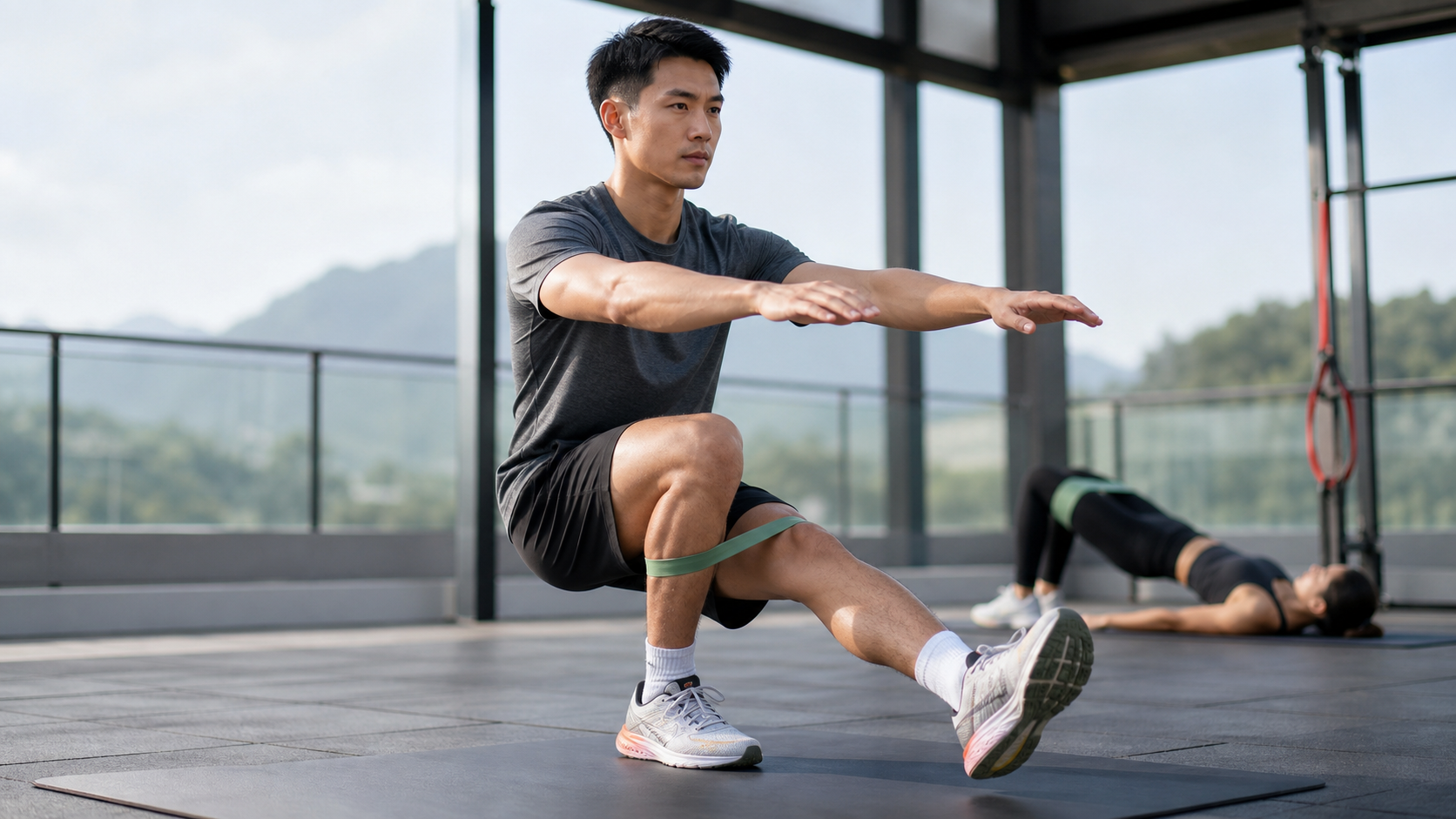
- Mimics the mechanics of the single-leg stance phase of running, making it the most functional runner-specific exercise
- Corrects knee valgus during running, preventing PFPS and ACL stress
- Assesses left-right leg strength asymmetry (a difference >15% is an injury risk factor)
Self-Assessment: Perform a single-leg squat in front of a mirror and observe:
- Does the knee align with the second toe? (It should not visibly cave inward)
- Does the pelvis remain level? (It should not drop on the opposite side)
- Does the torso stay upright? (It should not lean significantly to compensate)
Regression Variations (Suitable for Beginners):
- Wall-supported single-leg half squat (targeting 90 degrees of knee flexion)
- Sit on a chair then stand up on one leg (reduces depth requirement)
- TRX suspension-assisted single-leg squat
Training Progression:
Weeks 1–3: Assisted version, 3 sets × 8 reps
Weeks 4–6: Unassisted single-leg squat, 3 sets × 10 reps (60 degrees of knee flexion)
Weeks 7–10: 3 sets × 12 reps (70–80 degrees of knee flexion)
Weeks 11–12: Weighted vest or dumbbells, 3 sets × 8 reps
Movement 3: Hip Abduction Series
Target Muscles: Gluteus medius, gluteus minimus (hip abduction); TFL (tensor fasciae latae) assists
Injury-Prevention Benefits:
- The gluteus medius is the primary muscle for lateral pelvic stability, directly preventing a Trendelenburg gait
- Strengthening this muscle group improves outcomes for ITBS, PFPS, and gluteal tendinopathy
- Research suggests that a weakened gluteus medius is one of the single most predictive factors for running injuries
Three Execution Methods:
Side-Lying Hip Abduction (Foundation):
- Lie on your side, body in a straight line, slowly abduct the top leg straight to 35 degrees
- Hold at the top for 2 seconds, 3 sets × 15 reps
Clamshell:
- Lie on your side with knees bent at 60 degrees, keep feet together, open the top knee by externally rotating
- Like a clam opening and closing, 3 sets × 15 reps
- Add a resistance band above the knees to increase resistance
Standing Side Walk (Monster Walk):
- Place a resistance band above the knees, walk laterally in a half-squat position
- 20 steps per direction, 3–4 sets, the closest to functional running movement
Weekly Framework for Runner Strength Training
Twice per week, on non-long-run days:
Day A (Hip-Dominant): Hip bridge → Single-leg hip bridge → Side walk → Clamshell
Day B (Quadriceps-Dominant): Single-leg squat → Split squat → Side-lying hip abduction → Eccentric calf raises
2–3 sets per movement, approximately 30–40 minutes total
Balancing Strength Training with Mileage
- Schedule an easy jog the day after strength training; do not schedule a long run
- Delayed onset muscle soreness may occur in the early phase (first 4 weeks); this is a normal adaptation
- After 12 weeks, reduce to once per week for maintenance (once a strength base has been established)
Conclusion
Hip bridges, single-leg squats, and hip abduction—these three movements may seem simple, yet they are the key to addressing the root causes of most running injuries. An investment of twice a week, 30 minutes per session, yields faster paces, fewer injuries, and a longer running career. Elevating strength training from “optional” to “essential” is the evolutionary moment for every serious runner.
Related Reading
- Preventive Strength Training: Twice-Weekly Glute and Core Training Reduces Injury Rates
- Road Running Strength Supplement Plan: Weekly Program Design with Squats, Single-Leg Deadlifts, and Bridges
- Glute Training for Runners: Running Applications of Bridges, Clamshells, and Side-Lying Leg Raises
- Strength Training for Runners: Six Key Movements to Prevent Injuries
2019 柯P 超越北高 第一集團實錄 (11小時實錄請參考另一部影片) 一日雙城 一日北高 NeverStop Taiwan Long Distance Cycling Challenge
7 年前
Never Stop 西進武嶺 前後雙機 完整全程錄影 訓練台 實境
8 年前
一日北高常見問題大集合 | 攻略 | 路線 | 訓練 | 補給 | 自行車 單車 | 一日雙城 | 雙塔 | TWB北高360 | 屁股痛
6 年前
實景訓練台) 彰化經典百K 高強度喵團 90分鐘 跟著一起練功 2019 Indoor workout Changhua Classic 100 Taiwan
7 年前
西進武嶺 免費訓練分析服務 Intervals | 練不夠還是練過頭?你哪一種類型選手?AI模型告訴你! | 備戰神器 | 公路車 訓練 | CT Yeh
4 年前
單車 一日北高 ( 雙城 ) 肥宅雙人瘋狂行 紀錄片 REACTO
10 年前
[教學] Premiere 影片 手震 修正 教學 防抖 單眼 影像 GoPro 穩定 Video Stabilization
8 年前
CT趣訪 西進武嶺 2小時組 EP2 全村的希望 蔣緯緯! 訓練菜單&技巧公開 |公路車 |CT Yeh
4 年前