The Complete Guide to Preventing Swimmer's Shoulder: Causes, Diagnosis, and Strength Training for Rotator Cuff Injuries
The Complete Guide to Preventing Swimmer’s Shoulder: Causes, Diagnosis, and Strength Training for Rotator Cuff Injuries
Introduction
Swimming is widely regarded as a full-body, low-impact sport that’s easy on the joints and highly beneficial for cardiovascular fitness. Yet many swimmers overlook a potential threat lurking beneath the surface: Swimmer’s Shoulder. Research shows that up to 47% of adults who swim regularly have experienced shoulder pain, and the figure climbs to nearly 70% among competitive swimmers. Left unaddressed, this can range from disrupting training quality to causing rotator cuff tears that require surgical intervention.
This article will walk you through the causes of swimmer’s shoulder, how to recognize its symptoms, and most importantly, how to prevent it at the root through science-based strength training.
What Is the Rotator Cuff?
The rotator cuff is made up of four muscles that surround the head of the humerus, responsible for stabilizing the shoulder joint and controlling rotational movement in all directions:
- Supraspinatus: Initiates shoulder abduction
- Infraspinatus: Controls external rotation
- Teres Minor: Assists external rotation and depresses the humeral head
- Subscapularis: Controls internal rotation
During the freestyle pull, from hand entry through the pull and push phases, the rotator cuff must generate force at high speed and with high repetition. A recreational swimmer who swims 1,500 meters of freestyle three times a week can exceed 4,000 repetitive shoulder movements per week — a cumulative load that easily leads to overuse injury over time.
Main Causes of Swimmer’s Shoulder
1. Subacromial Impingement Syndrome
This is the most common type of swimmer’s shoulder. When the arm is raised above the water, the space between the acromion and the supraspinatus tendon narrows, and repeated friction leads to inflammation. Entering the water at too steep an angle (thumb-first entry) worsens this impingement.
2. Muscle Imbalance
Swimmers often develop overly strong pectoral and anterior shoulder muscles, while the lower trapezius, rhomboids, and external rotators of the rotator cuff remain relatively weak. This leads to poor scapular positioning and increases the risk of impingement.
3. Fatigue Accumulation and Sudden Increases in Training Volume
A sudden jump in swimming distance (more than a 10% weekly increase) is a common trigger for injury. Fatigued muscles cannot maintain correct movement patterns, and once compensatory movements appear, injury risk rises sharply.
4. Technical Flaws
- Thumb-first (crossover) hand entry causing excessive internal rotation of the shoulder
- A pull path that drifts across the body’s midline
- Lifting the shoulder out of the water too early, resulting in an incomplete push phase
Recognizing the Symptoms: Is Your Shoulder Crying for Help?
| Symptom Type | Description | Severity |
|---|---|---|
| Dull ache in the front of the shoulder during swimming | Common early warning sign | Mild |
| Pain when raising the arm above 90° | Classic sign of impingement syndrome | Moderate |
| Nighttime pain, especially when lying on the affected side | May indicate rotator cuff irritation | Moderate |
| Arm weakness, difficulty lifting objects | Suspected tendon tear | Severe, seek medical care |
| Clicking sound accompanied by pain | Tendon or bursa problem | Severe, seek medical care |
Prevention Training Plan: A 4-Week Dry-Land Strengthening Program
Perform the following exercises 3 times per week, choosing 2–3 exercises to do before and after swimming.
External Rotation Strengthening (Addressing the Most Common Weakness)
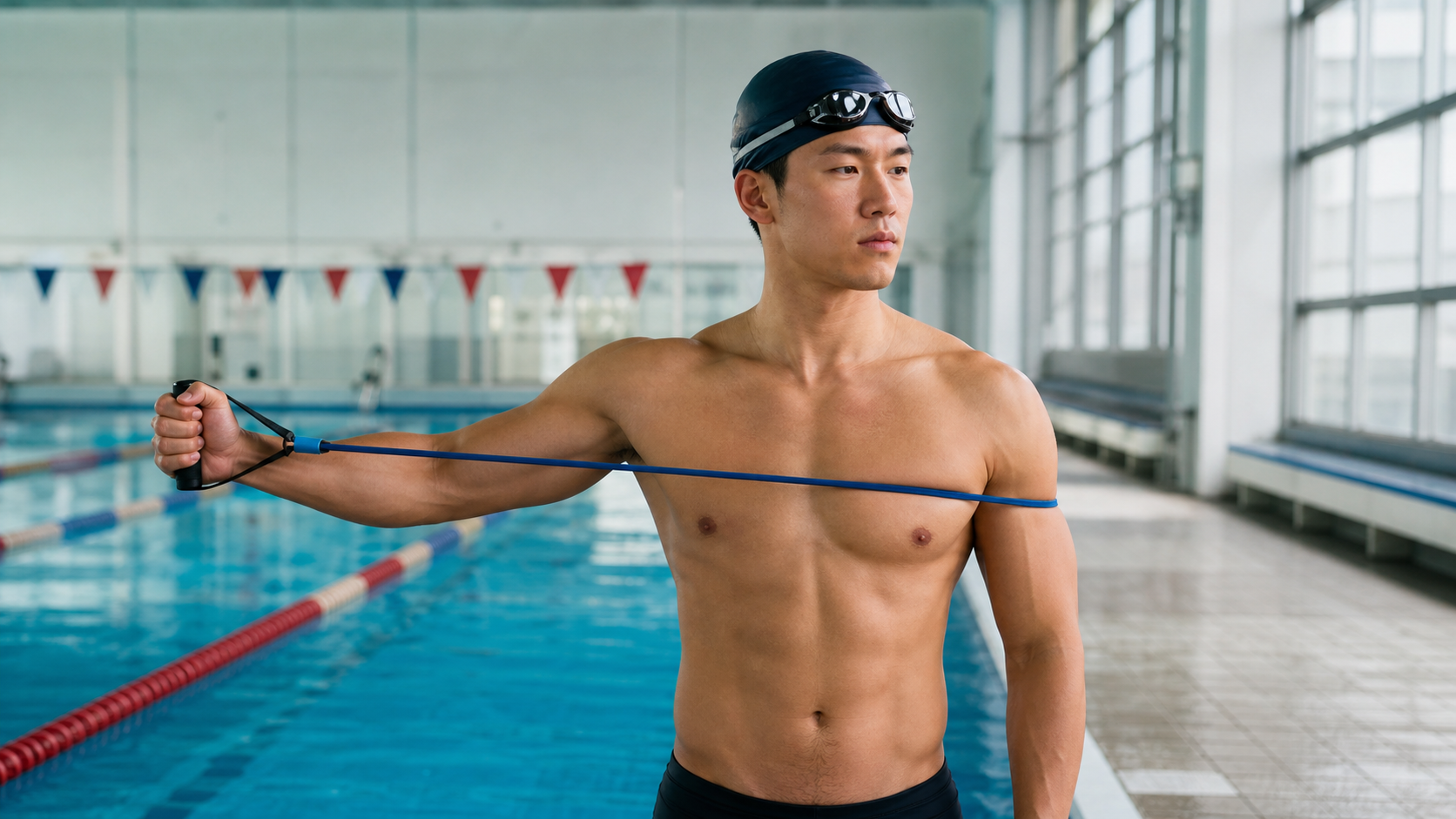
Resistance Band External Rotation
- Stand with the elbow bent at 90°, resistance band anchored directly in front
- Rotate the forearm outward to the maximum range, hold for 2 seconds, then slowly return
- 3 sets × 15 reps, emphasizing eccentric control
Prone Y-T-W Raises
- Lying face down on a bench, raise the arms in each direction to trace the shapes of the letters Y, T, and W
- Strengthens the middle and lower trapezius and the rhomboids
- 3 sets × 12 reps per position; light dumbbells (1–2 kg) can be added
Scapular Stability Training
Wall Slides
- Stand with your back against a wall, arms forming a W shape against the wall
- Slowly slide the arms upward overhead while maintaining full contact with the wall
- 3 sets × 10 reps
Side-Lying External Rotation
- Lying on your side, bend the top arm’s elbow at 90° while holding a light dumbbell
- Slowly rotate the arm outward to vertical, hold, then slowly lower
- 3 sets × 12 reps
Core and Kinetic Chain Integration
Dead Bug
- Lying on your back, extend opposite arm and leg alternately
- Trains core stability to reduce compensatory shoulder movement while swimming
- 3 sets × 10 reps (per side)
Technique Correction: Solving the Problem at Its Source
- Entry point: Fingers should enter the water directly in front of the shoulder, not crossing the midline
- Entry angle: Enter middle-finger-first (rather than thumb-first) to reduce internal rotation stress on the shoulder
- High-elbow catch: Maintaining a high-elbow position improves how you use the water’s resistance while also reducing supraspinatus impingement
- Training volume control: Keep weekly increases in swimming volume under 10%
Practical Recommendations
- Warm up for 5–10 minutes before swimming: Include shoulder circles and resistance band warm-ups; never enter the water cold
- Reassess every 6–8 weeks: Watch for asymmetric fatigue or pain patterns during training
- Don’t push through pain: If shoulder pain persists for more than 2 weeks, seek evaluation from a sports physical therapist
- Sleeping posture: Avoid prolonged side-lying pressure on the affected shoulder; placing a pillow under the arm can help
- Add dry-land cross-training: Exercises like rowing machines and pull-ups can strengthen the areas where swimmers are commonly weak
Conclusion
Swimmer’s shoulder is not an unavoidable fate — the vast majority of cases can be prevented through proper prevention training and technique correction. The rotator cuff is like a car’s shock absorbers: with proper maintenance, it can withstand the impact of the road for years to come. By incorporating dry-land strength training into your swimming program, you’ll not only protect your shoulder joints but also swim with a stronger pull and go further. Start today, and build a solid foundation for your swimming journey.
Related Reading
[教學] Premiere 影片 手震 修正 教學 防抖 單眼 影像 GoPro 穩定 Video Stabilization
8 年前
Insta 360 One 超級防手震技術實測
7 年前
一日北高/長距離團騎 常見問題補充篇 / 組團或跟團的眉角 / 壯車友容易被瘦車友慢性拉爆 / 原來屁股痛可能是這個原因...? / 風場配速法 / 公路車 / CT Yeh
2 年前
一日北高常見問題大集合 | 攻略 | 路線 | 訓練 | 補給 | 自行車 單車 | 一日雙城 | 雙塔 | TWB北高360 | 屁股痛
6 年前
如何把 GoPro 影片 翻轉 批次 轉正?
6 年前
抖肩舞 台灣x日本交流版 (台灣 vs 前橋) 赤城山登山賽 coincidance
8 年前
一日北高前的西濱集訓 | 跟著11小時軍團 | 300W踩不動的大逆風 | 輪車破風差幾瓦?
6 年前
2026 輪霸西濱200K 挑戰VLOG / 第一集團 / 首次參加..經驗不足、膀胱不足 /死守6H內 / AI戰鬥力顯示系統 / 公路車 / CT Yeh
4 個月前