Complete Land Training Program for Swimmers: A Guide to Band, Core, and Flexibility Workouts on Dry Land
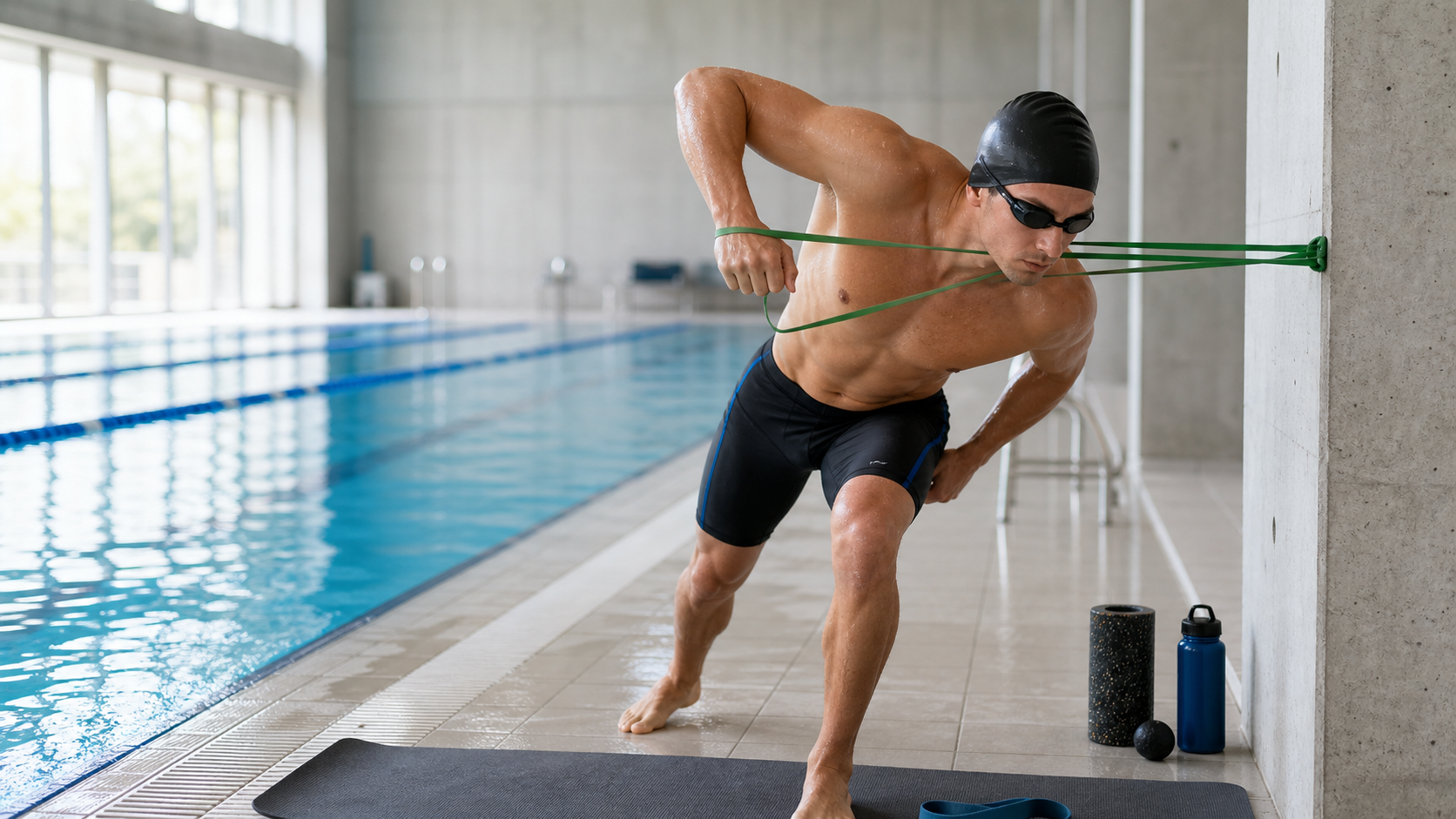
The Complete Dryland Training Plan for Swimmers: A Shoreline Guide to Resistance Bands, Core, and Flexibility
Introduction
Most amateur swimmers believe that swimming more is the key to swimming better. In reality, however, research consistently shows that dryland training can improve swimming performance as much as—or in some metrics, even more than—an equivalent amount of time spent in the water. This is why dryland training has become an indispensable part of modern swim training, from Olympic athletes to community pool swimmers.
This article provides a complete dryland training system designed specifically for swimmers, covering: resistance band stroke simulation, core stability strengthening, and swimming-specific flexibility work.
Why Do Swimmers Need Dryland Training?
Filling the Gaps Left by Water Training
While water resistance provides a full-body workout, dryland training holds advantages in several areas:
- Maximal strength training: High-resistance power training is impossible in the water; land-based weight training can enhance neuromuscular recruitment
- Stroke pattern correction: On land, you can practice swimming movements precisely in a stationary state, removing in-water distractions
- Asymmetry correction: The muscle imbalances common in swimmers (overdeveloped pectorals/weak trapezius) require dryland training to correct
Injury Prevention
As mentioned earlier, one of the primary causes of swimmer’s shoulder is the relative weakness of the rotator cuff external rotators. Dryland resistance band training can directly strengthen this weakness and prevent injury.
Part 1: Resistance Band Training (Stroke Simulation)
Required Equipment
- 1–2 resistance bands (recommend having one light (10–15 lbs) and one medium (15–25 lbs))
- An anchor point (wall-mounted anchor ring or door frame band anchor)
- An adjustable-height anchor point works even better
Freestyle Stroke Simulation
High Elbow Pull with Resistance Band
The most important swimming-specific dryland movement, directly simulating the full kinetic chain of catch → pull → push.
- Set the anchor point above head height
- Face the anchor point, hold the band with one hand, arm extended
- Simulate the swimming pull path: bend the elbow first (maintaining a high elbow), then press the forearm down and back
- 3 × 20 reps/arm, focusing on “eccentric control” (slow return phase)
Internal Rotation
- Anchor point at the side of the body, elbow bent 90° and close to the body
- Rotate the forearm from outside to inside (simulating the end of the push phase)
- 3 × 15 reps/side
External Rotation
- Anchor point in front of the body, elbow bent 90°
- Rotate the forearm from inside to outside (strengthens the rotator cuff, prevents swimmer’s shoulder)
- 3 × 15 reps/side, this is the most important preventive exercise
Butterfly/Breaststroke Pull Simulation
Lat Pulldown Variation
- Set the anchor point high, hold the band with both hands, simulating the simultaneous pull of both arms in butterfly
- Emphasize engagement of the latissimus dorsi and teres major
- 3 × 12 reps
Part 2: Core Training Plan
The power transmission pathway in swimming is: hips → core → shoulders → hands. A weak core means energy is lost in the midsection, significantly reducing stroke efficiency. The following exercises are graded by difficulty:
Level 1: Stability (Suitable for All Swimmers)
| Exercise | Sets × Reps/Time | Swimming Relevance |
|---|---|---|
| Standard Plank | 3 × 45–60 sec | Core control in horizontal position |
| Side Plank | 3 × 30 sec/side | Resistance to body roll |
| Dead Bug | 3 × 10/side | Contralateral limb coordination |
| Glute Bridge | 3 × 15 | Core-to-hip connection |
Level 2: Dynamic Stability (Progress After 1 Month of Training)
| Exercise | Sets × Reps | Swimming Relevance |
|---|---|---|
| Bird Dog | 3 × 12/side | Contralateral coordination + neutral spine |
| RKC Plank | 3 × 20 sec | Maximal core tension |
| TRX Suspended Core Curl | 3 × 12 | Core compression in the water |
| Anti-rotation Pallof Press | 3 × 12/side | Rotational stability during swimming |
Level 3: Power Integration (Progress After 2 Months of Training)
| Exercise | Sets × Reps | Swimming Relevance |
|---|---|---|
| Single-Leg Romanian Deadlift | 3 × 10/side | Full kinetic chain integration |
| Hanging Reverse Leg Raise | 3 × 12 | Lower core strength (kick initiation point) |
| Medicine Ball Rotational Wall Throw | 3 × 10/side | Explosive core rotation |
Part 3: Swimming-Specific Flexibility Training
Swimming requires a high degree of shoulder, thoracic spine, and ankle mobility. The following stretches are most effective when performed after training (stretching is more effective when muscles are warm).
Shoulder and Chest Flexibility
Pec Stretch (Doorway Stretch)
- Stand beside a doorway, elbow bent 90° against the frame, slowly shift your torso forward
- Hold 30 sec/side × 3 sets
- Improves: entry angle and breathing rotation range
Posterior Shoulder Stretch (Cross-Body Stretch)
- Bring one arm across your chest, use the other hand to apply pressure behind the elbow
- Hold 30 sec/side × 2 sets
- Improves: infraspinatus flexibility, reduces impingement risk
Thoracic Rotation (Quadruped Position)
- On all fours, place one hand behind your head and rotate toward the ceiling
- 10 reps/side, slow and controlled
- Improves: freestyle body roll range
Ankle Flexibility (The Overlooked Key!)
Swimming kick efficiency is highly correlated with ankle plantarflexion range of motion. Swimmers with stiff ankles kick as if they are applying the brakes.
Kneeling Ankle Stretch
- Kneel with the tops of your feet flat on the floor, slowly sit back toward your heels
- Hold 30 sec × 3 sets
Ankle Circles
- Seated, draw the largest possible circles with your ankles
- 15 circles in each direction × 2 sets
Hip Flexibility (Especially Important for Butterfly/Breaststroke)
Low Lunge Hip Flexor Stretch: Back knee on the ground, front foot planted, push the pelvis forward, hold 45 sec/side
Supine Butterfly Stretch (Breaststroke Kick Preparation): Lie on your back, bring the soles of your feet together, let your knees fall open naturally, hold 60 sec
Weekly Schedule Integration Recommendations
| Day | Water Training | Dryland Training |
|---|---|---|
| Monday | Technique session 60 min | Flexibility + resistance bands 15 min |
| Tuesday | Rest | Core 30 min |
| Wednesday | Aerobic session 60 min | Flexibility 10 min |
| Thursday | Rest | Core + resistance bands 30 min |
| Friday | Interval session 60 min | Flexibility 10 min |
| Saturday | Distance session 75 min | Resistance bands + core 20 min |
| Sunday | Rest or easy swim | Full-body flexibility 20 min |
Conclusion
Dryland training is not a “substitute” for swimming—it is a “multiplier.” Every strengthened rotator cuff, every trained transversus abdominis, every mobilized ankle joint translates into smoother strokes, a more stable body position, and a lower risk of injury in the water. Treat dryland training as part of your swim program rather than an extra burden, and you will be amazed at how a 30-minute investment outside the pool makes every meter inside the pool feel easier and faster.
Related Reading
- Land-Based Supplementary Training for Swimmers: A Complete Guide to Resistance Bands, Pull Racks, and Explosive Power Development
- Land-Based Supplementary Training for Swimmers: Swim-Specific Movements with Resistance Bands, Core Boards, and Yoga Balls
- Land-Based Supplementary Training for Swimmers: Applications of Resistance Bands and TRX in Swimming Fitness
- Cross-Strengthening Fitness for Swimmers: Transfer of Land-Based Explosive Power Training to Swimming Speed
西進武嶺 免費訓練分析服務 Intervals | 練不夠還是練過頭?你哪一種類型選手?AI模型告訴你! | 備戰神器 | 公路車 訓練 | CT Yeh
4 年前
一起升級!海鷗盃LSD團練...JJSC Zone2招待 騎到手抖 / 公路車 / CT Yeh
1 天前
一個測試有沒有認真練車的方法😂 #公路車
10 個月前
滑雪新手們慘摔學習全紀錄(請開字幕),滑雪好好玩 | Snowboard + Ski | 岩原 スキー場 | 滑雪APP使用 | GoPro Max
6 年前
一日北高/長距離團騎 常見問題補充篇 / 組團或跟團的眉角 / 壯車友容易被瘦車友慢性拉爆 / 原來屁股痛可能是這個原因...? / 風場配速法 / 公路車 / CT Yeh
2 年前
FTL 與 SYB 車隊專訪 西進武嶺 實用攻略分享! 2小時 如何練?!你不知道的眉角!新手準備武嶺必看 EP1 | 實力派女車友 | 精華版 | 公路車 | CTYeh
4 年前
沉浸室內單車練功房開箱! 100吋大畫面,最便宜的花費? 居然還能K歌!? | 公路車 | CT Yeh
3 年前
#公路車 #Fitting 靠人工智慧APP 幫你調整單車
6 年前