Swimming and Stress Management: Practical Methods of Aquatic Meditation and Research on the Mental Health Benefits of Regular Swimming
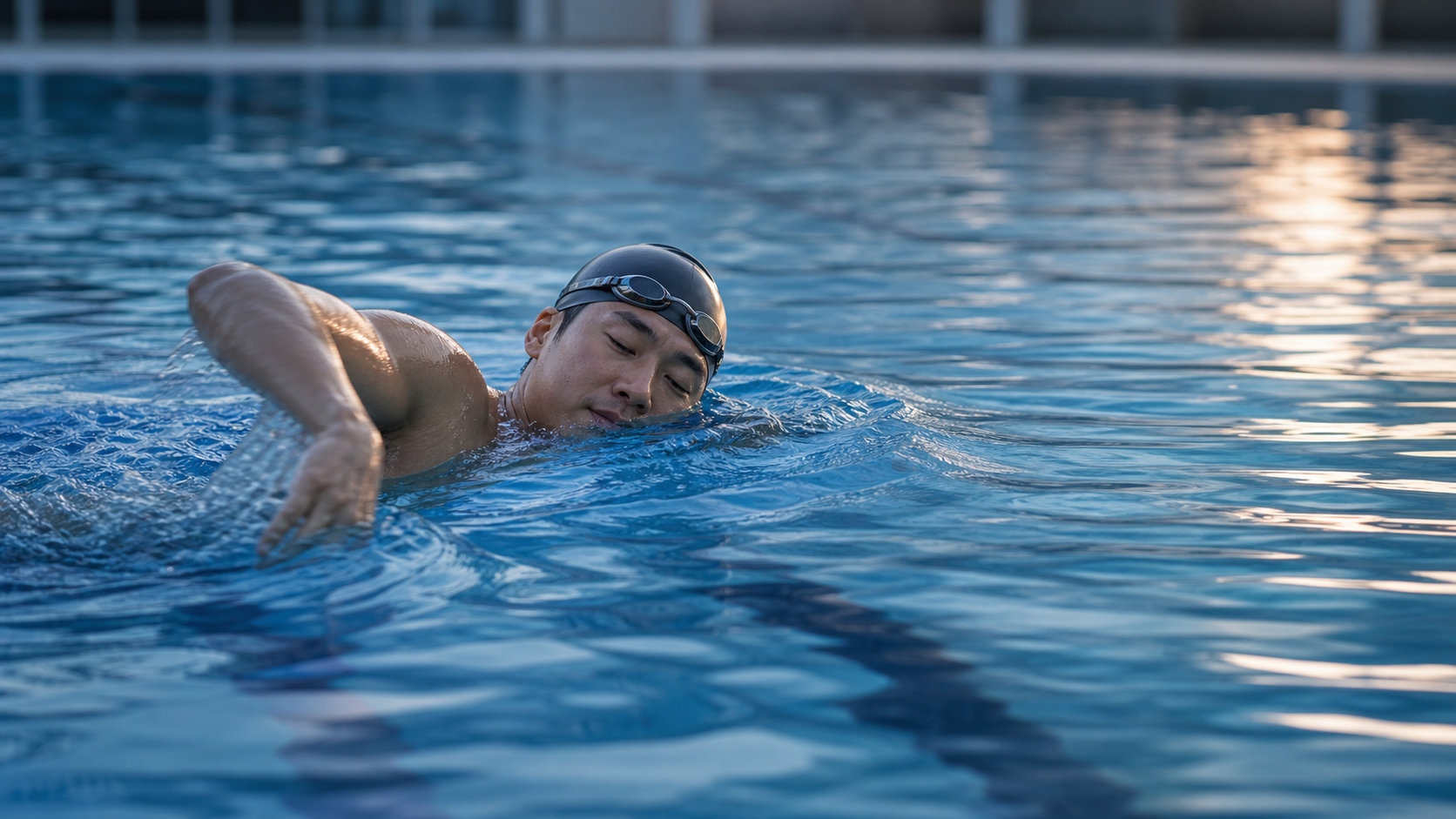
Swimming and Stress Management: Practical Methods of Water Meditation and Research on the Mental Health Benefits of Regular Swimming
Introduction
Stress levels among modern Taiwanese people remain persistently high. Overtime work, family caregiving, information overload—these pressures leave many in a state of chronic stress that not only affects mental health but also erodes physical health. Medication for anxiety and depression has its place, but exercise—particularly swimming—is gaining increasing scientific support as a complementary tool for mental health.
Swimming offers a unique combination of psychological benefits: the neurochemical effects of aerobic exercise, the relaxation response triggered by water’s sensory properties, and the meditation-like quality of repetitive movement. This article will take you deep into these mechanisms and teach you how to actively practice “water meditation” during your swims.
Scientific Evidence for Swimming’s Mental Health Benefits
Anxiety and Depression
Multiple systematic review studies confirm that regular aerobic exercise (including swimming) produces significant improvements in mild to moderate anxiety and depression:
- Research shows that 12 weeks of swim training can significantly reduce scores on anxiety scales (such as the STAI)
- For patients with mild depression, the antidepressant effect of regular swimming is comparable to low-dose antidepressant medication
- The mood improvement after swimming (often called the swimmer’s equivalent of “Runner’s High”) can last for 2–4 hours
Stress Hormones
| Indicator | Change After Swimming | Clinical Significance |
|---|---|---|
| Cortisol | Rapid rise followed by quick decline | Long-term baseline cortisol levels decrease |
| Adrenaline | Increases during exercise | Post-exercise relaxation rebound is more pronounced |
| BDNF (Brain-Derived Neurotrophic Factor) | Significant increase | Increased neuroplasticity, antidepressant effects |
| Endorphins | Rise after moderate-to-high intensity swimming | Enhanced feelings of pleasure and increased pain threshold |
The Special Significance of BDNF: This protein, often called “brain fertilizer,” is secreted at relatively higher levels after swimming compared to other aerobic exercises. BDNF promotes neurogenesis in the hippocampus (a key brain region for memory and emotional regulation), which is one of the key mechanisms behind swimming’s ability to improve cognitive function and mood.
Water’s Unique Psychological Benefits: The Blue Mind Theory
Marine biologist Wallace J. Nichols proposed the concept of “Blue Mind”: when humans come into contact with bodies of water (rivers, oceans, swimming pools), the brain spontaneously enters a mild meditative state, characterized by:
- Reduced activity in the Default Mode Network (DMN)
- Attention shifting from external stimuli to internal perception
- Reduced activity in the stress response system (amygdala)
- Subjective feelings: calmness, contentment, and an enhanced sense of “presence”
This effect is particularly pronounced in swimming because the sensory environment in water—the sound of water, resistance, buoyancy, temperature—provides rich yet unified sensory input, helping the brain switch from an overactive “thinking mode” to a more relaxed “feeling mode.”
Practical Methods of Water Meditation
“Water meditation” does not mean sitting cross-legged in the pool; it means actively cultivating the quality of mindfulness during your swim.
Method 1: Breath Awareness Swimming (Most Basic)
Suitable for: Any stroke, any skill level
Practice Steps:
- Swim at an easy pace (an intensity you can comfortably maintain for 20–30 minutes)
- Focus your attention entirely on your breathing rhythm: feel the sensation of bubbles dispersing in the water as you exhale, and the feeling of air filling your lungs as you inhale
- When your mind wanders (and it will), gently bring your attention back to your breath without judging yourself
- Your breathing rhythm is your “breath anchor,” similar to breath counting used in on-land meditation
Method 2: Body Scan Swimming (Advanced)
Suitable for: Swimmers with a solid foundation and stable technique
Practice Steps:
- Swim backstroke (face up, reducing breathing interference) at an easy pace
- Starting from your toes, work upward to feel each body part in the water in sequence: the resistance on the top of your feet as you kick, the contraction of your calves, the power of your thighs pushing water, the slight tension in your core…
- Do not judge the sensations; simply observe
- Complete roughly one full body scan per 25-meter lap
Method 3: Rhythm Awareness Swimming (Relaxation-Oriented)
Best for: Pre-bedtime swimming, stress-relief swimming
Practice Steps:
- Choose backstroke or freestyle (whichever stroke you are most proficient in)
- Set a fixed rhythm (e.g., breathe every 2 strokes) and let your movement enter “autopilot” mode
- Do not actively think about anything; let thoughts flow naturally—do not chase them, cling to them, or suppress them
- Feel the sensation of your body gliding through the water—this “gliding sensation” is the easiest gateway into water meditation
Long-Term Mental Health Benefits of Regular Swimming
Short-term mood improvement is just the beginning. The long-term psychological benefits of regular swimming include:
- Enhanced self-efficacy: Each small achievement in distance or technique during training accumulates into confidence in your own abilities
- Social connection: Swim buddy culture and swimming communities provide a sense of belonging that counters modern isolation
- Cognitive function protection: Long-term studies show that regular swimmers experience slower cognitive decline in old age
- Emotional regulation ability: People who swim regularly show more stable emotional responses and faster recovery when facing stressful events
Swimming Prescriptions for Different Types of Stress
| Stress Type | Recommended Swimming Approach | Special Considerations |
|---|---|---|
| Acute work stress | Moderate-intensity swimming for 30–45 minutes, paired with breath awareness | Avoid high-intensity sprints; let the body “release” rather than “escalate” |
| Chronic anxiety | Regular low-intensity swimming, 4–5 times per week | Prioritize consistency over intensity |
| Low mood | Any swimming helps; the most important thing is “getting into the pool” | Group swimming is more effective than swimming alone |
| Burnout | Easy swimming + water meditation | This is not the time to increase training volume |
| Sleep-related stress | Moderate-intensity swimming 2–3 hours before bed | Refer to the timing recommendations in the sleep improvement article |
Practical Recommendations
- Create “sacred time” for swimming: Leave your phone behind, don’t time yourself, don’t compare—make swimming time purely your own
- Practice non-judgment in the water: Feel like you swam terribly today? That too is part of water meditation—observe without judging
- The power of the swimming community: Join a community swim class or a swim buddy group; social support is a powerful catalyst for mental health
- Incorporate natural waters: If conditions allow, occasionally swim in safe natural bodies of water (such as open water events); the Blue Mind effect is stronger in natural environments
- Don’t turn swimming into another stressor: “I didn’t hit my training goal today” should not become a new source of anxiety. Swimming should fundamentally nourish, not deplete
Conclusion
In the fast pace of life, water gives us a pause button. Every push off the wall into the water is a farewell to external noise; every breathing motion is an invitation to return to the present moment. The mental health benefits of swimming come not from how fast or how far you swim, but from the pure state of being with the water. Learn to meditate in the water, and let swimming not only strengthen your body but also become your way of finding yourself again in a chaotic world.
Related Reading
- Swimming and Mental Health: Scientific Research on Water Meditation and Stress Reduction
- The Benefits of Swimming for Mental Health: The Relationship Between Water Exercise and Anxiety and Depression
- The Mental Health Benefits of Swimming: Relieving Anxiety and Depression
- Swimming and Stress Relief: The Mental Health Benefits of Water Exercise
西進武嶺 免費訓練分析服務 Intervals | 練不夠還是練過頭?你哪一種類型選手?AI模型告訴你! | 備戰神器 | 公路車 訓練 | CT Yeh
4 年前
[教學] Premiere 影片 手震 修正 教學 防抖 單眼 影像 GoPro 穩定 Video Stabilization
8 年前
實景訓練台) 彰化經典百K 高強度喵團 90分鐘 跟著一起練功 2019 Indoor workout Changhua Classic 100 Taiwan
7 年前
一起升級!海鷗盃LSD團練...JJSC Zone2招待 騎到手抖 / 公路車 / CT Yeh
1 天前
[防寒衣體驗] 鐵人魂 三鐵 防寒衣試穿會 於松運 深水游泳池 鯨魚池
8 年前
水金九不厭五分 10度寒流冷到不願停!feat. 卡卡 / 公路車 / CT Yeh
6 個月前
抖肩舞 台灣x日本交流版 (台灣 vs 前橋) 赤城山登山賽 coincidance
8 年前
NEKO's Fun 高美濕地團練
8 年前