Penghu Cross-Sea Marathon: Complete Race Management Techniques for Island Wind Conditions and Summer Heat
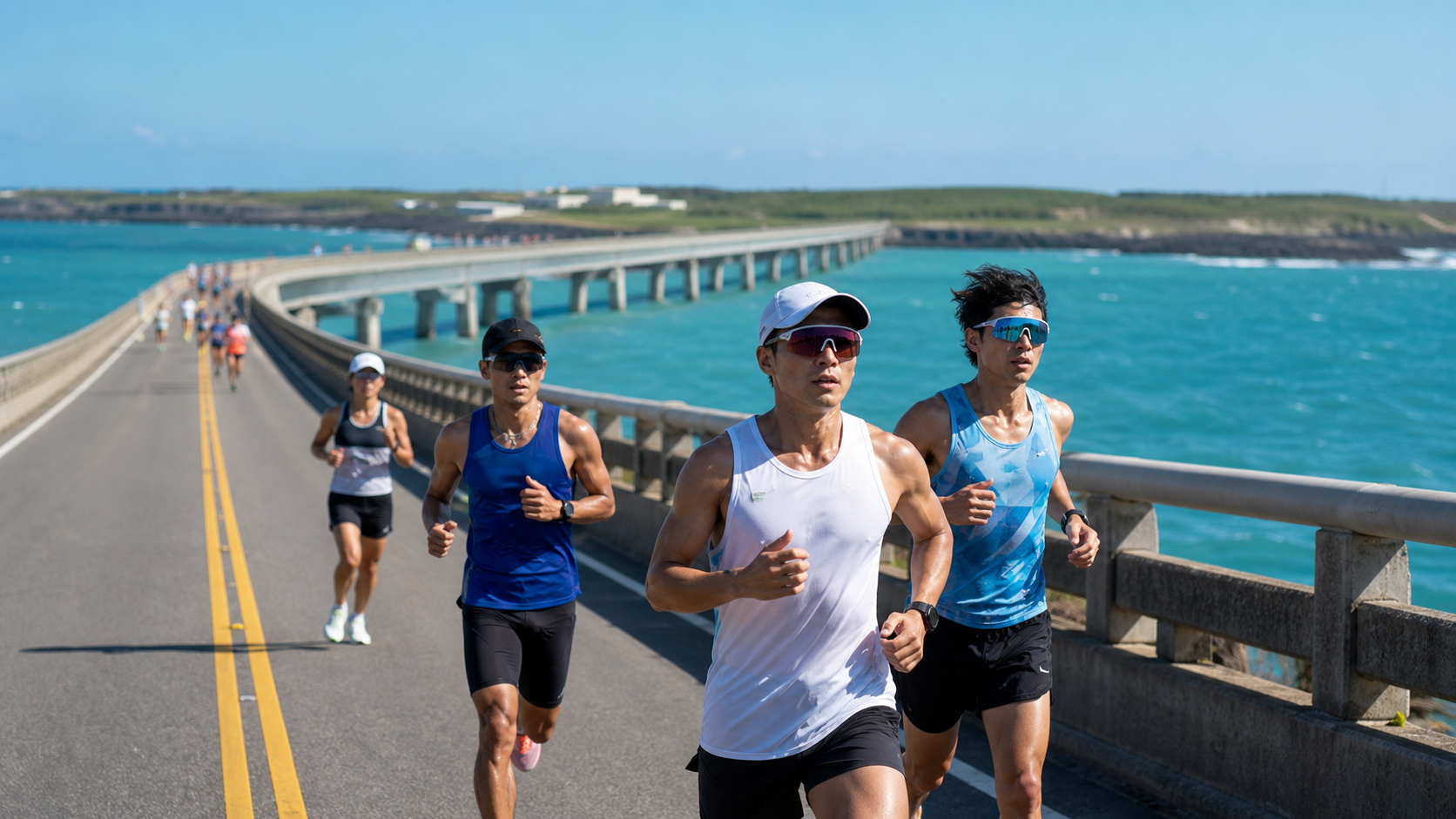
Penghu Cross-Sea Marathon: Complete Race Management Skills for Island Wind and Summer Heat
Introduction
The Penghu Cross-Sea Marathon is one of Taiwan’s most exotic road races, with a course that crosses the跨海大橋 (Cross-Sea Bridge) connecting Penghu’s main island and Baisha Island, accompanied throughout by clear coral-reef waters, basalt rock formations, and blue skies. However, Penghu’s June summer climate shows no mercy to runners: intense sunlight, temperatures above 30°C, and relentless sea winds from the South China Sea combine to create one of the harshest weather conditions in Taiwanese road racing. How to finish safely under the dual test of heat and wind is the core challenge of the Penghu Marathon.
Penghu Summer Climate Characteristics
| Climate Factor | Typical June Values | Impact on Running |
|---|---|---|
| Air Temperature | 28–33°C | Core body temperature rises rapidly |
| Feels-Like Temperature | 32–38°C | Feels hotter than actual temperature |
| Humidity | 75–85% | Sweat evaporation efficiency decreases |
| Wind Speed | 4–8 m/s | Cools the body but increases headwind effort |
| Sunshine Hours | 8–10 hours per day | Intense UV radiation |
In such an environment, heat exhaustion and heatstroke are real risks that should not be taken lightly.
Heat Acclimatization: The Key to Pre-Race Preparation
If you normally train in a cool environment and suddenly race in Penghu’s high heat and humidity, your body will face a huge shock. Heat acclimatization training is recommended:
- 10–14 days before the race: Start with easy jogs of 20–30 minutes during the hottest part of the day (2–4 PM)
- Gradually increase heat-environment training volume: Add 5–10 minutes each day to help your body learn to activate its cooling mechanisms earlier
- Do not perform high-intensity training in extreme heat: The heat acclimatization period should focus on low intensity to avoid heat illness
- Arrive in Penghu two to three days before the race: Give your body time to adapt to the local climate; do not arrive just one day before
Hydration Strategy: The Top Priority of the Penghu Marathon
In high-heat, high-humidity conditions, runners can lose 1–2 liters of sweat per hour, with significantly increased electrolyte losses as well. Hydration strategy:
- Take water every 2.5 km: Aid station density on the Penghu Marathon is usually sufficient; be sure to stop at every station for water
- Alternate between water and sports drinks: Consuming too much plain water dilutes blood sodium, leading to hyponatremia (the runner’s silent killer)
- Use water to cool down: Aid stations usually provide buckets of water for pouring over yourself; pouring water over your head, neck, and back effectively lowers core body temperature
- Bring your own electrolyte supplements: In addition to the official drinks provided, carry salt tablets or electrolyte capsules and take one every 40–50 minutes
- Start hydrating 2 hours before the race: Pre-race fluid reserves are more important than post-start replenishment
Fluid Intake Reference
| Running Intensity | Temperature | Recommended Fluid Intake per Hour |
|---|---|---|
| Easy jog | 30°C | 500–700 ml |
| Goal pace | 30°C | 700–900 ml |
| Near-sprint | 33°C | 900–1100 ml |
Special Management for the Cross-Sea Bridge Section
Crossing the Cross-Sea Bridge is the signature section of the Penghu Marathon, but this stretch presents unique challenges:
- No shade on the bridge deck: Direct sunlight combined with reflection off the bridge surface means the actual feels-like temperature can exceed 40°C
- Strong crosswinds: Sea winds are stronger than on land, with average wind speeds on the bridge reaching 6–10 m/s
- Mental hurdle: The bridge is long with no change in scenery, making it easy to feel like it stretches on forever
Bridge-crossing strategy:
- Top up on fluids and energy before entering the bridge
- Don’t look at the bridge’s length while crossing; treat every 500 meters as a small goal
- Slow your pace appropriately and accept the speed loss caused by the heat
- If you wear a hat, make sure it is secured (strong sea winds can easily blow hats away)
Clothing and Gear Recommendations
For summer heat races, clothing should prioritize “cooling efficiency” above all else:
- Light-colored technical short-sleeve shirt (white or light gray, to reflect heat)
- Moisture-wicking shorts to avoid inner-thigh chafing (can be paired with Vaseline for prevention)
- Wide-brimmed running cap for head and neck shade
- Sunglasses to reduce glare fatigue
- SPF 50+ sunscreen applied all over the body (including behind the ears and the back of the neck)
- A hydration belt to carry personal electrolytes and spare energy gels
Heatstroke Warning Signs and Self-Rescue
If any of the following symptoms appear, stop running immediately, cool down on the spot, and seek medical assistance:
- Abnormally dry skin (sudden cessation of sweating)
- Severe dizziness or blurred vision
- Confusion or slurred speech
- Core body temperature feeling abnormally high
Better to DNF (Did Not Finish) than to risk the aftereffects of heatstroke.
Conclusion
The spectacular scenery of the Penghu Cross-Sea Marathon offers a running experience that is hard to replicate, but its challenges are also among the most demanding in Taiwanese road racing. Prepare with heat acclimatization, hydrate diligently, and manage your pace, and you will complete a most memorable marathon journey witnessed by basalt rock formations and blue sea waters.
Related Reading
- Penghu Cross-Sea Swim: Channel Challenges of Strong Winds and Rough Seas, and Race Preparation Mindset
- Kinmen Marathon: Complete Guide to Wind Direction Utilization and Aid Station Specifics for an Island Race
- Penghu Cross-Sea Swimming Challenge: Direction Control and Mental Overcoming in Channel Currents
- Penghu Cross-Sea Bridge Cycling Challenge: A Test of Willpower in Sea Winds
大武山後門26%歡樂陡坡!JJSC南台灣單車行Day2 / 被颱風追著跑 / 公路車 / CT Yeh
2 年前
水金九不厭五分 10度寒流冷到不願停!feat. 卡卡 / 公路車 / CT Yeh
6 個月前
嘉義大埔、阿婆灣挑戰賽,美到以為在日本!ft. 環騎5 Cool 西拉雅188 / 公路車 / CT Yeh
7 個月前
備戰 戀戀197 賽前關門點分析 西濱團練 #公路車 4K高畫質
6 年前
2023 夏季KOM 參賽實況 / 穿越空拍視角 / 整車都凸台 / 太魯閣峽谷x合歡山絕美大景 / 東進武嶺 / Taiwan KOM Challenge / 公路車 / CT Yeh
3 年前
2025 海鷗團體繞圈賽 / 前八強賽事精華!/ 環台賽等級拍攝 / 國手菁英隊伍較勁 / CT Yeh #公路車
8 個月前
金門 ! 我騎過最棒的離島了 / 最後可以騎車上金門大橋的機會!?/ 公路車 / CT Yeh
1 年前
2025 海鷗團體繞圈賽 網路直播 超激烈裁判長視角 / EIPC 李廷威、Waypoint 等眾多高手競爭 / feat. 卡密兒主持 / 海鷗繞圈賽
9 個月前