Trail Running Uphill Technique: At What Grade Percentage Does the Energy Cost Divergence Between Walking and Running Occur?
單車訓練
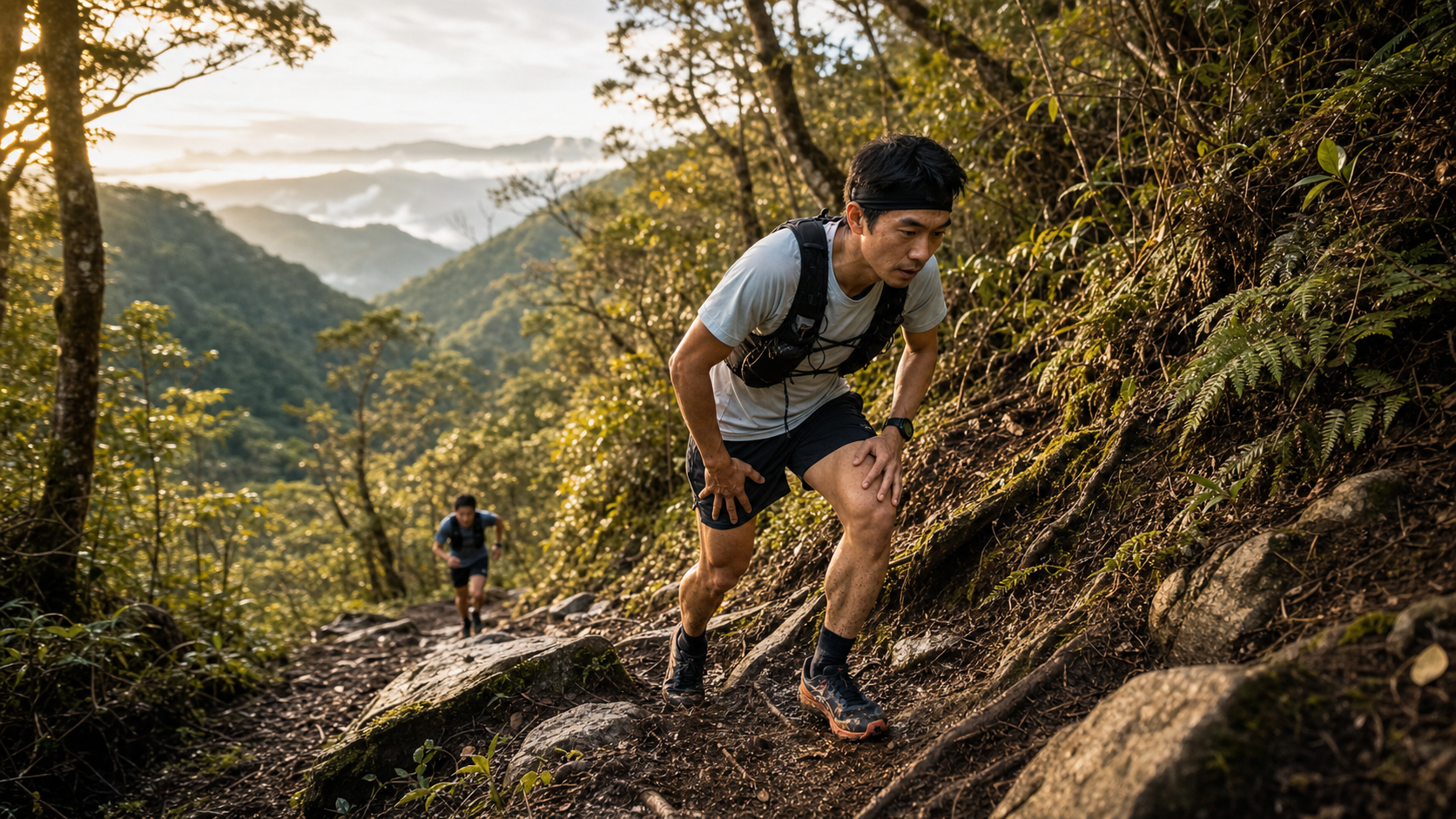
Core Conclusion: 12-15% Is the Divergence Point
According to exercise physiology research (Minetti et al., 2002), when the uphill gradient exceeds 15%, walking consumes less energy than running at the same speed. When the grade gets steeper (>20%), walking is even faster than running.
Energy Expenditure Comparison
| Grade | Running Energy Cost | Walking Energy Cost | More Efficient Method |
|---|---|---|---|
| 0% (flat) | 1.0 (baseline) | 0.5 | Run |
| 5% | 1.4 | 0.8 | Run |
| 10% | 1.9 | 1.2 | Still run |
| 15% | 2.4 | 1.7 | Close |
| 18% | 2.9 | 2.1 | Walk |
| 25% | 4.0 | 2.7 | Walk |
| 35% | Too energy-intensive | 3.4 | Walk (and use poles) |
How to Judge the Grade?
Visual judgment when you don’t have measuring tools:
- 5%: Feels like walking on a slope, slightly heavy breathing
- 10%: Clearly strenuous, but still runnable
- 15%: Breathing is heavy while running; walking feels more comfortable
- 20%+: Arms need to swing widely, almost “climbing”
- 30%+: May need to grab trees or use poles
Practical Strategy for Switching Timing
Short Hills (< 200m)
- Even if steep, run straight up
- Because the metabolic cost of switching posture is high, powering through in a short burst is more heart-rate efficient
Medium Hills (200m-1km)
- Switch based on grade: walk when it exceeds 15%
- When walking, lengthen your stride and push on your thighs: this is called “power hiking”
Long Hills (>1km)
- Fast walking as the main approach, with running穿插 on flatter sections
- In ultramarathons, walk almost the entire uphill: save energy for the flatter sections and downhills
Power Hiking Technique
Key skills for ultramarathon runners:
- Push on your thighs: Place your palms or elbows above the knees to transfer upper-body weight to your legs
- Long stride: 30-50% longer stride than walking on flat ground
- Heel strike first: Stretch the Achilles tendon and calves, drive with the hips
- Rhythmic breathing: Inhale and exhale every 3-4 steps
The Added Benefit of Trekking Poles
When using trekking poles:
| Action | Effect |
|---|---|
| Both poles pushing simultaneously | Short bursts of power, suitable for rocky steps |
| Opposite-side pole planting (left foot, right pole) | Long-distance rhythm, saves 25-30% effort |
| Poles planted 30cm ahead of the body | Pushing force aligns with forward body movement |
Heart Rate Management
The biggest issue on uphills is heart rate spiraling out of control:
- Check your current heart rate before starting the climb
- Criterion for switching to walking: heart rate is 10-15 bpm above your target zone
- Heart rate still high even when walking? Stop and catch your breath for 10-15 seconds, then continue
Training Recommendations
- Specific grade practice: Find two grades—12% and 18%—and practice the sensation of switching
- Weighted fast walking: Carry a 5-8kg pack and walk a steep slope for 30-60 minutes
- Pole familiarity: Start pole training at least 6 weeks before race day to build muscle memory
- Trail simulation: Find a training venue with a grade close to your race course
Common Mistakes
- Forcing yourself to run: Ego gets in the way—still running above 20%, then your heart rate blows up after 5 minutes
- Walking too slowly: Walking at a casual strolling pace wastes time
- Not training walking: Only training running makes your power hiking inefficient on race day
Conclusion
The outcome of trail running isn’t about who runs faster—it’s about who knows when to “run when it’s runnable, walk when it’s walkable.” A grade of 12-15% is the divergence point; beyond that, decisively switch to walking, and you’ll save heart-rate budget for the flatter sections.
Related Reading
相關影片
訂閱CT的頻道 RAMP FTP Test 直播 究竟能撐到幾瓦 訓練台 Gravat Zwift
6 年前
如果Pogačar騎西進武嶺可以多快?會破2嗎?各種情況深度推估探討 / 公路車 / CT Yeh
2 年前
白沙屯媽祖進香在家走!UREVO 坡度自調走步機 / 可連接訓練遊戲APP MyWhoosh / 邊看直播邊走起來 / CT Yeh
11 個月前
西進武嶺 8000名單車友數據分析 PART1 | 從新手到高手數量/瓦數/推力比/FTP推力比/功率計使用率 大解析 | 公路車 | CTYeh
5 年前
單車 梅山36灣 坡度介紹 路段介紹 空拍 (相關遊記影片,請參考說明或我的頻道喔,歡迎訂閱)
6 年前
大武山後門26%歡樂陡坡!JJSC南台灣單車行Day2 / 被颱風追著跑 / 公路車 / CT Yeh
2 年前
公路車 爬坡 破PR 紀錄 小技巧 分享
6 年前
半日 小台灣 極限單車路線挑戰實錄
7 年前