Pacing and Nutrition Rhythm for Long, Gradual Climbs (>30min)
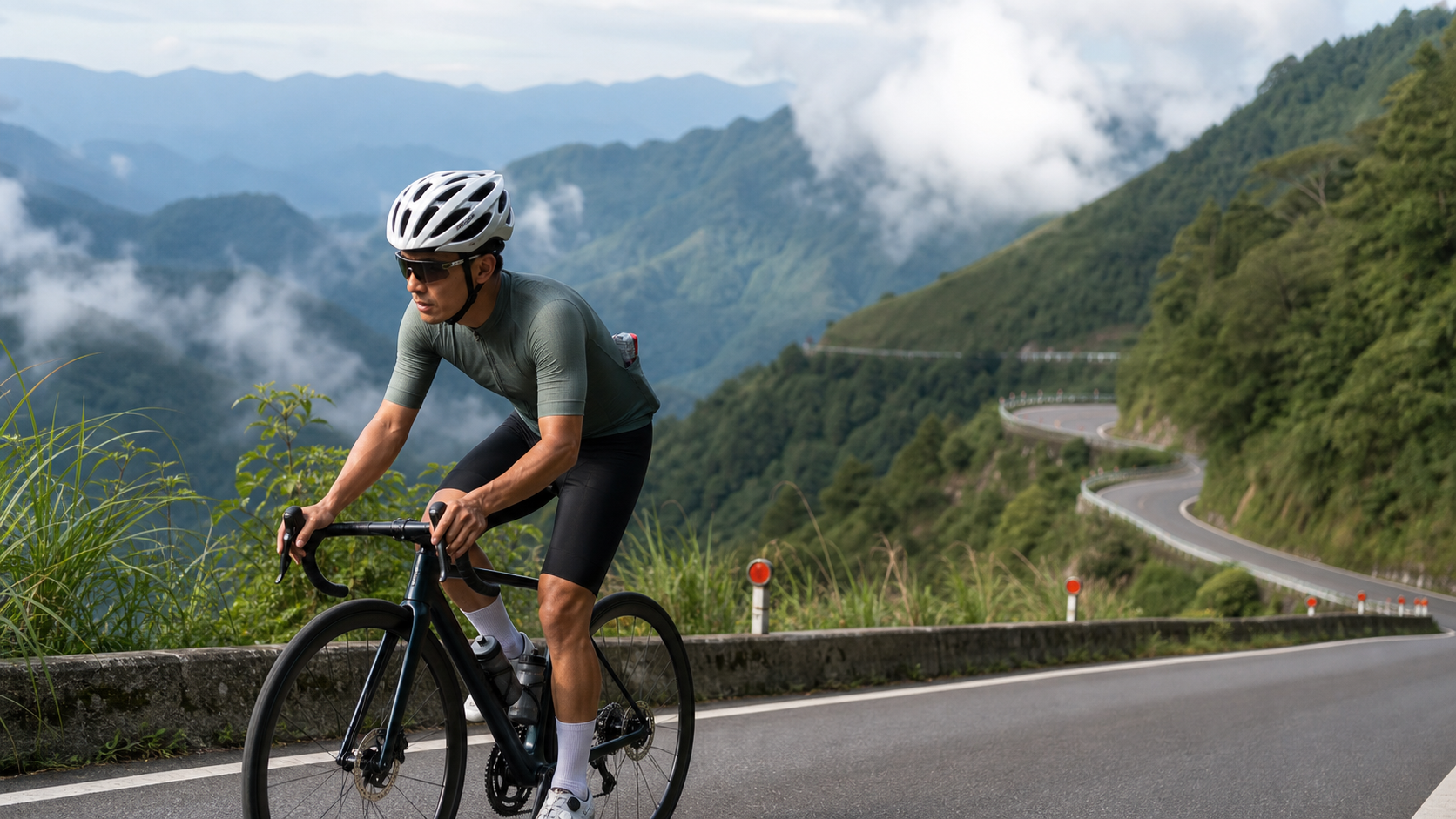
Wuling, Siyuan Pass, Cilan, Dayuling—these classic long climbs in Taiwan all take over 30 minutes. The challenge of this kind of “long, gradual climb” (< 8% average gradient, > 30min) is not a pure FTP contest, but a comprehensive battle of pacing, nutrition, and heart-rate management.
1. The Unique Challenges of Long Climbs
Unlike short climbs, long climbs present:
- Cardiac Drift: Heart rate gradually rises at the same power output
- Rising Core Body Temperature: Insufficient cooling; power drops 1–2% for every 1°C rise
- Glycogen Depletion: Glycogen drops below 50% after 60min
- Electrolyte Loss: 500–1500mg of sodium lost per hour
- Mental Fatigue: Attention drops, and pacing easily gets out of control
2. Pacing Strategy: Negative Split + Heart-Rate Zones
The best pacing for a long climb is “slow early, fast late” (Negative Split), but execution requires control:
60min Climb Segment Pacing (assuming FTP 280W):
| Time | Power Target | Heart-Rate Ceiling | Focus |
|---|---|---|---|
| 0–10min | 235W (84%) | LT1 + 5 | Control the urge, ease in |
| 10–25min | 245W (88%) | LT2 - 5 | Settle into rhythm |
| 25–45min | 252W (90%) | LT2 | Stay steady mid-section |
| 45–55min | 260W (93%) | LT2 + 3 | Push a bit |
| 55–60min | 270W (96%) | Don’t look | Final sprint |
Heart rate takes priority over power: If heart rate exceeds the ceiling, back off even if power is on target.
3. Managing Cardiac Drift
Cardiac drift cannot be completely avoided on long climbs, but it can be controlled:
- Normal drift: 5–8 bpm rise within 60min (at same power)
- Severe drift: Rise > 12 bpm, indicating overheating, dehydration, or glycogen depletion
Countermeasures:
- Actively cool down: pour water on head, neck, and arms every 15min
- Keep drinking: 100–150ml every 15min
- Monitor power/heart-rate ratio: if the ratio worsens by > 5%, actively reduce power
4. Nutrition Rhythm
Nutrition on long climbs follows the principle of “continuous, small amounts, regular.”
Carbohydrates
- 60–90g per hour (adjusted by intensity and body size)
- For high-intensity climbs, 80–90g/hr is recommended as the upper limit
- Sources: energy gels, energy bars, sports drinks
60min Climb Nutrition Example:
| Time | Intake | Amount |
|---|---|---|
| 30min before start | Banana + 200ml sports drink | 30g carbs |
| 5min before start | 1 gel | 25g carbs |
| 20min | 1 gel + 100ml water | 25g carbs |
| 40min | 1 gel + 100ml water | 25g carbs |
| 55min | No intake needed, prepare to sprint to the finish | — |
Total intake: 105g carbs + 200ml water
Fluids
- 500–800ml per hour (adjusted by temperature)
- Hot days (> 28°C): 800–1000ml per hour
- Cold days (< 15°C): 400–500ml per hour
Electrolytes
- 500–1000mg sodium per hour
- Heavy sweaters (salt stains on clothing) need 1500mg/hr
- Sources: sports drinks, salt tabs
5. Handling Terrain Changes
Long climbs are almost never at a uniform gradient; expect:
- Gentle sections (< 4%): Heart rate will drop slightly—don’t ease off, hold target power
- Steep sections (> 8%): Heart rate spikes—keep power from exceeding target + 15W
- Corners: Slow down but maintain cadence, then accelerate back to target immediately after the corner
- Rest platforms: Good opportunity to fuel, but don’t drop power for more than 30 seconds
6. Mental Strategy
Mental fatigue on long climbs often sets in before physical fatigue:
- Segment thinking: Split 60min into four 15min blocks—“I just need to make it to the end of the second block”
- Use metrics: Check distance and average power every 10min; don’t look at “how much is left”
- Positive self-talk: Tell yourself “I’m solid” instead of “I’m about to crack”
- Rhythm: Match a song’s beat to your cadence to let your brain run on autopilot
7. Training Recommendations
To perform well on long climbs, you should train:
- Long Sweet Spot efforts: 60–90min @ 85–90% FTP
- Real long climbs: One 60min+ actual climb per week
- Nutrition rehearsal: Simulate race fueling rhythm during training
- Heat adaptation: Dress heavier to deliberately create heat stress (summer training)
8. Conclusion
Long, gradual climbs are not won by “the rider with the most power,” but by “the rider with the steadiest pacing + proper fueling + controlled heart rate.” The rider who drops 90% of the field in the final 10K of the Wuling challenge is usually the one with the best pacing—seemingly behind for the first 70K, then overtaking everyone over the last 35K. Put the strategies in this article into practice on your next long climb, and your target time should improve by at least 3–5%.
Related Reading
西進武嶺 免費訓練分析服務 Intervals | 練不夠還是練過頭?你哪一種類型選手?AI模型告訴你! | 備戰神器 | 公路車 訓練 | CT Yeh
4 年前
西進武嶺 自製新版AI配速表產生器 x 賽前攻略 抱佛腳! 沒有功率計也可以產生配速表嗎?有什麼其他眉角賽前要注意的呢? | 西進武嶺 / 東進武嶺 KOM 攻略 | 公路車 | CT Yeh
4 年前
#公路車 #西進武嶺 配速配瓦實驗 坡度分析 四小時內攻略 建大盃 NeverStop #西進武嶺攻略
6 年前
西進武嶺各路段 前8000名 大數據分析 配速攻略/功率/心律/推力比/維持率/踏頻/踏瓦比/牽車率 大公開 | 建大盃 NeverStop 可參考 | 公路車 | CT Yeh
5 年前
FTL 與 SYB 車隊專訪 西進武嶺 實用攻略分享! 2小時 如何練?!你不知道的眉角!新手準備武嶺必看 EP1 | 實力派女車友 | 精華版 | 公路車 | CTYeh
4 年前
大禹嶺 到 武嶺牌樓 全程前後實況錄影 | 北進武嶺 | 東進武嶺 | KOM | 訓練台 | 坡度分析 | Taiwan KOM Last 10 km HARD | 公路車
6 年前
台北闊瀨陡坡 騎旅 / 日本單車雜誌編輯車友臨時加入!/ 髮香才是最強的 / feat. 北迴歸線小隊 / 公路車 CT Yeh
6 個月前
西進武嶺配速器 3.0更新 / NEW 免功率FTP估算! / 大數據xAI體能模型 / 如何模擬人止關前集團效應 / 配速儲存功能 / AI全台自行車賽事行事曆 / 公路車 / CT Yeh
1 年前