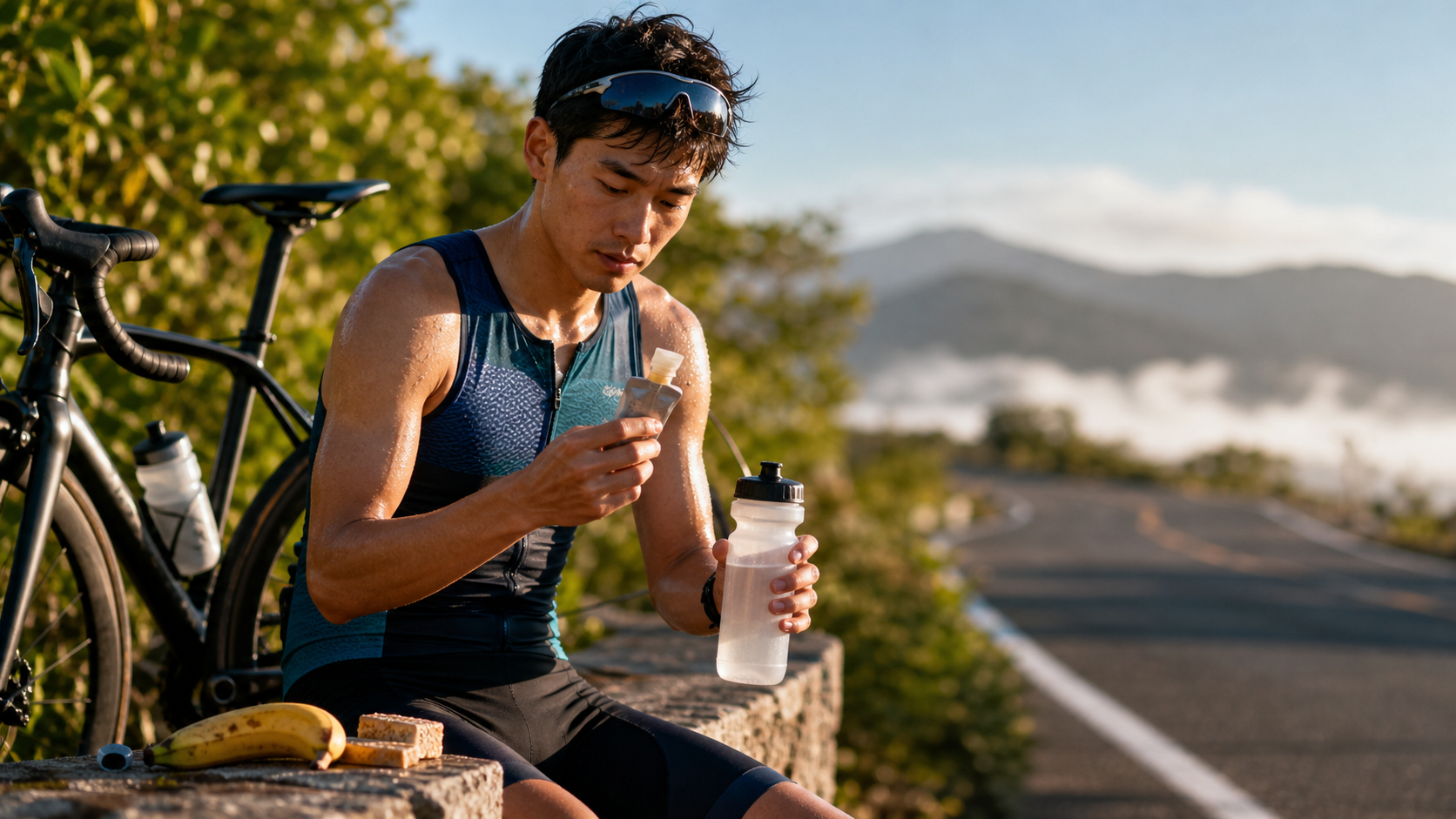
Why Does the Gut Need Training?
The human gut can learn to absorb high-sugar drinks during exercise. Research shows:
- Untrained gut: Absorbs a maximum of 30–45 g of carbs per hour; exceeding this causes nausea and diarrhea
- After 6 weeks of training: Can absorb 60–75 g/hr
- After 12 weeks of training: Can absorb 90–120 g/hr
The key enzyme is SGLT1 (sodium-glucose transport protein), which is upregulated with training.
The Two Goals of Gut Training
- Increase absorption capacity: More glucose transport proteins in the intestinal wall
- Improve tolerance: Reduce the likelihood of nausea, cramping, and diarrhea during exercise
12-Week Training Plan
Week 1–2: Foundation Phase (30 g/hr)
- Force yourself to consume 30 g/hr of carbs during every long session (>90 min)
- Source: 1 energy gel + 200 ml water, every 45 minutes
- Focus: Get used to “eating while exercising”
Week 3–4: Adaptation Phase (45 g/hr)
- Increase to 45 g/hr
- Example: Energy gel + half an energy bar + 200 ml sports drink
- Start trying solid foods (banana, white toast)
Week 5–6: Breakthrough Phase (60 g/hr)
- Reach 60 g/hr (the generally recommended minimum)
- Introduce dual-source carbs: glucose + fructose at a 2:1 ratio
- Example: 500 ml sports drink (glucose + sucrose formula)
Week 7–8: High-Volume Phase (75 g/hr)
- Increase to 75 g/hr
- Start simulating race intensity (Z3–Z4)
- Many people experience gastrointestinal discomfort at this point—this is normal
Week 9–10: Race Phase (90 g/hr)
- Reach 90 g/hr (IM-level fueling)
- Practice eating immediately after T2
- Rehearse various combinations of fuel products
Week 11–12: Rehearsal Phase (80–90 g/hr)
- Maintain 80–90 g/hr
- Use only the brands you will use on race day
- Fully simulate race-day conditions
The Importance of Dual-Source Carbs
Glucose is absorbed via SGLT1, while fructose is absorbed via GLUT5. Opening both pathways simultaneously can:
- Increase total absorption by 50–75%
- Lower intestinal osmotic pressure, reducing cramping
- Speed up gastric emptying
The Golden Ratio 2:1 (Glucose:Fructose)
Example: 60 g glucose + 30 g fructose = 90 g/hr
Common fuel product ratios:
| Product | Carb Source | Ratio |
|---|---|---|
| Maurten 320 | Maltodextrin + fructose | 0.8:1 |
| SiS Beta Fuel | Maltodextrin + fructose | 1:0.8 |
| Tailwind | Glucose + sucrose | ~2:1 |
| GU Roctane | Maltodextrin + fructose | ~2:1 |
Gut Monitoring During Training
After every long session, record:
- What you ate and when
- Whether you experienced nausea, cramping, excessive gas, or diarrhea
- Bowel movements within 2 hours after training
If you experience a heavy stomach or nausea: reduce concentration, dilute with more water
If you experience cramping or excessive gas: lower the fructose ratio
If you experience diarrhea: reduce the amount, check fuel ingredients (FODMAP)
Race-Day Fueling Rehearsal Checklist
- [ ] The fuel products you’ll use on race day have been tested in 5+ long training sessions
- [ ] The sports drink brand provided at the event has been tested (IM typically uses Gatorade Endurance or Maurten)
- [ ] 90 g/hr has been achieved at least 3 times in training
- [ ] Rehearsed the scenario of eating immediately after T2
- [ ] Rehearsed fueling in rain/high heat
Common Gut Training Mistakes
Mistake 1: Only Training at Easy Pace
At race intensity (Z3–Z4), gut blood flow decreases by 50%. You must rehearse at high intensity for it to be meaningful.
Mistake 2: Training with A, Racing with B
Brand, formula, and flavor all affect tolerance. Train with what you race with.
Mistake 3: Starting Only a Month Before the Race
Gut adaptation takes 8–12 weeks. Start Gut Training at the same time as your triathlon base phase.
Mistake 4: Ignoring Liquid Concentration
If carb concentration (osmolality) is too high (>10%), water is drawn into the gut, causing diarrhea. 6–8% is the optimal range for sports drinks.
Dietary Support for Gut Training
Daily nutrition can support gut health:
- Probiotics: Yogurt, miso, kimchi (1 serving per day)
- Prebiotics: Onion, garlic, banana, oats (feed the good bacteria)
- Avoid antibiotics: Unless necessary, as they disrupt the gut microbiome
- Increase fiber gradually: A sudden jump in fiber can backfire
Conclusion
Gut Training is the hidden level of triathlon preparation. With the same training volume and the same fuel products, an athlete with a well-trained gut can easily absorb 90 g/hr, while someone who hasn’t trained it will fall apart at 45 g/hr. Start 12 weeks early, and you’ll be more than 30 minutes ahead on race day.
Related Reading
- Gut Training: An Evidence-Based Method to Expand Carb Absorption Capacity in Two Weeks
- Gut Training for Triathlon Fueling: Treat Your Gut Like a Muscle
- Gut Training: Treat Your Gut as a Trainable Organ to Keep Eating in the Second Half
- The Complete Guide to Gut Training: Help Your Gut Adapt to High Carb Intake
FTL 與 SYB 車隊專訪 西進武嶺 實用攻略分享! 2小時 如何練?!你不知道的眉角!新手準備武嶺必看 EP1 | 實力派女車友 | 精華版 | 公路車 | CTYeh
4 年前
一日北高前的高裝檢 | 北高 360 | 挑戰11小時的裝備 | 一日雙塔 | 補給
6 年前
西進武嶺 免費訓練分析服務 Intervals | 練不夠還是練過頭?你哪一種類型選手?AI模型告訴你! | 備戰神器 | 公路車 訓練 | CT Yeh
4 年前
CT暗黑廚房) 車友必備 宇宙無敵鮮蚵湯 幫助訓練恢復 天然食補 好市多 超肥鮮蚵 破PR
7 年前
單車AI教練!全新 ChatGPT4o 幫你分析訓練成果!排武嶺課表,分析騎車姿勢! 太神了! / 公路車 / CT Yeh / feat. 緯緯
2 年前
福隆鐵人團練隨拍
8 年前
實景訓練台) 彰化經典百K 高強度喵團 90分鐘 跟著一起練功 2019 Indoor workout Changhua Classic 100 Taiwan
7 年前
一日北高常見問題大集合 | 攻略 | 路線 | 訓練 | 補給 | 自行車 單車 | 一日雙城 | 雙塔 | TWB北高360 | 屁股痛
6 年前