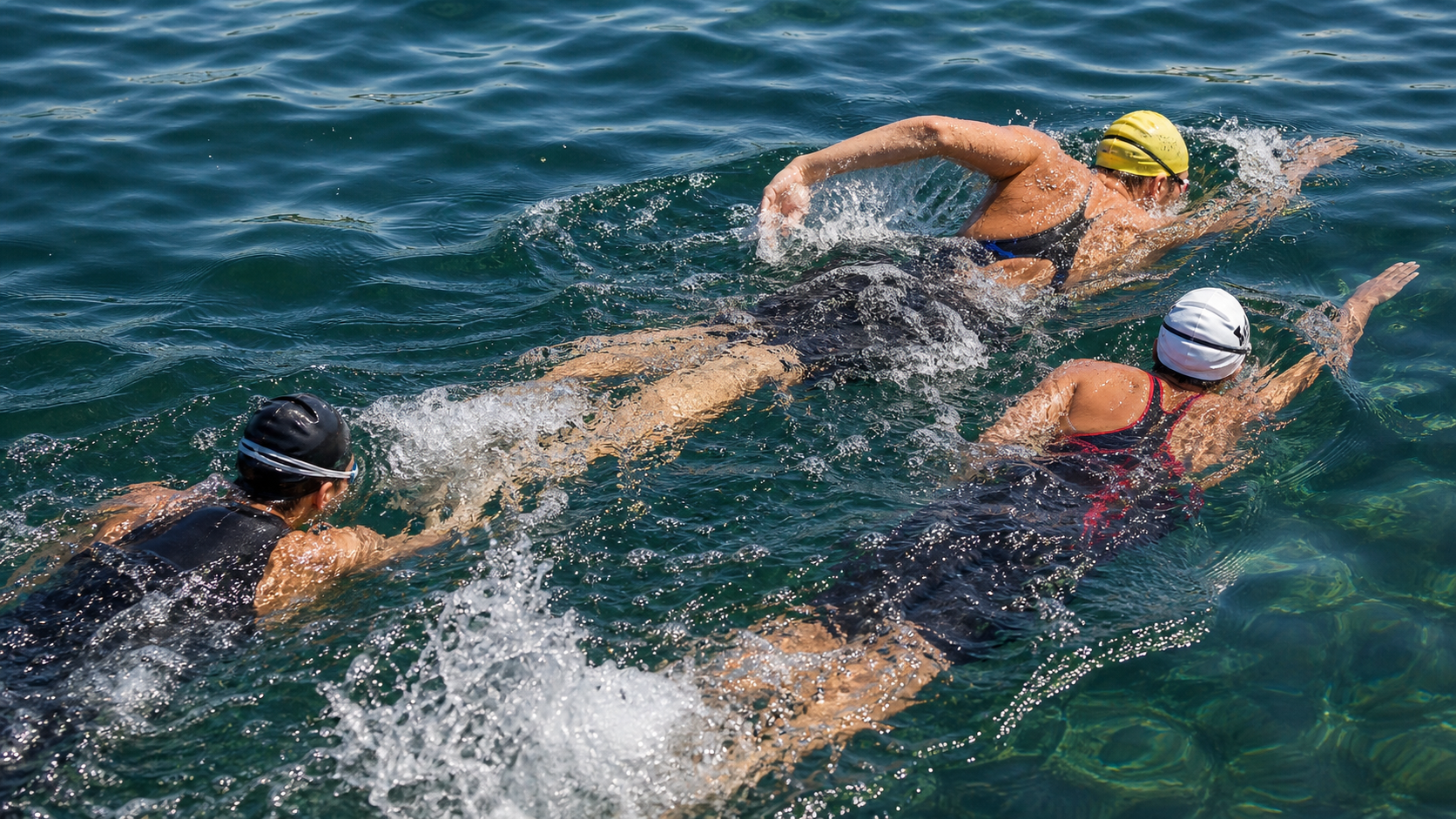
The Science Behind Drafting
When a swimmer moves forward, they create a “slipstream” behind them where water resistance drops significantly. Laboratory data:
- 30 cm directly behind the heels: 25-30% energy saved
- 50 cm to the side of the hip: 15-20% energy saved
- One body length behind the shoulder: 10-15% energy saved
- Beyond 2 meters: the drafting effect disappears
Translated to actual racing, drafting over 1500 meters can save 60-180 seconds—a massive benefit.
Detailed Breakdown of Three Drafting Positions
Position A: Directly Behind the Heels (Foot Draft)
Energy saved: 25-30%
Distance: 30-50 cm behind the lead swimmer’s feet
Advantages: Maximum energy savings, good visibility (watch the bubble trail of the swimmer ahead)
Disadvantages: Risk of being kicked, requires constant fine-tuning of distance
Technical points:
- When your fingers extend, you should be about 30 cm from the lead swimmer’s feet
- Focus your gaze on the “bubble band” created by the lead swimmer’s feet
- Synchronize your kick tempo with theirs to reduce collisions
- Look up every 10 strokes to check direction (because your view is blocked)
Position B: Hip Draft (Side of the Hip)
Energy saved: 15-20%
Distance: Parallel to the lead swimmer, with your head level with their hip, 50-80 cm apart
Advantages: Low risk of being kicked, clear visibility, can breathe while watching the other swimmer
Disadvantages: Less energy savings than the feet position, risk of being pushed to the outside
Technical points:
- Breathe toward the side closest to the other swimmer
- Maintain a pace slightly slower by 1 stroke than theirs to leave reaction room
- The water flow from their kick will push you forward
Position C: Behind the Shoulder (Shoulder Draft)
Energy saved: 10-15%
Distance: Diagonally behind the lead swimmer’s shoulder, one body length back (about 1.5-2 meters)
Advantages: No risk of being kicked at all, safe distance
Disadvantages: Least energy savings, vulnerable to others cutting in
Technical points:
- Use this when the pace difference is small and you don’t want to take risks
- Suitable for women’s categories and amateur athletes
- Breathe away from the other swimmer to avoid inhaling the splash they create
Drafting Position Selection Decision Tree
How much faster is the other swimmer than me?
├─ More than 5% faster → Use Position A (squeeze out every bit of energy savings)
├─ 2-5% faster   → Use Position B (balance energy savings and safety)
├─ About the same    → Use Position C (avoid conflict)
└─ I'm faster  → Don't draft, lead on your own
Criteria for Choosing a Drafting Target
Not everyone is worth drafting behind. A good drafting target:
| Trait | Why It Matters |
|---|---|
| Steady pacing | No sudden speed changes, consistent energy savings |
| Swims in a straight line | Good sighting, won’t lead you off course |
| Larger build | Larger slipstream, better energy savings |
| Steady breathing rhythm | Easy to predict, no sudden turns |
| Good at judging buoy distances | Follow them and you’ll take the shortest route |
When to Take Over the Lead
Racing isn’t just about drafting—sometimes you need to take the lead proactively:
- 50 meters before a buoy: Surge ahead to grab the inside line
- The other swimmer visibly slows down: Pass them and find the next drafting target
- The pack splits up: Swimming on your own may be better than drafting the wrong person
- Final 200-meter sprint: Drafting can’t help you accelerate; you must swim on your own
Drafting Rules and Restrictions
World Aquatics (FINA) rules:
- Drafting is allowed in open water swimming (unlike the cycling leg in triathlon, where it’s prohibited)
- No pulling, pushing, or blocking
- Contact is permitted, but intentional obstruction will result in disqualification
Training Methods
- Pool drafting drills: In pairs, take turns leading for 100 meters
- Endurance drafting: Draft for 1500 meters and compare heart rate (should be 5-10 bpm lower than when leading)
- Position switching practice: In a 25-meter pool, practice switching from the feet position to the hip position
- Overtaking practice: Practice suddenly accelerating from a drafting position to pass the swimmer ahead
Conclusion
Drafting is the key skill that separates amateur from advanced swimmers. Mastering it means getting a “free” 1-2 minutes in every race. But drafting is also an art—it takes long-term practice to smoothly switch positions and choose the right drafting target. We recommend practicing drafting with teammates at least 4 times a month to gradually build water feel and positional awareness.
Related Reading
- The Complete Guide to Open Water Drafting: The Energy-Saving Map of 18% Behind the Feet and 12% at the Hip
- Open Water Drafting Benefits and Techniques: Swim Smart and Save 30% of Your Energy
- Sprint Triathlon Swim Drafting Techniques: The Invisible Weapon for Saving Energy
- Legal Drafting Tactics in Open Water: The Positioning Science of Saving 8% in Swimming
西進武嶺 自製新版AI配速表產生器 x 賽前攻略 抱佛腳! 沒有功率計也可以產生配速表嗎?有什麼其他眉角賽前要注意的呢? | 西進武嶺 / 東進武嶺 KOM 攻略 | 公路車 | CT Yeh
4 年前
CT 喇低賽) 武嶺牽車 才是王道 西進牽車四小時內秘訣 攝手位置 如何判斷 防抽筋小秘訣
7 年前
Live) 備戰2019彰化經典百K 賽前攻略 (已完賽請看新影片
7 年前
戰略) Zwift Race 如何咬在第一集團 如何評估自己要開多少推力 (請開1.5倍速看)
7 年前
#公路車 #Fitting 靠人工智慧APP 幫你調整單車
6 年前
西進武嶺 免費訓練分析服務 Intervals | 練不夠還是練過頭?你哪一種類型選手?AI模型告訴你! | 備戰神器 | 公路車 訓練 | CT Yeh
4 年前
ThinkRider 智騎 XXPRO 訓練台,高階機種功能 只要 1/3價格!? 實測功率對比、噪音實測 / 公路車 / CT Yeh
1 年前
備戰 戀戀197 賽前關門點分析 西濱團練 #公路車 4K高畫質
6 年前