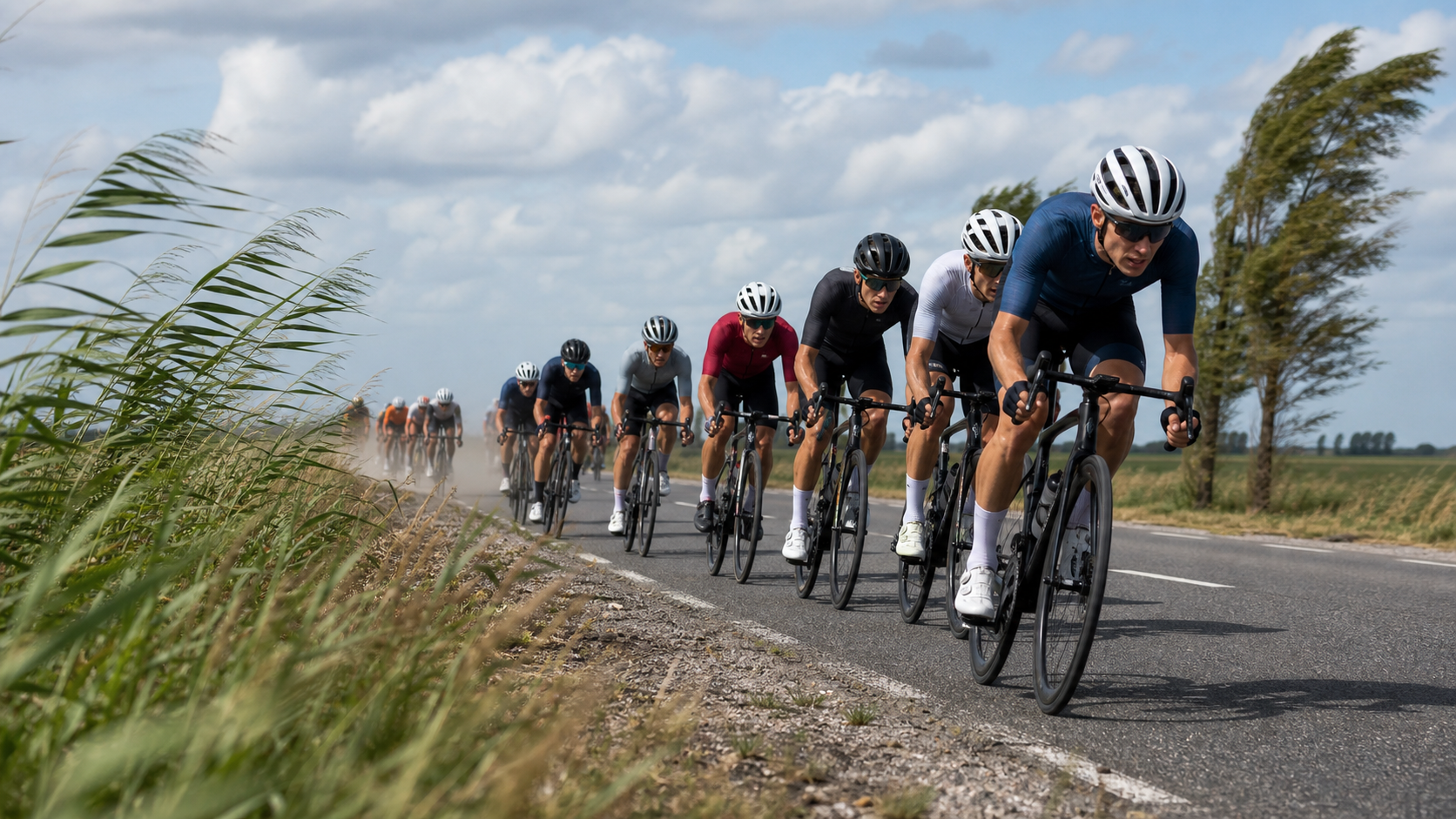
Echelon: The Diagonal Formation and Survival Guide in Crosswinds
Ever watched the Tour de France’s “Crosswind Stage”? A 200 km flat stage, the peloton instantly splits into five groups, and the overall leader drops to 20th place. That’s the power of the Echelon—the peloton’s tactical weapon in crosswinds.
What is an Echelon?
Riding directly in a straight line behind someone works best for direct headwinds or direct tailwinds, but when the wind comes from 90 degrees, the “draft” of the rider ahead shifts diagonally. So you can’t sit directly behind; you must position yourself behind and to the side—forming a diagonal line.
Wind direction →→→

[1][ ][ ][ ][ ]
   [2][ ][ ][ ]
      [3][ ][ ]
         [4][ ]
            [5]
Rider 1 is at the top, facing the wind; rider 5 is at the tail, sheltered but shifted to the right.
The Physics of an Echelon
When the wind comes from the right at 90 degrees, the air in front of a rider is pushed to the lower left:
- Riding directly behind (due north): almost no energy saved
- Riding behind and to the left (southwest direction): you can enter the draft
The draft extends in the opposite direction of the wind. So if the crosswind comes from the right, the echelon stretches back to the left.
Energy Savings of an Echelon
At 50 km/h with a 30 km/h crosswind (resultant wind coming from a 31° angle):
| Formation | Energy saved for rider #5 |
|---|---|
| Straight-line drafting | 12% |
| 30° echelon | 35% |
| 45° echelon | 48% |
| 60° echelon | 30% (past the optimal point) |
The optimal echelon angle aligns with the direction of the resultant wind.
Road Width Limits: The Critical Factor
Here’s the problem: the road is only 7-8 meters wide. An echelon can typically only accommodate 5-8 riders.
When the 9th rider wants to join, there’s no room—he can only sit directly behind the 8th rider, forming a “second echelon.”
First echelon (front):
[1][ ][ ][ ][ ]
   [2][ ][ ][ ]
      [3][ ][ ]
         [4][ ]
            [5]

Gap (wind blasts straight through; catching the first group is very costly)

Second echelon (rear):
[6][ ][ ][ ][ ]
   [7][ ][ ][ ]
      ...
Why Does the Peloton “Shatter”?
The leader of the second echelon (rider #6) must face the wind alone, requiring 400 W+ of power. If he can’t hold it, the second group slows down, and the gap to the first group keeps growing.
Once an amateur rider gets dropped 100 meters in crosswinds, it’s nearly impossible to get back—because he has to break the wind alone.
Survival Strategies
1. Predict Crosswind Sections
Check the weather forecast and course direction before the race. Be alert on any section where the crosswind angle exceeds 45° relative to the road.
2. Move Up Early
5 km before entering a crosswind section, fight your way into the top 30 positions of the peloton. If you wait until the split happens to try to squeeze in, it’s already too late.
3. Read Wind Changes
When the course turns, the relative wind direction changes. A direct headwind can suddenly become a crosswind. Watch for road signs, leaves, and flags.
4. Choose the Correct Side
Wind from the right → echelon extends back to the left → you should be on the left side of the peloton.
5. Don’t Get Dropped During the Transition
The moment the group switches from straight-line drafting to an echelon, the peloton shifts laterally by 2-3 meters. If you don’t follow, you’re spat out the back.
Team Tactics: Deliberately Causing Crosswind Splits
Strong teams will actively “snap” the peloton:
- 2 km before the crosswind section, the whole team rotates at the front, pushing 55 km/h
- Once in the crosswind, 4-5 teammates line up side by side, taking up the full road (a legal echelon)
- Weaker riders can’t join → a split occurs → rival GC contenders get dropped
- The team pushes on at full gas, opening a 2-3 minute gap in just 5-10 km
Famous Example
2015 Tour de France, Stage 2: On the Dutch coastal roads with 40 km/h crosswinds, Etixx-QuickStep deliberately split the peloton. Chris Froome stayed in the front group, while Nairo Quintana and Vincenzo Nibali both fell to the third group, losing 1 minute 28 seconds in a single stage—a stage that decided the overall title that year.
Conclusion
The echelon is cycling’s most brutal tactic. Those who don’t understand it get dropped and lose 5 minutes. Next time you ride into a crosswind, remember: form the diagonal, hold your position, and don’t be afraid of the squeeze—when the crosswind hits, the front 5 riders are your only lifeline.
Related Reading
- Team Rotating and Breakaway Tactics: Why Drafting Saves Energy, Formation Principles, and Etiquette & Safety for Group Rides
- Complete Analysis of Pro Cycling Team Tactics: Formations, the Sail Effect, and Final Sprint Launches
- The Energetics of Riding in the Peloton: How Many Watts Does Drafting Actually Save?
- Sprint Line Selection: Tactical Use of Corners and Tailwinds
2025 海鷗團體繞圈賽 / 前八強賽事精華!/ 環台賽等級拍攝 / 國手菁英隊伍較勁 / CT Yeh #公路車
8 個月前
CT 喇低賽) 武嶺牽車 才是王道 西進牽車四小時內秘訣 攝手位置 如何判斷 防抽筋小秘訣
7 年前
西進武嶺 世界紀錄挑戰!破2:30 ?!一群人推著一個夢上山 直播精華版 / ft. 張翰允 & 台視主播魏于恬 & KPLUS / #cycling 公路車 CT Yeh
2 個月前
風櫃嘴時間 預測西進武嶺時間?13000名車友統計數據分析告訴你 !
5 年前
一日北高/長距離團騎 常見問題補充篇 / 組團或跟團的眉角 / 壯車友容易被瘦車友慢性拉爆 / 原來屁股痛可能是這個原因...? / 風場配速法 / 公路車 / CT Yeh
2 年前
「悲情男車友」創作單曲 爆笑MV / 公路車 / CT Yeh / 4K劇情版
7 個月前
戰略) Zwift Race 如何咬在第一集團 如何評估自己要開多少推力 (請開1.5倍速看)
7 年前
西進武嶺 8000名單車友數據分析 PART1 | 從新手到高手數量/瓦數/推力比/FTP推力比/功率計使用率 大解析 | 公路車 | CTYeh
5 年前