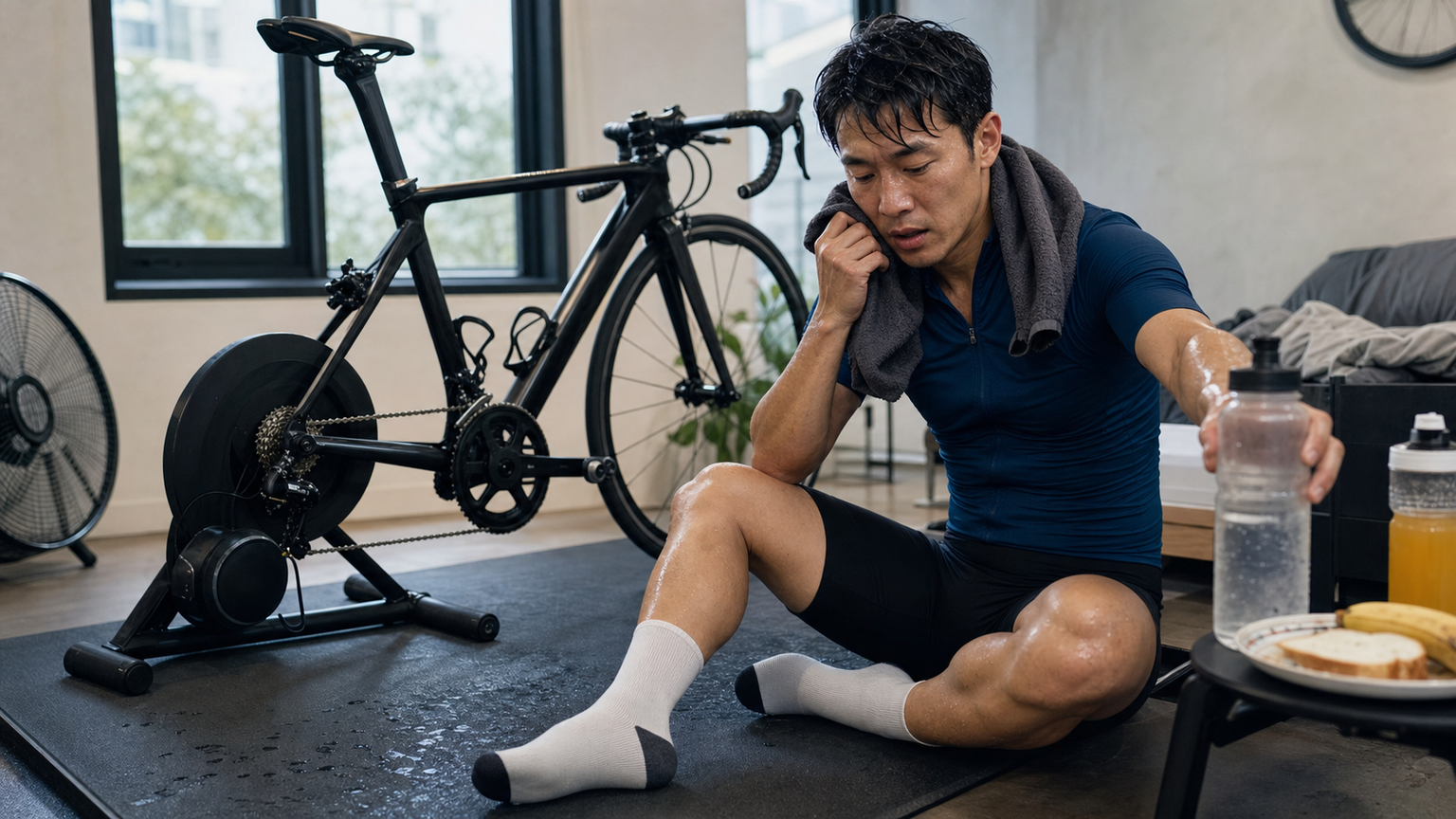
Physiological Characteristics After Indoor Training
Compared with outdoor riding, your body shows the following differences after indoor training:
| Metric | 1 Hour Outdoors | 1 Hour Indoors | Difference |
|---|---|---|---|
| Sweat Volume | 600-900ml | 900-1500ml | +50% |
| Peak Core Temperature | 38.2°C | 38.8°C | +0.6°C |
| Heart Rate Drift | +5 bpm | +12 bpm | +140% |
| Muscle Stiffness | Moderate | High | +30% |
| Electrolyte Loss | Moderate | High | +40% |
Why the Big Difference
1. Poor Heat Dissipation
- Outdoor wind at 30km/h carries away 60% of heat
- Indoors, you rely solely on sweat evaporation
- Sweat volume naturally increases
2. Continuous Pedaling
- Outdoors there are descents, red lights, and turns
- Indoors you pedal non-stop for 60-90 minutes
- Muscle lactate accumulates faster
3. Monotonous Position
- Outdoors you change position to handle terrain
- Indoors your position barely changes
- Upper back, neck/shoulders, and hips become stiff
4. Accumulated Mental Fatigue
- Indoor monotony wears down the nervous system
- Central nervous system fatigue builds up quickly
The Golden 30 Minutes After Training
Immediate Action (0-5min)
-
5 Minutes of Easy Spinning
- Drop power below 80W
- Cadence at 80rpm
- Lower heart rate below 100 bpm
-
Stand for 30 Seconds After Getting Off the Bike
- Don’t sit or lie down immediately
- Let blood flow gradually return to the core
- Avoid orthostatic hypotension
Rehydration (5-15min)
Calculate fluid loss:
Pre-training weight - Post-training weight = Fluid loss
Example: 72.5 - 71.0 = 1.5kg = 1500ml lost
Rehydration Principle: Loss × 1.5 = Amount to replenish
- 1.5kg lost → replenish 2250ml (spread over 2-3 hours)
- Plain water isn’t enough; you need electrolytes
- Add 200-300mg sodium per 500ml of water
Nutrition (15-30min)
Carbohydrates: 1.0-1.2g / kg body weight
- 70kg rider → 70-84g carbs
- Example: 1 banana (25g) + 500ml sports drink (30g) + 2 slices of toast (30g)
Protein: 0.3-0.4g / kg body weight
- 70kg rider → 21-28g protein
- Example: 1 scoop of whey protein (25g) or 100g chicken breast (30g)
Sample Recovery Drink Recipe:
- 300ml milk (15g carbs + 10g protein)
- 1 banana (25g carbs)
- 1 tablespoon honey (17g carbs)
- 1 scoop whey protein (25g protein)
- 1 pinch of salt (300mg sodium)
Muscle Recovery Protocol (30-60min)
1. Stretching (15min)
Key areas:
| Area | Movement | Duration |
|---|---|---|
| Front of thigh | Standing ankle grab | 30s × 2 |
| Back of thigh | Seated forward fold | 30s × 2 |
| Hip flexors | Lunge | 30s × 2 |
| Glutes | Pigeon pose | 45s × 2 |
| Lower back | Child’s pose | 45s |
| Neck/shoulders | Neck rotations | 30s |
2. Foam Rolling (10min)
Key areas to roll:
- IT Band (outer thigh)
- Quad (front of thigh)
- Glutes
- Upper back
Roll each area back and forth 10 times, holding on tender points for 30 seconds.
3. Contrast Shower (5min)
- Hot water at 38°C for 1 minute
- Cold water at 15°C for 30 seconds
- Repeat 3-4 times
- Boosts blood circulation
Advanced Recovery Tools
1. Pneumatic Compression Boots (NormaTec)
- 30-minute programmed massage
- Reduces perceived soreness by 40-50%
- Suitable for those doing 3+ high-intensity sessions per week
2. Ice Bath / Cold Plunge
- 10-15°C water for 10 minutes
- Suppresses inflammatory response
- Note: avoid within 24 hours before a race (it suppresses adaptation)
3. Infrared Sauna
- Do 1-2 hours after training
- Promotes blood flow and accelerates lactate clearance
Sleep Management
- Sleep quality within 8-10 hours after training directly determines recovery
- Avoid screen blue light 90 minutes before bed
- Keep room temperature at 18-20°C
- Every extra 30 minutes of sleep adds +3-5% to next-day FTP retention
What NOT to Do After Training
1. Icing Your Thighs Immediately
- Suppresses muscle repair signals
- Save it for race day; don’t use it in daily training
2. Drinking Beer to “Rehydrate”
- Alcohol is a diuretic and accelerates dehydration
- Impairs muscle protein synthesis by 30%+
3. Skipping Stretching
- Stiffness will come back to haunt you 24 hours later
- Next-day RPE will be abnormally high
4. Eating a Big Meal Immediately
- Blood flow to the digestive system is stolen by the muscles
- Prone to nausea and poor digestion
- Rehydrate + eat light first, then have a full meal 60 minutes later
Next-Day Recovery Checklist
Check upon waking:
- HRV (Heart Rate Variability): above average → recovery successful
- Resting Heart Rate: within 5 bpm of average → good
- Muscle Sensation: mild soreness = normal; sharp pain = overtraining
- Sleep Quality: > 7 hours of deep sleep → healthy
Strategy for Consecutive Training Days
If you train again the next day:
- Increase fluid intake by 50% that evening
- Increase protein by 20%
- Add 1 hour of sleep
- Extend next-day warm-up to 25 minutes
Indoor training is highly efficient, but the trade-off is a greater recovery demand. Systematic recovery isn’t a luxury—it’s the foundation of high-frequency training.
Related Reading
- Outdoor vs. Indoor Training Power Differences: Why Riding Outdoors Feels Harder
- Indoor Training Nutrition: Fueling Strategies That Differ from Outdoor Riding
- Cooling Down After Speed Work: A Recovery Protocol of Static Stretching and 10 Minutes of Jogging
- Indoor Sweet Spot Workouts: Key Points for Executing 60-90 Minute Continuous Intervals
相關影片
訂閱CT的頻道 實景訓練台) 彰化經典百K 高強度喵團 90分鐘 跟著一起練功 2019 Indoor workout Changhua Classic 100 Taiwan
7 年前
西進武嶺 免費訓練分析服務 Intervals | 練不夠還是練過頭?你哪一種類型選手?AI模型告訴你! | 備戰神器 | 公路車 訓練 | CT Yeh
4 年前
CT暗黑廚房) 車友必備 宇宙無敵鮮蚵湯 幫助訓練恢復 天然食補 好市多 超肥鮮蚵 破PR
7 年前
2016/4/20 - 中社路 夜騎 半年甩肉14KG 後測
10 年前
Live) 備戰2019彰化經典百K 賽前攻略 (已完賽請看新影片
7 年前
FTL 與 SYB 車隊專訪 西進武嶺 實用攻略分享! 2小時 如何練?!你不知道的眉角!新手準備武嶺必看 EP1 | 實力派女車友 | 精華版 | 公路車 | CTYeh
4 年前
一日北高 11小時 賽後心得分享篇 | TWB北高360 | 一日雙城 | 單車 | 公路車
6 年前
#公路車 #Vo2Max #最大攝氧量 測驗 體驗 | 心肺測試
6 年前