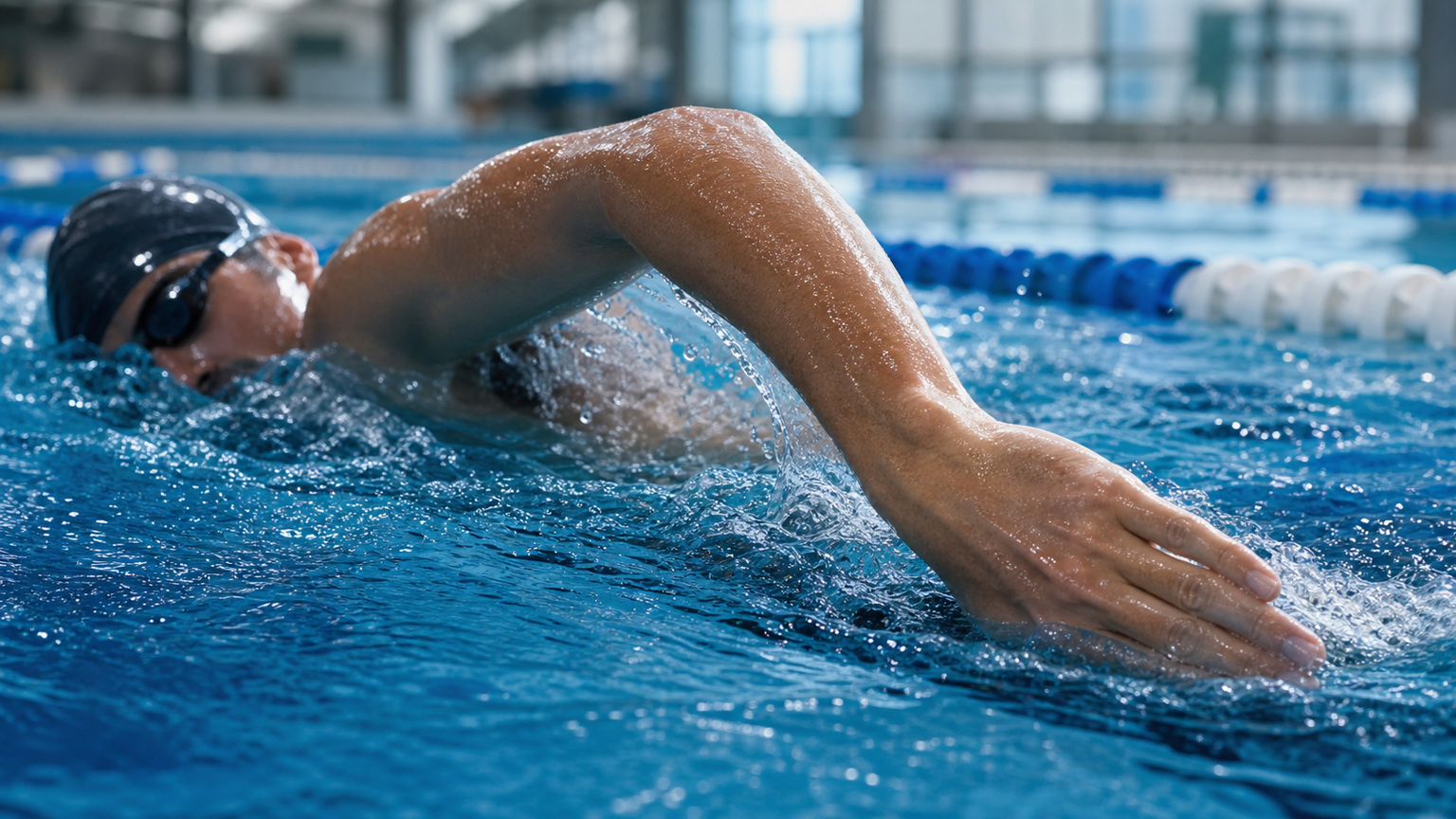
Swimming Wrist Pain Is Underestimated
Compared to swimmer’s shoulder, wrist problems are discussed less frequently, but according to a survey by Swimming Australia, approximately 17% of competitive swimmers have had training affected by wrist pain. The wrist joint is composed of 8 carpal bones and multiple ligaments, and its capacity to withstand stress is far lower than that of the shoulder or knee. Once inflamed, recovery is slow.
Three Common Injuries
1. Triangular Fibrocartilage Complex (TFCC) Injury
- Location: Wrist joint on the little finger side
- Pain point: At the moment of hand entry during the catch, and when performing a wringing-a-towel motion
- Cause: Ulnar deviation of the wrist (bending toward the little finger side) during the freestyle catch, with long-term repetition causing micro-tears in the TFCC.
2. Wrist Flexor Tendinitis
- Location: Palmar side of the wrist joint
- Pain point: During the acceleration phase of the pull, and when using hand paddles
- Cause: Using hand paddles forces wrist flexion, leading to overuse of the wrist flexors.
3. Scaphoid Stress Injury
- Location: Below the base of the thumb
- Pain point: When the wrist is extended (dorsiflexed)
- Cause: Excessive wrist extension impact upon hand entry during the butterfly’s undulating motion.
Wrist Biomechanics of the Freestyle Catch
Ideal wrist angle during the catch:
| Phase | Wrist Angle | Stress Level |
|---|---|---|
| Hand Entry | Neutral (0°) | Low |
| Before Catch | Slight flexion (10-15°) | Medium |
| Pull | Return from neutral to extension | Medium |
| Recovery | Relaxed neutral | Low |
Incorrect Angles and Their Consequences:
- Wrist flexion of more than 30 degrees at hand entry → Excessive contraction of the wrist flexors
- Ulnar deviation during the pull → Compression on the TFCC
- Stiff, inflexible wrist during the catch → Force transmitted directly to the carpal bones
Hand Paddles: A Double-Edged Sword
Hand paddles can improve feel for the water and strength, but they are also the number one culprit behind wrist pain.
At-Risk Groups:
- Paddle size too large (more than 30% larger than the palm)
- Use more than 3 times per week
- Distance per session exceeding 1500m
- Continuing to use them despite existing wrist pain
Safe Usage Principles:
- Choose a size similar to the palm or slightly larger (10-20%)
- No more than 2 times per week
- Cumulative distance per session not exceeding 2000m
- Stop immediately if soreness or swelling appears
Prevention Strategies
Before Training
3-Minute Wrist Warm-Up:
- Clasp hands together and make circles: 10 clockwise, 10 counterclockwise
- Interlace fingers and push forward, push up, and push down, holding each for 10 seconds
- With one hand, grasp the 4 fingers of the other hand and gently stretch the wrist flexors and extensors, 30 seconds each
During Training
- Imagine “hugging a big ball” during the catch: Keep fingers naturally spread, not clenched, and maintain a neutral wrist
- Fingertips enter the water first: Not the wrist first, to avoid impact from wrist extension
- Palm faces backward during the pull: Rather than downward, to reduce ulnar deviation
After Training
- Ice for 10 minutes: After high-intensity training or extensive paddle use
- Wrist joint stretch: In a kneeling position with palms flat on the floor and fingers pointing toward the knees, gently sit back and hold for 30 seconds
Rehabilitation Phases
Acute Phase (Days 1-7):
- Complete cessation of swimming
- Ice once every 2 hours, 15 minutes each time
- Wear a wrist brace to immobilize in a neutral position
- Taking non-steroidal anti-inflammatory drugs (NSAIDs) requires physician instruction
Subacute Phase (Weeks 1-3):
- Begin isometric contractions: Make a fist in a neutral wrist position and hold for 10 seconds, 10 reps × 3 sets
- Progressive resistance: Use grip balls or grip strengtheners
- May resume lower-body kicking drills (without using the arms)
Return Phase (Weeks 3-6):
- Start with backstroke (lowest wrist strain)
- Breaststroke next
- Freestyle at low intensity with gradual progression
- Butterfly is the last to resume
- Strictly prohibited from using hand paddles for 8 weeks
Red Flag Warning Signs
The following conditions require evaluation by a specialist physician:
- Obvious swelling of the wrist
- Weakness when making a fist
- A distinct “clicking” sound during wrist movement
- Numbness or tingling radiating into the fingers (suspected nerve compression)
- Pain lasting more than 4 weeks without improvement
The key to protecting your wrists is: Better to swim 100m less than to swim 1000m in pain.
Related Reading
- Tendinitis in Swimming: Overuse Injuries of the Wrist, Shoulder, and Knee Tendons
- Freestyle Low Elbow Pull: The Root Cause of Shoulder Injuries and High Elbow Drills
- Shoulder Injuries in Swimming: Causes and Prevention of Swimmer’s Shoulder
- Shoulder Mobility for Swimmers: The Land-Based Foundation for Speed in the Water
[教學] Premiere 影片 手震 修正 教學 防抖 單眼 影像 GoPro 穩定 Video Stabilization
8 年前
CT 喇低賽) 武嶺牽車 才是王道 西進牽車四小時內秘訣 攝手位置 如何判斷 防抽筋小秘訣
7 年前
抖肩舞 台灣x日本交流版 (台灣 vs 前橋) 赤城山登山賽 coincidance
8 年前
碟煞公路車 銑面器 !? 原來銑完差這麼多! 降低蹭碟機率! | TIME 公路車 保養小記錄 | CT Yeh
3 年前
CT 喇低賽) 單車 比賽總是沒照片? 攝影師的觀點大公開 姿勢就是力量! 請加速1.25倍收看
7 年前
一日北高/長距離團騎 常見問題補充篇 / 組團或跟團的眉角 / 壯車友容易被瘦車友慢性拉爆 / 原來屁股痛可能是這個原因...? / 風場配速法 / 公路車 / CT Yeh
2 年前
如何把 GoPro 影片 翻轉 批次 轉正?
6 年前
洗完單車整隻手黑的解決妙招🤣 #bike
1 年前