TT Time-Trial Helmet Aero Showdown: Interpreting Wind-Tunnel Data for Open, Long-Tail, and Short-Tail Designs
文章導覽
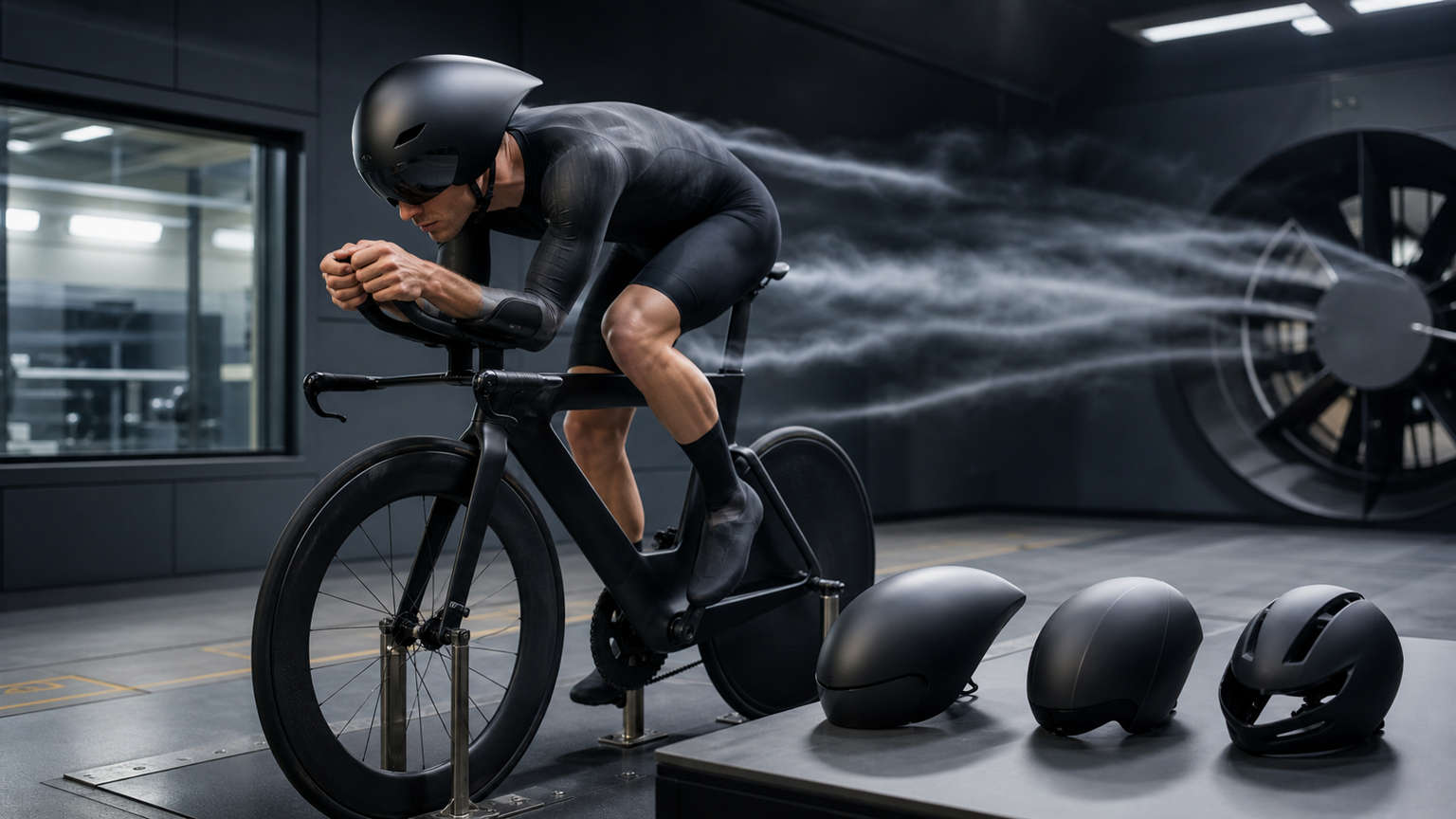
Why Do TT Helmets Look So Strange?
On the bike leg, aerodynamic drag accounts for 70-80% of total resistance, and the head is the “highest aerodynamic disturbance point.” A good TT helmet can save 10-25W of power at 40 km/h, equivalent to saving 2-5 minutes on the IRONMAN bike leg.
But the definition of “good” varies from person to person. Helmet design must match:
- Riding position (how low you are)
- Head angle relative to the torso
- Race temperature (cooling needs)
- Race duration (comfort over 6 hours of wear)
Three Major TT Helmet Design Schools
1. Long Tail — The Classic Aero School
Key feature: The tail extends 15-25cm rearward, forming a “teardrop” shape.
Pros:
- Excellent low-drag performance when the tail rests against the back in a stable, head-down position
- Performs best on flat, straight sections (e.g., Cairns 70.3 in Australia)
Cons:
- The tail lifts up when you raise your head to look ahead, disrupting airflow
- Aero benefits diminish on courses with frequent climbs and descents
- Short-necked riders look comical in them (though nobody cares during a race)
Best suited for: Riders with long necks, stable positions, and those who don’t need to look up frequently
2. Short Tail / Stubby — The Modern Mainstream
Key feature: The tail extends only 5-10cm, with a rounder, more compact overall shape.
Pros:
- Retains about 80% of aero benefit even when looking up
- Lighter weight (350-450g)
- Less visually extreme, suitable for crossover use (e.g., hilly courses)
Cons:
- Slightly less efficient than long-tail on pure flat sections
- Fewer vents than open-vent designs
Best suited for: Most amateur riders, those with unstable positions, and hilly routes
3. Open Vent / Hybrid — Cooling First
Key feature: Large front intake vents, with a shape between a TT and a road helmet.
Pros:
- Best cooling performance, ideal for hot races (Kona, Kenting)
- High comfort for long events like IRONMAN
- Some models feature adjustable ventilation valves
Cons:
- Lowest aero efficiency (3-5W worse than short-tail)
- Heavier (450-550g)
Best suited for: Riders prone to overheating in hot weather, and full-distance IRONMAN racers
How to Read Wind Tunnel Data
Brands publish data claiming “saves X watts vs. a reference model,” but note:
| Condition | Impact |
|---|---|
| Riding position (high/low) | Same helmet can vary by up to 8W |
| Yaw angle | Results at 0° and 10° can flip |
| Test speed (40 vs 50 km/h) | Amateurs ride 30-35 km/h, so discount the numbers |
Industry consensus: “Manufacturer claims -20W, actual amateur racing -8W” is a reasonable expectation.
Visor Systems
Modern TT helmets mostly come with magnetic visors, eliminating the hassle of wearing sunglasses. When shopping, note:
- Lens clarity (optical grade vs. standard PC sheet)
- Whether a clear lens is included (for night training)
- Fogging issues in rain (some models have anti-fog coatings)
- Scratch resistance of the lens (premium models include a protective pouch)
Safety Standards
All legally sold TT helmets must pass:
- CPSC (USA)
- EN 1078 (EU)
- AS/NZS 2063 (Australia)
Some pro races require MIPS or similar rotational impact reduction systems. It’s not mandatory for most amateur events, but models with it are recommended (spend an extra NT$ 2,000-3,000 for a significant safety boost).
Fitting and Measurement
Head circumference measurement: wrap a soft tape measure around your head 2cm above the eyebrows, at the widest point. Match it to each brand’s size chart:
| Head Circumference | International Size |
|---|---|
| 52-55 cm | S |
| 55-58 cm | M |
| 58-61 cm | L |
| 61-64 cm | XL |
Key fitting points:
- Without the straps fastened, the helmet stays stable and doesn’t fall off
- No wobble when shaking your head up and down
- No pressure between the visor and your nose
- No pressure points in front of either ear
- No red marks on the forehead after wearing for 5 minutes
Price Ranges (Anonymous Examples)
| Tier | Price | Features |
|---|---|---|
| Entry | NT$ 5,000-8,000 | Basic short tail, no MIPS, fixed visor |
| Mid-range | NT$ 10,000-15,000 | Magnetic visor, MIPS included, adjustable ventilation |
| High-end | NT$ 18,000-25,000 | Wind tunnel certified, dual visors, lightweight < 400g |
| Top-tier | NT$ 30,000+ | Custom fit, ultra-lightweight, premium optical lenses |
Buying Advice for Triathletes
- First 70.3: Choose a mid-range short-tail model for the best value
- IRONMAN goal: Go with open-vent or short-tail; cooling matters more than 5W
- Kona qualifying goal: Worth investing in a top-tier wind tunnel certified model
- Multi-season use: Avoid overly bizarre shapes for higher usage rates
Conclusion
A TT helmet isn’t about “the faster, the better” — it’s about “the better it fits your position and your race, the better it is.” For your first helmet, we recommend a short-tail + mid-range price point. After gaining experience from more than 3 70.3 races and understanding your riding position and weaknesses, then upgrade to a pro-level model. A wrong choice could have you constantly adjusting mid-race due to discomfort, negating any aero benefit.
Related Reading
- Aero Time Trial Helmet Buying Guide: From Wind Tunnel Data to Real-World Choices
- Individual Time Trial (TT) Equipment Optimization: The Benefits of Aero Helmets
- Aerodynamics of Time Trial Equipment: Helmet, Handlebars, and Skinsuit Benefits
- Helmet Wind Tunnel Data Comparison: Balancing Aero, Ventilation, and Safety