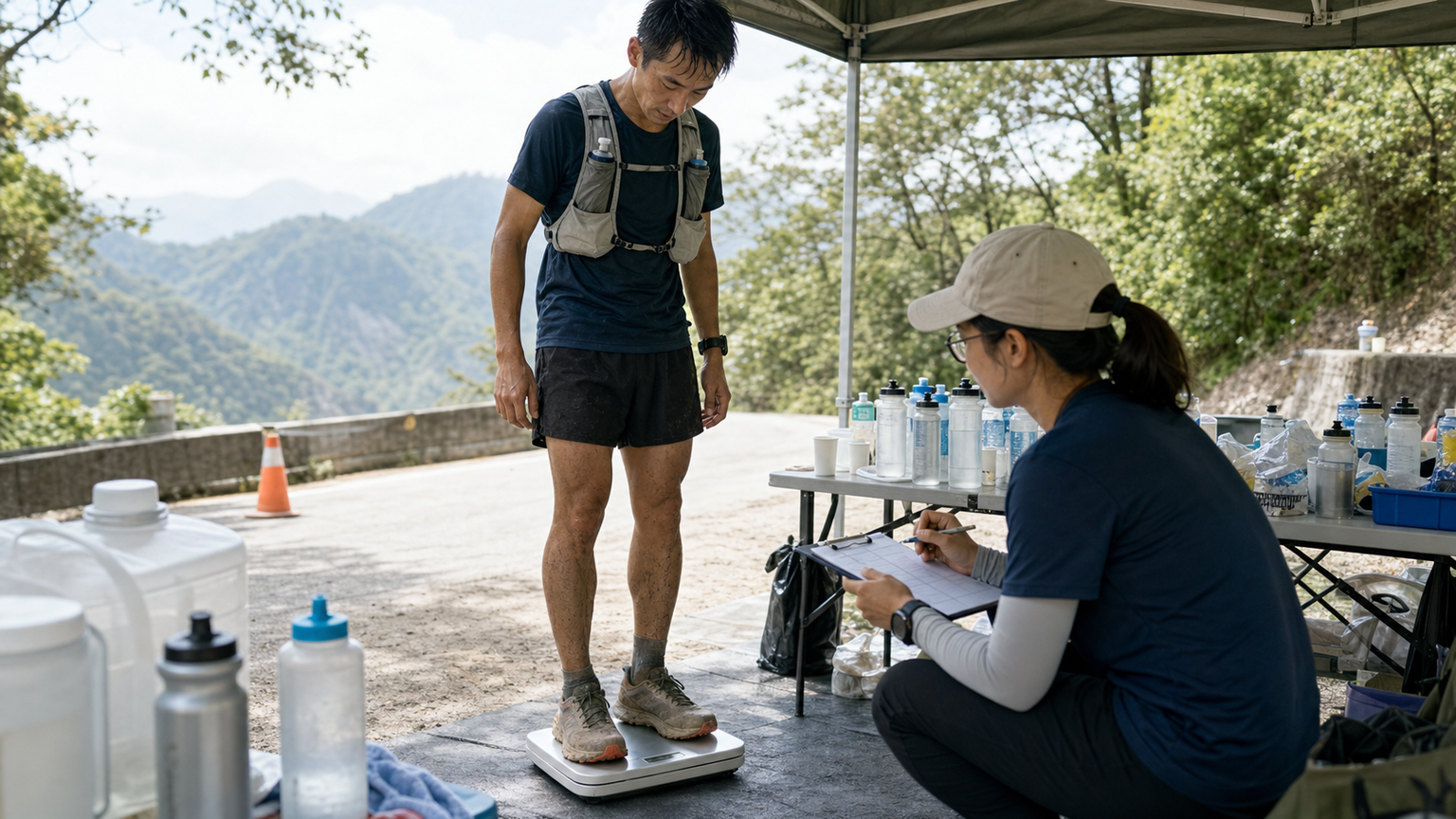
Ultramarathon Weight Monitoring: Body Weight Changes and Hydration Assessment at Each Aid Station
Introduction
At the medical stations of ultramarathon events, weighing runners is a seemingly simple yet critically important monitoring procedure. Most runners assume that “losing weight after running is normal,” but in the context of ultramarathons, both the magnitude and direction of weight change are key pieces of information. Excessive weight loss indicates dehydration, but weighing more than at the start could signal a more dangerous condition—overhydration.
This article will teach you how to interpret weight data during an ultramarathon and adjust your fueling strategy based on those changes.
1. The Scientific Relationship Between Body Weight and Hydration Status
Short-term, significant fluctuations in body weight (within hours) primarily reflect water status, not changes in fat or muscle mass. Therefore, weight monitoring during a race serves as an effective proxy indicator of hydration status.
Body Weight Change and Corresponding Dehydration Levels
| Weight Loss (% of body weight) | Dehydration Level | Impact on Athletic Performance |
|---|---|---|
| <1% | Mild | Almost no impact |
| 1–2% | Mild | Endurance begins to decline by 5–8% |
| 2–3% | Moderate | Noticeable fatigue, slower reaction times |
| 3–5% | Severe | Increased risk of heat exhaustion |
| >5% | Critical | Requires medical intervention |
Important Exception: A weight loss of 1–2% is considered normal and safe in ultramarathons. Overly pursuing zero weight change actually increases the risk of hyponatremia.
2. Weighing More Than at the Start: A Dangerous Signal
What ultramarathon medical stations fear most is not weight loss, but weighing more than at the start. This indicates the runner has consumed more fluid than they have excreted, diluting blood sodium levels, which can develop into Exercise-Associated Hyponatremia (EAH).
Main Risk Groups for EAH
- Runners with low sweat rates (smaller build, cool weather) but fixed drinking habits
- Runners who over-follow “drink ahead of thirst” advice rather than thirst-driven drinking
- Runners who consume large volumes of low-sodium or electrolyte-free beverages
Monitoring Criteria
If body weight is more than 1% above the starting weight, immediately:
- Stop drinking until thirst returns
- Consume high-sodium foods (salt tablets, salty crackers)
- Notify medical station personnel
3. Practical Weight Monitoring During a Race
Establishing a Baseline Before the Start
Weigh yourself 5–10 minutes before the race start (after using the restroom), record this baseline value, and set your personal safe weight range:
- Upper Limit (overhydration warning): Baseline weight + 0.5kg
- Safe Zone: Baseline weight ± 1–1.5kg
- Lower Limit (moderate dehydration warning): Baseline weight − 2% (e.g., for a 65kg runner, the warning line is 63.7kg)
How to Monitor Weight During a Race
Medical stations at major ultramarathon events are typically equipped with scales. Proactively request a weigh-in, especially in the following situations:
- Feeling headache, nausea, or confusion
- No urination for more than 2 consecutive hours
- Urine color is dark yellow (possible dehydration) or colorless (possible overhydration)
- Noticeable swelling (edema in ankles, fingers)
Quick Urine Color Assessment (Supplementary Tool)
| Urine Color | Hydration Status Assessment | Recommended Action |
|---|---|---|
| Clear/Colorless | Overhydration | Stop drinking, replenish electrolytes |
| Pale Yellow | Well hydrated | Maintain current strategy |
| Dark Yellow | Mild dehydration | Increase fluid intake |
| Orange/Brown | Moderate to severe dehydration | Hydrate immediately, notify medical station |
4. Building a Personalized Hydration Plan
Test your sweat rate during training to establish a personalized hydration plan:
Step 1: Choose a training day with weather similar to race conditions and run for 2 hours
Step 2: Record body weight before and after training (after using the restroom, wearing the same clothing)
Step 3: Record the volume of fluid consumed during training
Step 4: Calculate sweat rate: (Weight difference + Fluid intake) ÷ Training hours
Repeat 3–5 times under different weather conditions to build your own “sweat rate database,” and set your race hydration targets accordingly.
5. Weight Considerations in Special Ultramarathon Scenarios
- Night Sections: Sweat rate decreases as body temperature drops, but habitual drinking patterns persist, making overhydration more likely
- High-Altitude Sections: Faster breathing increases fluid loss, but cold temperatures reduce thirst sensation, making it easy to underestimate needs
- Late Race Stages (80km+): A 1–2% weight loss is typically normal; there is no need to force weight maintenance
Conclusion
Weight monitoring is not about weighing yourself at every station—it is a tool for objective assessment when something feels off. Establish your hydration baseline during training, and combine the three indicators of thirst, urine color, and body weight during the race. You will then be able to make the most precise hydration decisions and safely complete your ultramarathon challenge.
Related Reading
- The Science of Fluid Replacement: How to Calculate Your Personal Sweat Rate and Hydration Needs
- Ultramarathon Fueling Strategies: Timing Management of Solid Food, Fluids, and Electrolytes
- Ultramarathon Fueling Strategy: Energy and Electrolyte Rhythm from 50K to 100K
- Ultramarathon Aid Station Strategy: Efficiency Comparison Between Mobile and Fixed Aid
#公路車 #Fitting 靠人工智慧APP 幫你調整單車
6 年前
西進武嶺 免費訓練分析服務 Intervals | 練不夠還是練過頭?你哪一種類型選手?AI模型告訴你! | 備戰神器 | 公路車 訓練 | CT Yeh
4 年前
靠單車減肥35公斤 心得分享與整理
7 年前
#公路車 #Vo2Max #最大攝氧量 測驗 體驗 | 心肺測試
6 年前
CT暗黑廚房) 車友必備 宇宙無敵鮮蚵湯 幫助訓練恢復 天然食補 好市多 超肥鮮蚵 破PR
7 年前
2016/4/20 - 中社路 夜騎 半年甩肉14KG 後測
10 年前
崇越盃武嶺冠軍高手 賽前JJSC 群峰會精華!對應大數據分析,會有落差嗎?/ feat. JJSC中部公路車約騎 /公路車 / CT Yeh
2 年前
單車胎壓觀察到的有趣現象,SRAM Quarq TyreWiz 2.0 無內胎胎壓計 / 裝了有哪些幫助? / Tubeless / 公路車 / CT Yeh
1 年前