Introduction
Cycling may seem like an activity that requires balance, but most riders have never seriously trained their balance abilities. For older cyclists, the cost of this oversight can be significant. Falls are the leading cause of cycling injuries among those over 65, and the most effective intervention for fall prevention is systematic training targeting the core muscles and proprioception.
Why Balance Declines with Age
Balance control is an integrated system involving three major inputs—vision, the vestibular system, and proprioception—along with the output of muscle reaction speed. With age:
- Proprioceptive decline: The density of sensory nerve endings in the soles of the feet decreases, slowing the transmission of ground information
- Reduced vestibular function: The number of hair cells in the inner ear decreases with age, diminishing dynamic balance adjustment capacity
- Slower reaction time: Nerve conduction velocity slows, increasing the time gap between “perceiving instability” and “muscle activation”
- Core muscle atrophy: Deep core muscles such as the transversus abdominis and multifidus are lost, reducing spinal stability
Balance Challenges in Cycling
| Cycling Scenario | Primary Balance Challenge | Relevant Muscles |
|---|---|---|
| Low-speed turning | Dynamic lateral stability | Gluteus medius, obliques |
| Starting/stopping | Single-leg support with foot down | Calves, ankle proprioception |
| Rough terrain | Rapid postural corrections | Deep paraspinal muscles |
| Climbing out of the saddle | Trunk rotational control | Transversus abdominis, multifidus |
| Crosswind disturbance | Lateral stability | Lateral core (QL, obliques) |
Core Training Program (15 Minutes Per Session)
Exercise 1: Dead Bug
Lie on your back with arms pointing vertically toward the ceiling and both legs raised with knees bent at 90 degrees. On the exhale, slowly extend your right arm overhead while straightening your left leg; inhale as you return, then switch sides. 10 reps per side × 2 sets.
Training focus: Diagonal neuromuscular coordination, directly corresponding to the pedaling pattern in cycling.
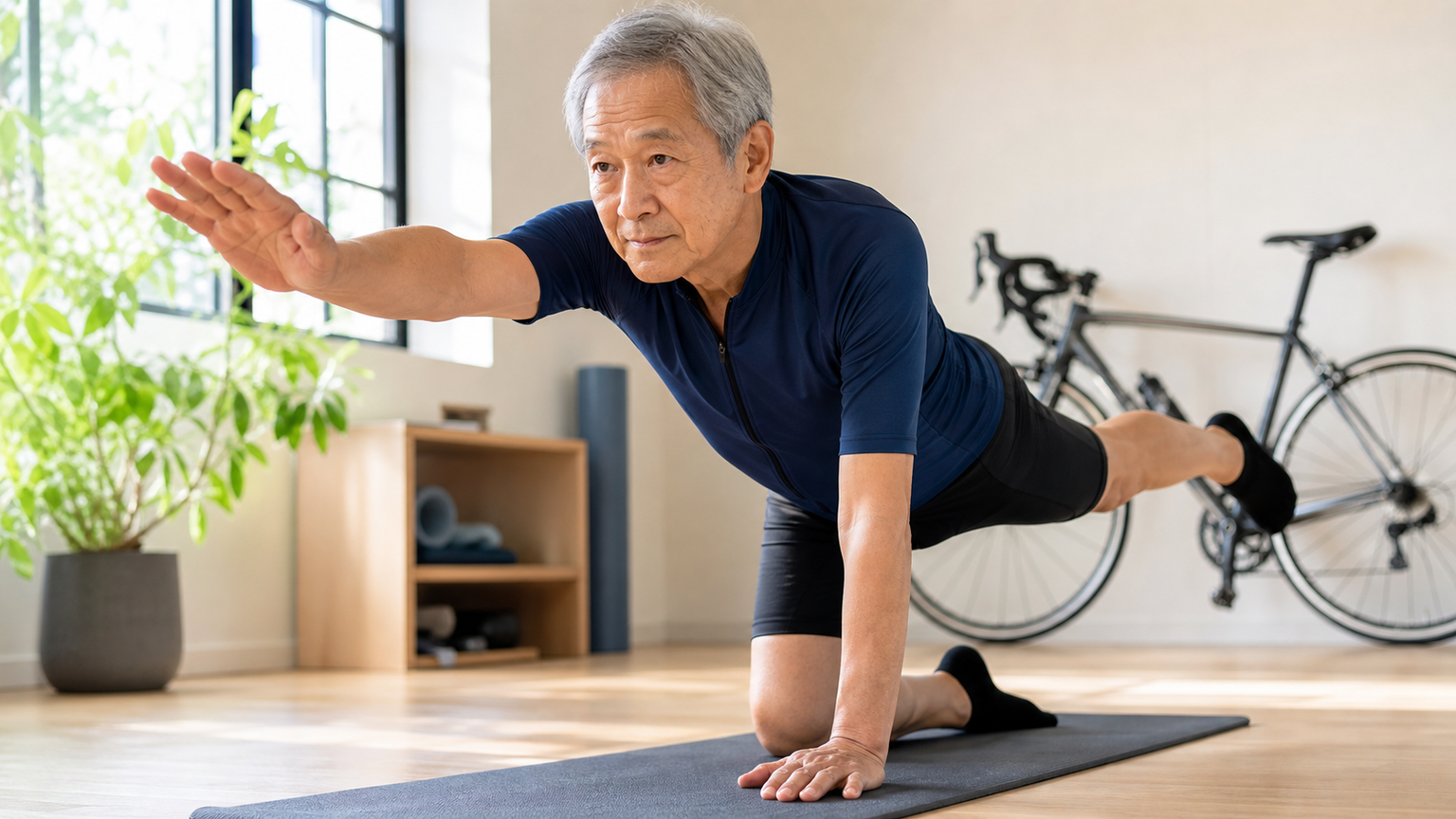
Exercise 2: Bird Dog
Start on all fours. On the exhale, slowly raise your right arm and left leg to horizontal, hold for 3 seconds, then lower on the inhale. 10 reps per side × 2 sets.
Training focus: Maintaining a neutral spine position and balance integration.
Exercise 3: Advanced Side Plank
After holding a basic side plank (forearm supported) for 20 to 30 seconds, try adding small forward-and-backward swings of the top leg to increase the dynamic challenge. 2 sets per side.
Exercise 4: Progressive Single-Leg Stance
Work through the following challenges from bottom to top:
- Basic: Single-leg stance for 30 seconds (eyes open, hands on hips)
- Level 1: Single-leg stance with eyes closed for 20 seconds
- Level 2: Single-leg stance with eyes open while turning the head left and right (simulating looking back while riding)
- Level 3: Single-leg stance on a balance pad
The Specifics of Proprioceptive Training
Proprioception is the ability of joints and muscles to sense body position and movement—a core element of balance control. The following methods can effectively enhance it:
- Barefoot training: Walk barefoot briefly each day in a safe indoor environment to stimulate the sensory nerves in the soles of the feet
- Balance board training: Perform gentle knee bends and extensions while standing on a wooden balance board
- Tai Chi or yoga: Research shows that 12 weeks of Tai Chi training can reduce fall risk by 25% in people over 65
Safety Adjustments to Cycling Equipment
Beyond physical training, equipment adjustments are also a key part of fall prevention:
- Frame size: Older riders should choose models with a low standover height for easier foot placement on the ground
- Saddle height: Slightly lower than traditional recommendations (so the whole foot can touch the ground rather than just the toes), sacrificing a little efficiency for greater confidence
- Handlebar design: Butterfly bars or flat bars are more suitable for older riders than drop bars, allowing a more upright riding position
- Protective gear: A helmet is essential; elbow guards are also recommended (especially for those over 60)
Practical Advice
- Do 2 to 3 minutes of single-leg stance practice before every ride to activate the proprioceptive system
- When choosing routes, prioritize bike lanes that are wide enough and have smooth pavement
- Avoid riding after dark, in the rain, or on wet roads—the risk multiplies for older riders
- Ride with companions; beyond safety, having someone to help when difficulties arise is invaluable
Conclusion
Preventing falls is the most important health priority for older cyclists. Core and balance training does not require a large time commitment—just 15 minutes per session, 2 to 3 times per week, can yield significant results. Treat those 15 minutes as the “insurance premium” for every ride, so you can enjoy a longer and safer cycling career.
Related Reading
- How Cycling Improves Balance in Older Adults: Applying Fall-Prevention Training to the Bike
- Balance and Fall Prevention for Athletes: A Practical Guide from Single-Leg Stance Assessment to Senior Fall Prevention
- Strength Training for Older Cyclists: A Twice-Weekly Program to Prevent Sarcopenia
- Bike Fit for Senior Riders: Upper-Body Adjustment Strategies After Flexibility Declines
[教學] Premiere 影片 手震 修正 教學 防抖 單眼 影像 GoPro 穩定 Video Stabilization
8 年前
一日北高/長距離團騎 常見問題補充篇 / 組團或跟團的眉角 / 壯車友容易被瘦車友慢性拉爆 / 原來屁股痛可能是這個原因...? / 風場配速法 / 公路車 / CT Yeh
2 年前
一日北高常見問題大集合 | 攻略 | 路線 | 訓練 | 補給 | 自行車 單車 | 一日雙城 | 雙塔 | TWB北高360 | 屁股痛
6 年前
摔車後補裝備: 好市多新款單車安全帽& Specialized Romin 北高整路屁股都不痛的坐墊 | 一千元居然有MIPS | CT Yeh | 公路車
4 年前
#公路車 #Fitting 靠人工智慧APP 幫你調整單車
6 年前
Insta 360 One 超級防手震技術實測
7 年前
ThinkRider 智騎 XXPRO 訓練台,高階機種功能 只要 1/3價格!? 實測功率對比、噪音實測 / 公路車 / CT Yeh
1 年前
單車 一日北高 ( 雙城 ) 肥宅雙人瘋狂行 紀錄片 REACTO
10 年前