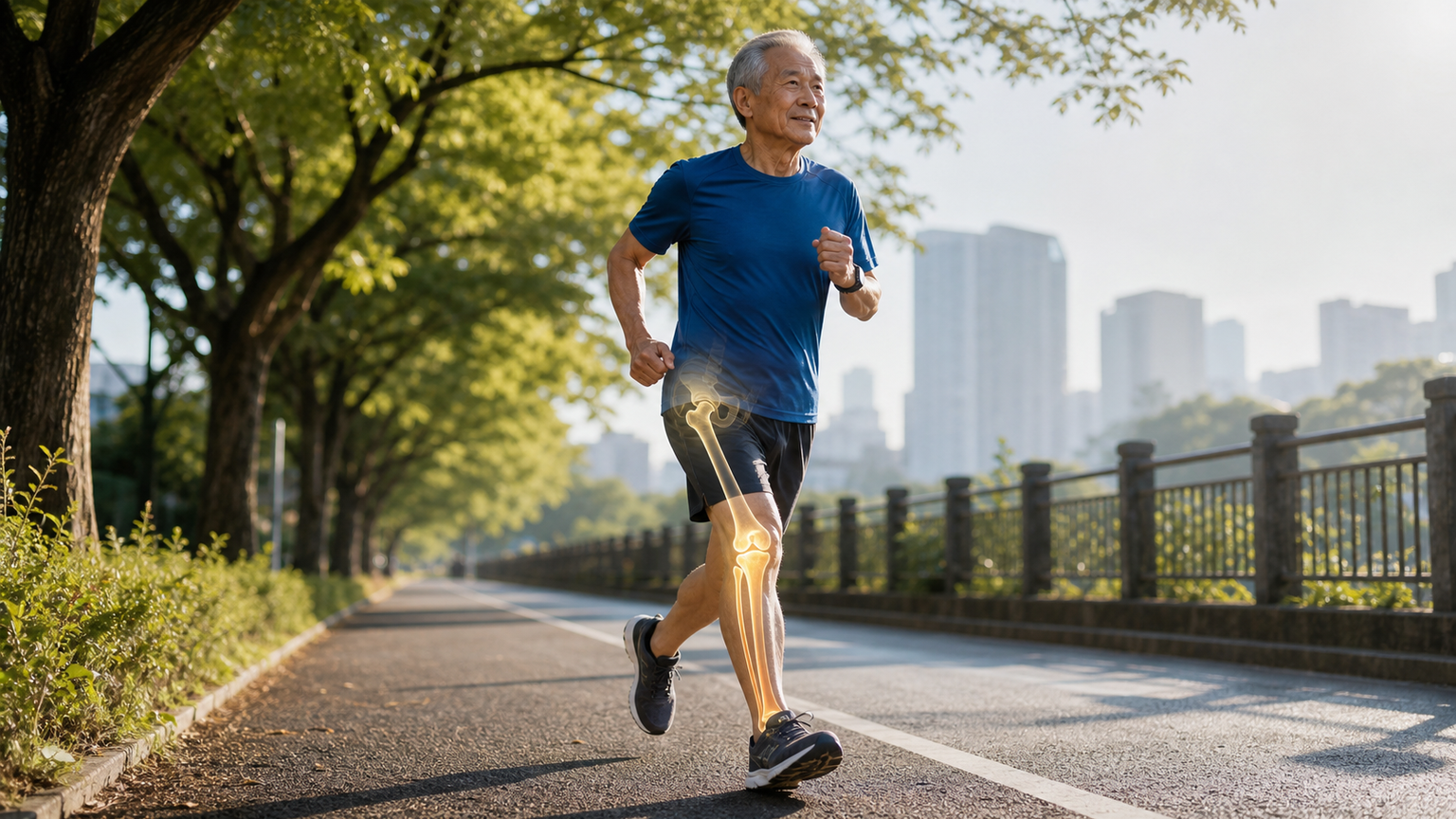
Introduction
The prevalence of osteoporosis among women over 65 in Taiwan exceeds 30%, while men stand at around 10 to 15%. Osteoporosis is not just a numbers issue—the mortality rate within one year after a hip fracture is as high as 20 to 25%, making bone protection one of the most urgent priorities in elderly health. And running—an activity many worry “will hurt the knees”—is actually one of the most effective bone-protecting exercises available today.
Why Running Benefits Bone Health
Bones are living tissue. When stimulated by mechanical stress, they initiate the bone remodeling process:
- Piezoelectric Effect: Compression on bone generates a weak electrical current that stimulates osteoblast activity
- Impact Force Transmission: The ground reaction force upon landing while running (approximately 1.5 to 2.5 times body weight) is transmitted to the tibia, femur, and spine—precisely the appropriate dose to stimulate bone
- Muscle Pull: Strong muscle contractions create tension at bone attachment sites, which is also an important stimulus for osteoblasts
Comparison of Bone Density Benefits Across Exercises
| Exercise Type | Bone Density Benefit | Primary Areas Affected |
|---|---|---|
| Running | High | Tibia, femur, lumbar spine |
| Jump rope / Jumping | Very high | Whole body, especially the hips |
| Brisk walking | Moderate | Femoral neck, spine |
| Swimming | Very low (non-weight-bearing) | Almost no bone density benefit |
| Cycling | Low to moderate | Femoral neck (limited) |
| Weight training | High | Primarily the specific areas trained |
While cycling and swimming benefit the cardiovascular system and muscles, they cannot effectively stimulate bone growth—which is precisely why some cyclists who only ride tend to have lower bone density.
Bone-Protective Running Strategies for Older Runners
Key Principle: Enough Impact, But Not Too Much
Running that benefits bone requires a certain level of impact, but excessive impact or overly high training volume can lead to stress fractures. The sweet spot for older runners:
- Run 3 times per week, 30 to 45 minutes per session at moderate intensity
- Maintain a cadence of 170 to 180 steps per minute (helps control peak impact forces)
- Land on the midfoot or forefoot rather than with a heavy heel strike
The Synergistic Effect of Adding Jump Training
Research shows that even in the 50 to 70 age group, 10 to 20 jumping movements (such as jump rope or small vertical jumps) can effectively stimulate hip bone density. It is recommended to add these before or after running:
- Vertical jumps: Slightly squat with both feet, then jump upward; land with knees slightly bent to absorb impact—10 reps × 2 sets
- Lateral hops: Alternate left and right to simulate lateral impact—10 reps × 2 sets
- Step-ups: Step up and down a platform with one leg, benefiting both bone and balance—15 reps per side × 2 sets
Calcium and Vitamin D: Essential Partners for Bone Training
Exercise stimulation is the signal for bone remodeling, but the building materials still need to come from diet and sunlight:
- Calcium: The recommended daily intake for those over 60 in Taiwan is 1,200 mg, which can be obtained from dairy products (one glass of milk contains about 300 mg), tofu, and black sesame seeds
- Vitamin D: A daily intake of 800 to 1,000 IU is recommended; the best source is sunlight (exposing the face and arms for 10 to 20 minutes daily), with dietary sources including salmon, egg yolks, and fortified foods
- Bone density testing: Women over 65 and men over 70 in Taiwan are advised to undergo a DEXA bone density scan every 2 years
Special Considerations for Runners with Osteoporosis
If osteoporosis has already been diagnosed (T-score ≤ -2.5), running can still be performed, but the following should be noted:
- Avoid running on uneven surfaces or in low-light conditions at night
- If osteoporosis is severe (T-score < -3.0), consult your primary physician first to assess the safety of running
- Start with brisk walking, gradually progress to fast walking interspersed with jogging, then transition to continuous jogging
- Downhill sprinting is not recommended, as the landing impact is too great
Practical Recommendations
- Spend 3 to 5 minutes in the sun before your morning run each day, combining vitamin D synthesis with circadian rhythm adjustment
- After running, consume a calcium-rich snack (such as a small cup of yogurt)
- Track bone density once a year to understand the actual impact of running on your bones
- Those with osteoporosis who wish to continue running can discuss a “bone-protective exercise prescription” with a sports medicine physician
Conclusion
Osteoporosis is not a contraindication to running—it is all the more reason to run. Every correct landing is a deposit into your bone bank. As long as older runners manage appropriate training volume, use proper technique, and consume adequate calcium and vitamin D, running can be the most economical and effective investment in bone protection.
Related Reading
- Bone Density in Female Runners: The Long-Term Benefits of Regular Road Running for Bone Health
- Bone Density Benefits of Road Running: Impact Forces and Bone Strengthening
- Skeletal Adaptation in Road Running: How Impact Forces Strengthen Bone Density and Reduce Fracture Risk
- The Key Value of Strength Training for Bone Density and Aging Athletes
白沙屯媽祖進香在家走!UREVO 坡度自調走步機 / 可連接訓練遊戲APP MyWhoosh / 邊看直播邊走起來 / CT Yeh
11 個月前
實景訓練台) 彰化經典百K 高強度喵團 90分鐘 跟著一起練功 2019 Indoor workout Changhua Classic 100 Taiwan
7 年前
2018 田中馬拉松 全程健跑 VR 360 環景錄影 體驗現場狂野加油氣氛! Insta 360
7 年前
Never Stop 西進武嶺 前後雙機 完整全程錄影 訓練台 實境
8 年前
CT暗黑廚房) 車友必備 宇宙無敵鮮蚵湯 幫助訓練恢復 天然食補 好市多 超肥鮮蚵 破PR
7 年前
台北大雁西飛 約騎挑戰 feat. Doris | 公路車 | CT Yeh
3 年前
摔車後補裝備: 好市多新款單車安全帽& Specialized Romin 北高整路屁股都不痛的坐墊 | 一千元居然有MIPS | CT Yeh | 公路車
4 年前
爬陡坡被爆胎的車友跑步超車 #cycling #里佳部落
9 個月前