Sleep for Young Athletes: The Necessity of 9–10 Hours of Sleep for Growth and Training Recovery
Introduction
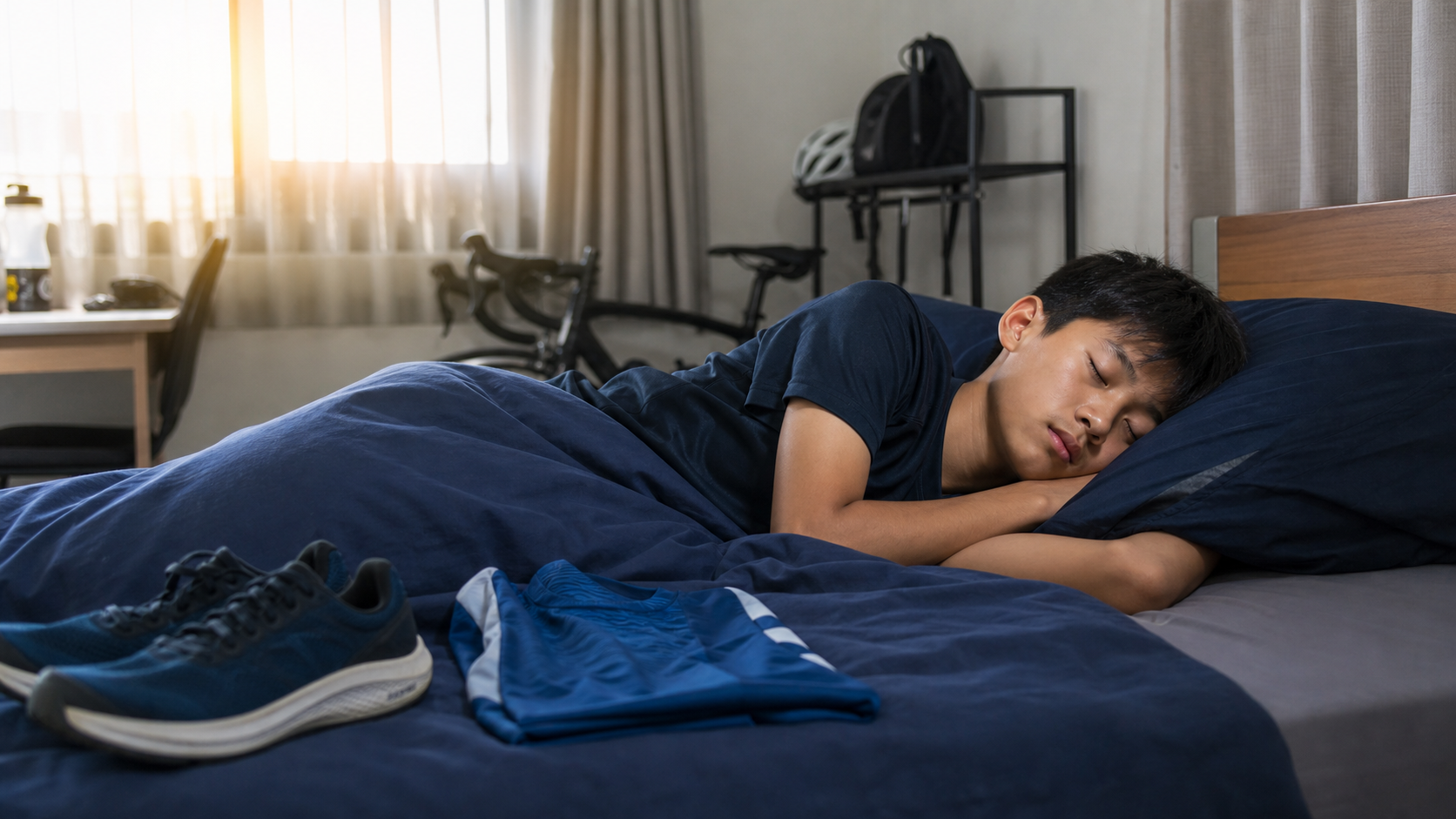
If there were an intervention that could simultaneously enhance athletic performance, improve learning efficiency, boost immunity, promote bone and muscle growth, and cost absolutely nothing—most parents and coaches would adopt it without hesitation. This “magical intervention” is adequate sleep.
However, among young athletes in Taiwan, sleep is often the first resource to be sacrificed: 5 a.m. swim training, late nights after cram school, long trips for weekend competitions… all of these erode the most important recovery tool for adolescents. This article, grounded in scientific research, explains why 9–10 hours of sleep is not a luxury but a necessity for young athletes.
Why Do Adolescents Need More Sleep Than Adults?
The recommended sleep duration for adults is 7–9 hours, while for adolescents (ages 13–18) it is 8–10 hours. Athletes should add another 1–2 hours (i.e., 9–10 hours). The reason is that adolescents’ sleep needs include a “growth requirement” that adults do not have:
Growth Hormone Secretion During Sleep
Approximately 70–80% of human growth hormone (HGH) is secreted during deep sleep (NREM Stage 3). The functions of growth hormone include:
- Promoting longitudinal bone growth
- Stimulating muscle protein synthesis (muscle repair after training)
- Regulating body fat metabolism
- Enhancing immune system function
In short, children grow taller, grow stronger, and recover from training-induced fatigue during sleep—all of which require sufficient deep sleep time as a prerequisite.
The Impact of Sleep Deprivation on Young Athletes
| Area of Impact | Consequences of Sleep Deprivation | Benefits of Adequate Sleep |
|---|---|---|
| Reaction time | Increased by 15–20% | Near-optimal performance |
| Sprint speed | Decreased by 5–10% | Optimal output |
| Post-training recovery | Extended by 24–48 hours | Normal recovery window |
| Risk of sports injury | 1.7 times higher (<8 hours per night) | Baseline risk |
| Learning and memory | Efficiency of transferring new learning to long-term memory drops by 30–40% | Optimal consolidation efficiency |
| Emotional regulation | Increased irritability and anxiety | Stable emotional baseline |
| Immune function | 4.5 times higher risk of colds (sleep <6 hours) | Maintained immunity |
A study of American adolescent athletes (Milewski et al., 2014) found that adolescent athletes who slept less than 8 hours per night were 1.7 times more likely to sustain a sports injury than those who slept adequately. This figure is more significant than the protective effect of any protective equipment.
The Four Stages of Sleep and Their Relationship to Athletes
A complete sleep cycle lasts approximately 90 minutes and includes:
- NREM Stage 1 (sleep onset transition): approximately 5–10 minutes
- NREM Stage 2 (light sleep): accounts for 50–60% of the night; body temperature drops, heart rate slows
- NREM Stage 3 (deep sleep): the primary period of growth hormone secretion, accounting for 15–20% of the night
- REM Sleep (rapid eye movement): the period of memory consolidation and neural integration of motor skills
A finding particularly important for young athletes: during REM sleep, the brain reprocesses motor skills learned during the day (such as swimming strokes, cycling cadence, running gait), allowing “muscle memory” to truly form. Depriving REM sleep directly impairs the internalization efficiency of technical movements.
Why Adolescents Tend to “Not Get Enough Sleep”—The Challenge of Circadian Rhythms
Pubertal hormonal changes lead to a “circadian phase delay”: adolescents’ biological clocks tend toward falling asleep later (not feeling sleepy until 12–1 a.m.) and having difficulty waking in the morning. This is not laziness but a physiological change.
This means that requiring adolescents to wake before 6 a.m. for training is equivalent to forcing their biological clocks into constant conflict with an external schedule. The accumulated sleep debt has profound effects on both health and performance.
How to Improve Sleep Quality in Young Athletes
Environmental Optimization
- Sleep in a dark room: use blackout curtains to make the sleep environment nearly pitch black
- Cool temperature: the ideal bedroom temperature for sleep is 18–20°C; excessive heat impairs deep sleep
- Electronic device management: stop using phones and tablets 1 hour before bed (blue light suppresses melatonin secretion)
- Consistent sleep schedule: “catching up” on sleep for more than 1 hour on weekends disrupts the biological clock, making Monday mornings even harder
Supporting Adjustments to Training Arrangements
- Strategic choice of early training sessions: if there is a choice, prioritize later training slots (after 7 a.m.)
- Post-training relaxation routine: after high-intensity training, use 10–15 minutes of stretching and static relaxation to lower neural activation levels and aid falling asleep
- Avoid high-intensity training before bed: high-intensity training after 9 p.m. raises cortisol and delays sleep onset
Using Naps Correctly
A 20–30 minute nap can effectively replenish sleep energy without affecting nighttime sleep. Naps exceeding 45 minutes may enter deep sleep, leaving you feeling even groggier upon waking.
The Role of Parents and Coaches
Ensuring adequate sleep for young athletes requires systematic support:
- Coaches: evaluate training schedule arrangements and avoid long-term demands for athletes to train during time slots that prevent sufficient sleep
- Parents: establish a “sleep culture” at home so children do not feel guilty about sleeping
- Schools: understand the science of adolescent biological clocks and provide flexibility in arrangements such as morning self-study for students with training needs
Practical Recommendations
- Calculate sleep time: record your daily bedtime and wake time for this week, calculate the average sleep duration, and identify the sleep deficit
- Establish a fixed pre-sleep routine: stretching → reading (not on electronic screens) → sleep, repeated every night to help form sleep-onset cues
- Discuss the training schedule with your coach: if early training exceeds 3 times per week, proactively discuss with your coach whether adjustments are possible
- Include sleep in the training plan: write sleep time into your training log and treat it with the same importance as training volume
Conclusion
Sleep is the cheapest, most effective, and most often overlooked recovery tool for young athletes. 9–10 hours of sleep is not coddling—it is the fundamental condition for maximizing the return on training investment. When we invest substantial time and money in training equipment and programs for adolescents, ensuring they get adequate sleep is what truly allows those investments to pay off. Letting children sleep enough is the best sports science practice.
Related Reading
- Sleep Needs for Young Runners: The Importance of Adequate Sleep for Athletic Performance and Growth
- Athlete Sleep Optimization Guide: Using Scientific Methods to Double Recovery Efficiency
- Sleep and Athletic Performance: How Much Performance Drops for Every Hour Lost?
- Sleep Is the Strongest Legal Performance Enhancer: A Practical Guide to Sleep Optimization for Athletes
一日北高前的高裝檢 | 北高 360 | 挑戰11小時的裝備 | 一日雙塔 | 補給
6 年前
西進武嶺 免費訓練分析服務 Intervals | 練不夠還是練過頭?你哪一種類型選手?AI模型告訴你! | 備戰神器 | 公路車 訓練 | CT Yeh
4 年前
CT暗黑廚房) 車友必備 宇宙無敵鮮蚵湯 幫助訓練恢復 天然食補 好市多 超肥鮮蚵 破PR
7 年前
滑雪新手們慘摔學習全紀錄(請開字幕),滑雪好好玩 | Snowboard + Ski | 岩原 スキー場 | 滑雪APP使用 | GoPro Max
6 年前
一日北高/長距離團騎 常見問題補充篇 / 組團或跟團的眉角 / 壯車友容易被瘦車友慢性拉爆 / 原來屁股痛可能是這個原因...? / 風場配速法 / 公路車 / CT Yeh
2 年前
一日北高 11小時 賽後心得分享篇 | TWB北高360 | 一日雙城 | 單車 | 公路車
6 年前
單車 一日北高 ( 雙城 ) 肥宅雙人瘋狂行 紀錄片 REACTO
10 年前
一日北高常見問題大集合 | 攻略 | 路線 | 訓練 | 補給 | 自行車 單車 | 一日雙城 | 雙塔 | TWB北高360 | 屁股痛
6 年前