Designing a Weekly Training Plan for Power Training: A Safe Combination of 2 High-Intensity Sessions per Week + Base Volume
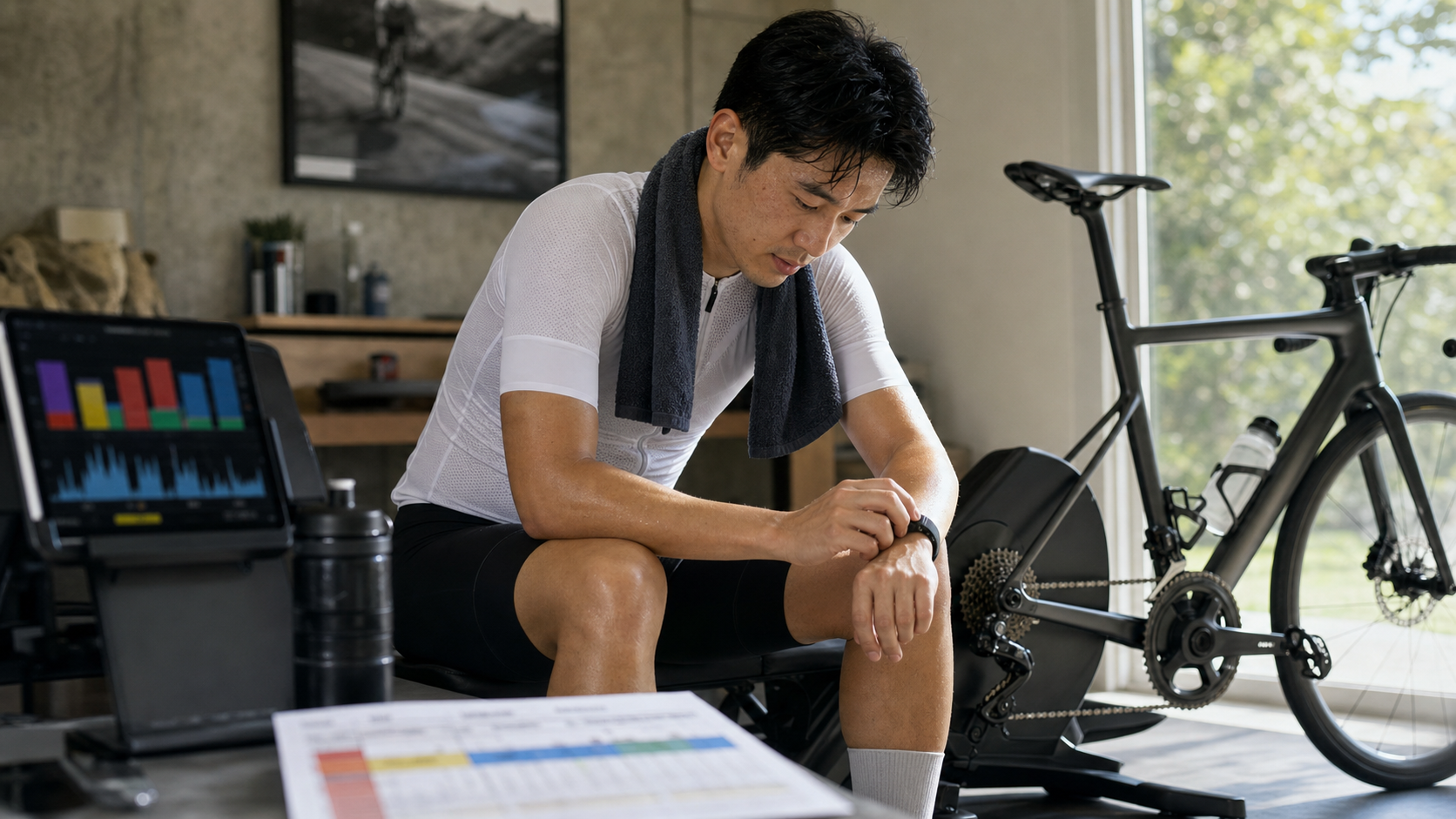
Introduction
“More training means more progress” is the intuition of many amateur cyclists, but the answer from sports science is: only with adequate recovery after appropriate stress will the supercompensation effect occur, bringing real progress. For most amateur cyclists training 6–12 hours per week, more than 2 high-intensity sessions per week is often not “investing more” but “overdrawing the account.”
This article provides a power-based weekly training schedule design framework to help you find the optimal balance between progress and health.
Core Principle: The 80/20 Training Rule
After studying athletes’ training data, sports scientist Stephen Seiler found that elite endurance athletes’ training intensity distribution follows an 80/20 pattern: about 80% of training time is at low intensity (Z1–Z2), and 20% at high intensity (Z4–Z5 and above).
This ratio applies not only to professional athletes—amateur cyclists adopting the same structure can also achieve optimal adaptation results.
Intensity Distribution by Weekly Training Hours
| Weekly Training Hours | Z1–Z2 (Low Intensity) | Z3 SST | Z4–Z5 (High Intensity) |
|---|---|---|---|
| 6 hours | 4.5 hours | 0.5 hours | 1 hour |
| 8 hours | 6 hours | 1 hour | 1 hour |
| 10 hours | 7.5 hours | 1.5 hours | 1 hour |
| 12 hours | 9 hours | 2 hours | 1 hour |
Note: The high-intensity time cap is approximately 1 hour/week and does not increase proportionally with total hours, because the recovery demands of high intensity are fixed.
7-Day Weekly Schedule Design Templates
Weekly Schedule A (8–10 Training Hours/Week, Build Phase)
| Day | Workout Content | Intensity | Duration | Estimated TSS |
|---|---|---|---|---|
| Monday | Active recovery ride | Z1 | 45 min | ~20 |
| Tuesday | High intensity: Over-Under | Z4 | 75 min | ~80 |
| Wednesday | Base aerobic | Z2 | 90 min | ~60 |
| Thursday | High intensity: VO2max intervals | Z5 | 60 min | ~75 |
| Friday | Complete rest or very easy | Z1 | 30 min | ~10 |
| Saturday | Long aerobic ride | Z2 | 3 hours | ~130 |
| Sunday | Sweet Spot or easy ride | Z2–Z3 | 90 min | ~70 |
| Total | ~9.5 hours | ~445 |
Weekly Schedule B (6 Training Hours/Week, Maintenance Phase)
| Day | Workout Content | Intensity | Duration | Estimated TSS |
|---|---|---|---|---|
| Monday | Complete rest | — | — | 0 |
| Tuesday | High intensity: Threshold workout | Z4 | 60 min | ~65 |
| Wednesday | Base aerobic | Z2 | 75 min | ~50 |
| Thursday | High intensity: SST (increased difficulty version) | Z3–Z4 | 60 min | ~65 |
| Friday | Complete rest | — | — | 0 |
| Saturday | Long aerobic ride | Z2 | 2 hours | ~80 |
| Sunday | Easy ride | Z1–Z2 | 60 min | ~35 |
| Total | ~6 hours | ~295 |
The 4-Week Periodization Structure
What amateur cyclists most often overlook is the arrangement of “deload weeks.” A 3+1 structure is recommended:
- Week 1: Normal training volume
- Week 2: Training volume +5–10% (progressive overload)
- Week 3: Training volume +5–10% (continue overload)
- Week 4: Deload week, training volume reduced by 30–40%, intensity maintained
The core concept of the deload week: it is not a “rest week” but a “supercompensation week.” Reducing volume allows the body to recover from the stimulus of the previous three weeks. FTP testing is typically done after the deload week, and progress is often visible.
Principles for Arranging High-Intensity Workouts
Principle 1: At least 48 hours between high-intensity sessions
The Tuesday and Thursday arrangement provides a full Wednesday buffer between the two high-intensity sessions. Friday is easy or rest, preparing for Saturday’s long ride.
Principle 2: Put the long ride on Saturday
Taiwanese cyclists typically have more time on weekends. Scheduling the long aerobic ride (2–4 hours) on Saturday is the best arrangement for building the aerobic base.
Principle 3: No second-highest intensity the day after a high-intensity session
After Tuesday’s high-intensity session, Wednesday should be Z2 or lighter—no second SST or higher intensity session.
Common Mistakes
Mistake 1: A little “stimulus” every day
Believing that every day needs some discomfort to count as training. The result is moderate intensity every day—not low enough for recovery, not high enough for stimulus, falling into the “gray zone.”
Mistake 2: Long high-intensity rides on both weekend days
Climbing on Saturday, then climbing again on Sunday—fatigue cannot recover, the quality of Monday and Tuesday’s workouts declines, creating a vicious cycle.
Practical Recommendations
- Use TSS to track weekly training load: The ATL/CTL charts in TrainingPeaks or Intervals.icu are great tools for monitoring fatigue
- Taiwan summer adjustments: Under high heat and humidity, the TSS of the same workout may be 10–15% higher; appropriately reduce intensity or shorten duration
- Race weeks: Reduce volume the week before a race (keep only 2–3 easy rides), actively recover the week after, and only then resume normal training
Conclusion
A good weekly schedule is the art of stress and recovery. Two high-intensity sessions per week, sufficient low-intensity base volume, and regular deload weeks—the combination of these three elements allows amateur cyclists to achieve maximum FTP improvement efficiency within limited training time. Schedule design doesn’t need to be complicated, but it needs to be systematic and consistent.
Related Reading
- Power Training Periodization: Scientific Schedule Design for Base, Build, and Race Phases
- Seasonal Arrangement of Speed Training: An 8-Week Pre-Race Speed Build Phase Schedule
- Multi-Power-Zone Mixed Workouts: The Design Logic of Combining Multiple Intensities in One Session
- Cycling Special Topic | Rest Week Design: Preventing Overtraining (C035)
西進武嶺 免費訓練分析服務 Intervals | 練不夠還是練過頭?你哪一種類型選手?AI模型告訴你! | 備戰神器 | 公路車 訓練 | CT Yeh
4 年前
Fitting訓練兩用功率車 ! Thinkrider ST900 完整實測!/ 坡度升降 / 鄰居測試/ smart bike/公路車/ CT Yeh
2 年前
#公路車 #西進武嶺 配速配瓦實驗 坡度分析 四小時內攻略 建大盃 NeverStop #西進武嶺攻略
6 年前
ThinkRider 智騎 XXPRO 訓練台,高階機種功能 只要 1/3價格!? 實測功率對比、噪音實測 / 公路車 / CT Yeh
1 年前
一日北高前的高裝檢 | 北高 360 | 挑戰11小時的裝備 | 一日雙塔 | 補給
6 年前
一個測試有沒有認真練車的方法😂 #公路車
10 個月前
西進武嶺 8000名單車友數據分析 PART1 | 從新手到高手數量/瓦數/推力比/FTP推力比/功率計使用率 大解析 | 公路車 | CTYeh
5 年前
#公路車 #Vo2Max #最大攝氧量 測驗 體驗 | 心肺測試
6 年前