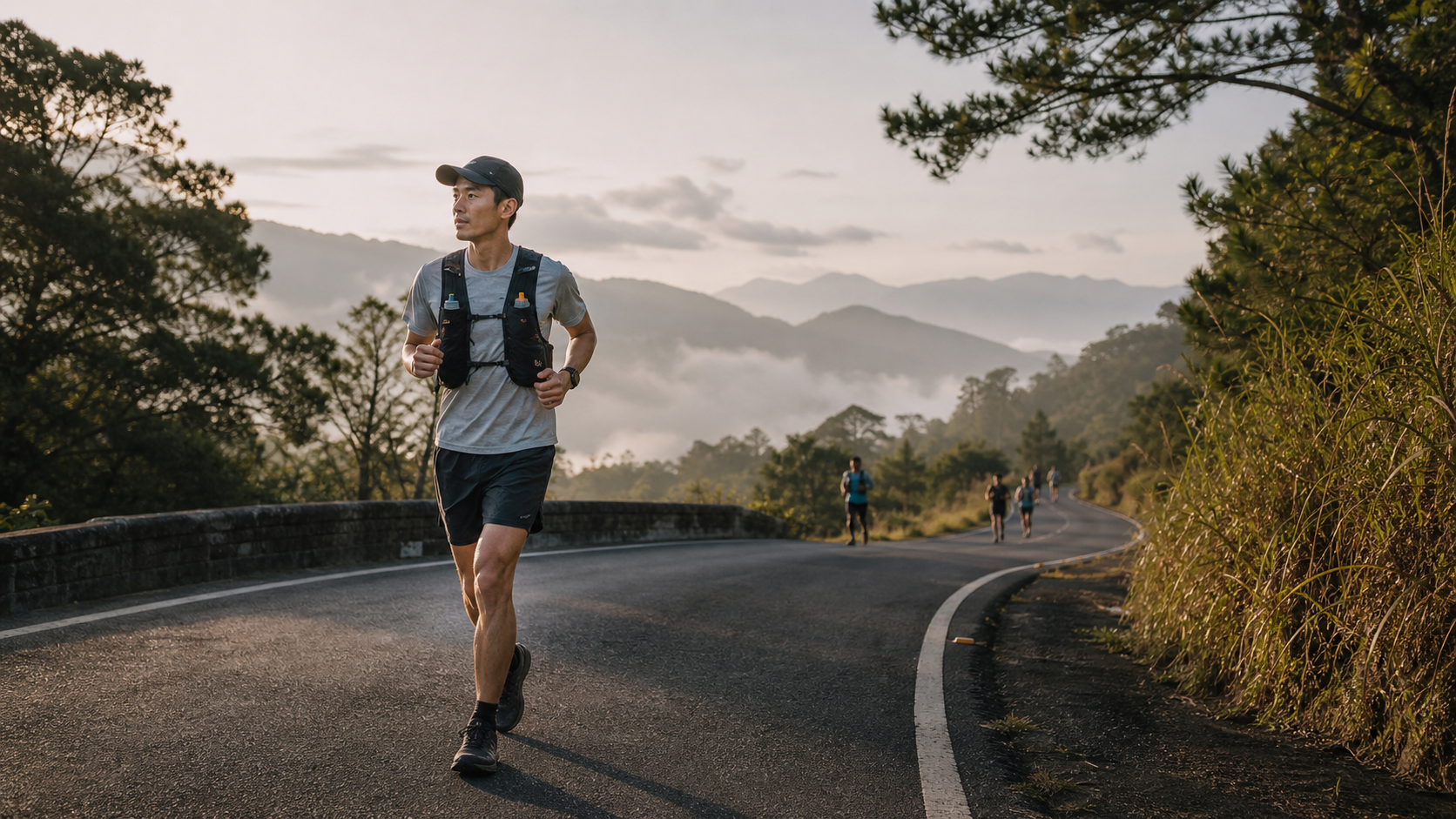
The Difference in Pacing Mindset Between Ultramarathons and Marathons
Many runners moving up from marathons to ultramarathons make the same mistake in their first 100km race: applying marathon pacing logic to an ultramarathon. The result is a complete collapse at 60–70km, with the final 30–40km turning into a stop-and-go purgatory.
The pacing philosophy of ultramarathons (especially anything over 100km) is fundamentally different:
- Marathon: A test of aerobic limits, targeting the “fastest sustainable pace”
- Ultramarathon: A long game of energy management, with “still having something left after finishing” as the top priority
The Physiological Basis for Being Conservative in the First 40km
1. Long-Term Glycogen Management
A 100km race typically lasts 9–18 hours. The body’s glycogen stores can support only about 90–120 minutes of high-intensity exercise. If the early pace is too fast:
- Glycogen runs out by 50–60km
- The maximum power output from pure fat metabolism is only 60–70% of that from glycogen metabolism
- The pace for the final 40–50km will be more than double the early pace (shifting from running to walking)
2. The Cumulative Effect of Muscle Damage
Muscle damage in ultramarathons does not accumulate linearly—it grows exponentially:
| Distance | Muscle Damage Index (relative value) |
|---|---|
| 20km | 10 |
| 40km | 25 |
| 60km | 50 |
| 80km | 90 |
| 100km | 150+ |
The faster you run early on, the faster muscle damage accumulates, and the earlier and more severe the “can’t run anymore” phase becomes.
3. Protecting Gastrointestinal Function
One of the most common causes of DNF (Did Not Finish) in ultramarathons is gastrointestinal issues. High-intensity running will:
- Reduce intestinal blood flow (blood is diverted to the muscles)
- Increase gastrointestinal motility, leading to nausea and vomiting
- Impair the absorption efficiency of nutrition
With a conservative early pace, the gastrointestinal tract receives adequate blood supply, maintaining digestion and absorption functions and ensuring the effectiveness of later fueling.
The Pacing Framework for 100km
| Segment | Suggested Intensity | Notes |
|---|---|---|
| 0–40km | Feels “very easy” RPE 4–5 | Being conservative to the point where it feels uncomfortably slow is correct |
| 40–70km | Feels “easy, slightly effortful” RPE 5–6 | Start reading your body and assessing whether you have a buffer |
| 70–90km | Feels “effortful but controlled” RPE 6–7 | If the early segment was conservative, you can push here |
| 90–100km | Push as hard as possible RPE 7–8 | Release all reserved energy in the final 10km |
The “Walking Strategy” in Ultramarathon Pacing
In ultramarathons, planned walking is not failure—it is a necessary energy-saving strategy:
- Walk on climbs: When the gradient exceeds 8–10%, the energy cost of brisk walking is nearly identical to slow running, with less muscle damage
- Walk through aid stations: Gives the body a brief recovery and ensures complete fueling intake
- Walking pace target: A brisk walk at about 7–8 min/km—don’t slow down to a stroll
There is a famous saying in the ultramarathon world: “A marathoner walking for 10 minutes is embarrassing; an ultrarunner who doesn’t walk is the fool.”
The Importance of a Fueling Strategy
Fueling in ultramarathons is not just “drink water and grab a gel”—it is mobile dietary management:
- Consume 200–400 kcal per hour (more than a marathon, because the duration is longer)
- Solid foods (bananas, sandwiches, rice balls) become more appealing than gels in the later stages
- Sodium intake of 500–1500mg per hour (electrolyte replacement is far more important than in a marathon)
- Avoid over-relying on caffeine (save it for the second half)
Practical Advice
- Make “walking part of the course” Plan A, not an exception: When designing your pacing, assume you will walk certain sections
- Keep your heart rate below 70% of HRmax for the first 40km: On flat terrain this will feel like a stroll, and on climbs it will feel even easier
- Study finish data from runners faster than you: The time lost after an ultramarathon pacing collapse is often 3–5 times greater than the time lost from running conservatively
- Establish an aid station ritual: Do the same routine at every aid station (drink, change insoles, take in food) to build a rhythm
Conclusion
A 100km ultramarathon is a practice in philosophy: accept your slowness now, and you will have your speed later. The “conservatism” of the first 40km is not timidity—it is a deep respect for the body’s energy systems. Those ultrarunners who can still accelerate after 70–80km are invariably the ones who suppressed their impulses in the early stages. An ultramarathon teaches you not just physical endurance, but patience and long-term strategy—wisdom far more valuable than any finish certificate.
Related Reading
- Ultramarathon 50km First-Timer Finish Strategy: Conservative First 30km, Steady Last 20km
- Ultramarathon Fueling Strategy: Energy and Electrolyte Rhythm from 50K to 100K
- Energy Management in the Later Stages of an Ultramarathon: Prioritized Carbohydrate Replenishment After 80km
- Complete 100K Ultramarathon Fueling Rhythm Plan: The Science of Hourly Calories, Sodium, and Solid-Liquid Switching
Live) 備戰2019彰化經典百K 賽前攻略 (已完賽請看新影片
7 年前
西進武嶺 免費訓練分析服務 Intervals | 練不夠還是練過頭?你哪一種類型選手?AI模型告訴你! | 備戰神器 | 公路車 訓練 | CT Yeh
4 年前
戰略) Zwift Race 如何咬在第一集團 如何評估自己要開多少推力 (請開1.5倍速看)
7 年前
西進武嶺 自製新版AI配速表產生器 x 賽前攻略 抱佛腳! 沒有功率計也可以產生配速表嗎?有什麼其他眉角賽前要注意的呢? | 西進武嶺 / 東進武嶺 KOM 攻略 | 公路車 | CT Yeh
4 年前
#公路車 #西進武嶺 配速配瓦實驗 坡度分析 四小時內攻略 建大盃 NeverStop #西進武嶺攻略
6 年前
CT 喇低賽) 單車 比賽總是沒照片? 攝影師的觀點大公開 姿勢就是力量! 請加速1.25倍收看
7 年前
CT 喇低賽) 武嶺牽車 才是王道 西進牽車四小時內秘訣 攝手位置 如何判斷 防抽筋小秘訣
7 年前
FTL 與 SYB 車隊專訪 西進武嶺 實用攻略分享! 2小時 如何練?!你不知道的眉角!新手準備武嶺必看 EP1 | 實力派女車友 | 精華版 | 公路車 | CTYeh
4 年前