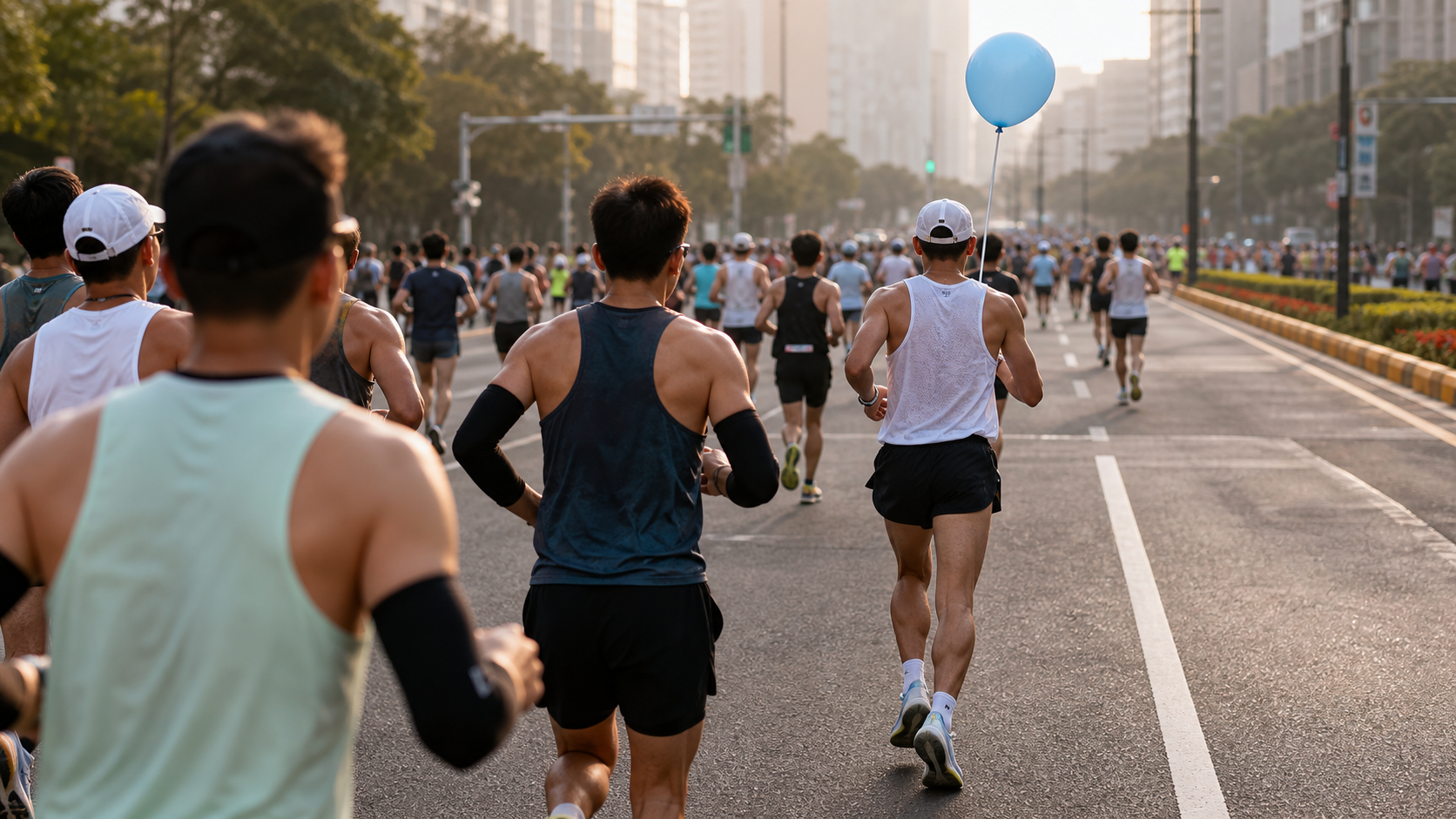
The Purpose of a Pacer
In major marathon events, pacers (also known as rabbits) are among the most valuable resources for runners. A good pacer can:
- Provide precise real-time pacing, so runners don’t need to constantly check their GPS watches
- Open a path through the crowd, reducing runners’ mental fatigue
- Offer a crowd-motivation effect during mental low points
- Usually possess extensive race experience, able to anticipate course conditions and make real-time adjustments
But “running with a pacer” isn’t just about following behind—an incorrect drafting approach can actually consume more energy than pacing yourself.
Optimal Drafting Positions
Position 1: 1–2m Directly Behind the Pacer (Most Efficient)
According to wind tunnel experiments, drafting 1–2m behind while running can save:
| Drafting Distance | Wind Resistance Reduction | Energy Savings |
|---|---|---|
| 0.5m behind | 20–30% | Approx. 1.5–3% |
| 1m behind | 15–25% | Approx. 1–2.5% |
| 2m behind | 10–15% | Approx. 0.5–1.5% |
Being 1m directly behind is the optimal balance point: significant wind resistance savings without the risk of stepping on the runner ahead’s heels.
Position 2: 45° Behind and to the Side of the Pacer
When the crowd is dense, you can move to a position roughly 45° behind and to the side of the pacer. This allows you to take advantage of some wind-blocking effect while avoiding being separated by the crowd.
Energy Management in the Crowd
Locating the Pacer After the Start
Major marathons in Taiwan typically have 3,000–20,000 participants, and pacer flags can be difficult to spot in the crowd. Recommendations:
- Position yourself near the pacer 15 minutes before the start
- Use the pacer’s flag color (Taipei Marathon typically uses different colors for identification) as a visual anchor
- If you get separated, maintain your target pace using your GPS watch and wait to naturally catch up or be overtaken
Calculating Energy Savings from Drafting
Research estimates that at a 4:00/km marathon pace, drafting the entire race (compared to running solo) can save approximately 2–4 minutes of finish time, equivalent to a 1–2% energy savings.
Common Drafting Pitfalls
Pitfall 1: Failing to Notice Pacer Fluctuations
Pacers are not machines; pace fluctuations occur before and after aid stations, on uphills, and on downhills. Pacers who start out faster will make up time at aid stations. If you blindly follow every acceleration, you may burn out within the first 10km.
Solution: Keep monitoring your own GPS pace. When the pacer runs more than 5 seconds faster than your target, actively slow down and wait for the pacer to return to a normal rhythm after the aid station.
Pitfall 2: Extra Lateral Movement Caused by Crowd Jostling
In the crowd around a pacer, moving left and right and dodging others is additional energy expenditure. Research shows that the actual distance run in a crowded field can be 0.5–1.5% more than what GPS records (because runners are constantly weaving).
Solution: After the crowd initially thins out (usually after 5–8km), find a stable drafting position and reduce lateral movement.
Pitfall 3: Over-Reliance on the Pacer Degrades Self-Pacing Ability
Following a pacer for the entire race causes runners to lose awareness of their own rhythm. If the pacer stops at an aid station or falls behind, the runner may immediately fall into panic.
When Should You Break Away from the Pacer?
| Situation | Recommendation |
|---|---|
| Feeling better than expected after 30km | Consider passing the pacer and slightly accelerating toward the finish |
| Gastrointestinal discomfort requiring an aid station stop | Actively break away and focus on recovering your own rhythm |
| Pacer’s actual pace is clearly faster than your target | Slow down immediately; do not follow an excessive pace |
| Temperature above 28°C | Lower your target and stop following the original pacer |
Practical Advice
- Communicate proactively with the pacer: Before the start, ask about the pacer’s aid station strategy (whether they stop or not) and understand their pacing plan
- Trust your GPS over your feelings: Under a pacer’s guidance, the early stages often feel slower than they actually are—trust the numbers
- Train independent pacing ability: A pacer is a tool, not a crutch. During training, develop the ability to pace independently without external reference points
- Quality of Taipei Marathon pacers: Taipei Marathon pacers are typically elite Taiwanese runners with high accuracy and reliability
Conclusion
Pacers are a hidden advantage in marathon racing. Runners who know how to use them can save energy, stabilize their pace, and face the second half of the race with greater composure. But ultimately, what carries you across the finish line is not the pacer—it’s your own understanding of pace and control over your body. Drafting is the starting point of learning; running solo is the endpoint of evolution.
Related Reading
西進武嶺 自製新版AI配速表產生器 x 賽前攻略 抱佛腳! 沒有功率計也可以產生配速表嗎?有什麼其他眉角賽前要注意的呢? | 西進武嶺 / 東進武嶺 KOM 攻略 | 公路車 | CT Yeh
4 年前
武嶺配速表最佳使用方式 #bike
1 年前
CT 喇低賽) 武嶺牽車 才是王道 西進牽車四小時內秘訣 攝手位置 如何判斷 防抽筋小秘訣
7 年前
戰略) Zwift Race 如何咬在第一集團 如何評估自己要開多少推力 (請開1.5倍速看)
7 年前
#公路車 #Fitting 靠人工智慧APP 幫你調整單車
6 年前
西進武嶺配速器 3.0更新 / NEW 免功率FTP估算! / 大數據xAI體能模型 / 如何模擬人止關前集團效應 / 配速儲存功能 / AI全台自行車賽事行事曆 / 公路車 / CT Yeh
1 年前
再快都跟的上!? 單車跟隨攝影機之王 HOVERAir X1 PROMAX 全面實測 / 唯一!8K畫質&自行車專用模式和跟蹤信標&前後避障 / DJI Neo 可參考/ 公路車 / CT Yeh
1 年前
一日北高/長距離團騎 常見問題補充篇 / 組團或跟團的眉角 / 壯車友容易被瘦車友慢性拉爆 / 原來屁股痛可能是這個原因...? / 風場配速法 / 公路車 / CT Yeh
2 年前