Why Does Swimming Need Heart Rate Monitoring?
Swimming training has long relied on “feel” and “pace” to gauge intensity, but both methods have limitations: feel is influenced by fatigue, mood, and water temperature; pace only reflects current swimming speed and does not directly reflect the body’s metabolic stress. Heart rate monitoring provides an objective physiological intensity metric, allowing you to confirm whether you are actually working within your target training zone.
For long-distance swimmers, the most critical application of heart rate monitoring is: confirming the lower intensity limit of Z2 aerobic training. Many swimmers think they are swimming in Z2, but their heart rate has actually climbed to Z3, accumulating mileage in the wrong intensity zone and significantly diminishing the training benefits.
Choosing the Type of Waterproof Heart Rate Strap
There are two main heart rate monitoring solutions for swimming on the market:
| Type | Representative Products | Principle | Swimming Accuracy | Recommended Use Case |
|---|---|---|---|---|
| Chest strap heart rate monitor | Polar H10, Garmin HRM-Swim | ECG electrical signal | High | Pool training (recommended) |
| Optical wristwatch | Garmin Swim 2, Apple Watch Ultra | Photoplethysmography (PPG) | Medium (less accurate while swimming) | For reference only, not suitable for precise training |
| Arm band heart rate monitor | Polar Verity Sense | Photoplethysmography (PPG) | Medium-high | Open water (upper arm position is more stable) |
Recommendation: For monitoring intensity during pool training, prioritize a chest strap heart rate monitor (such as the Polar H10), paired with a waterproof watch or goggle display. The chest strap measures electrical signals and is unaffected by water flow or arm movement, making it currently the most accurate solution for swimming.
Wearing Tips: Ensuring Accurate Readings
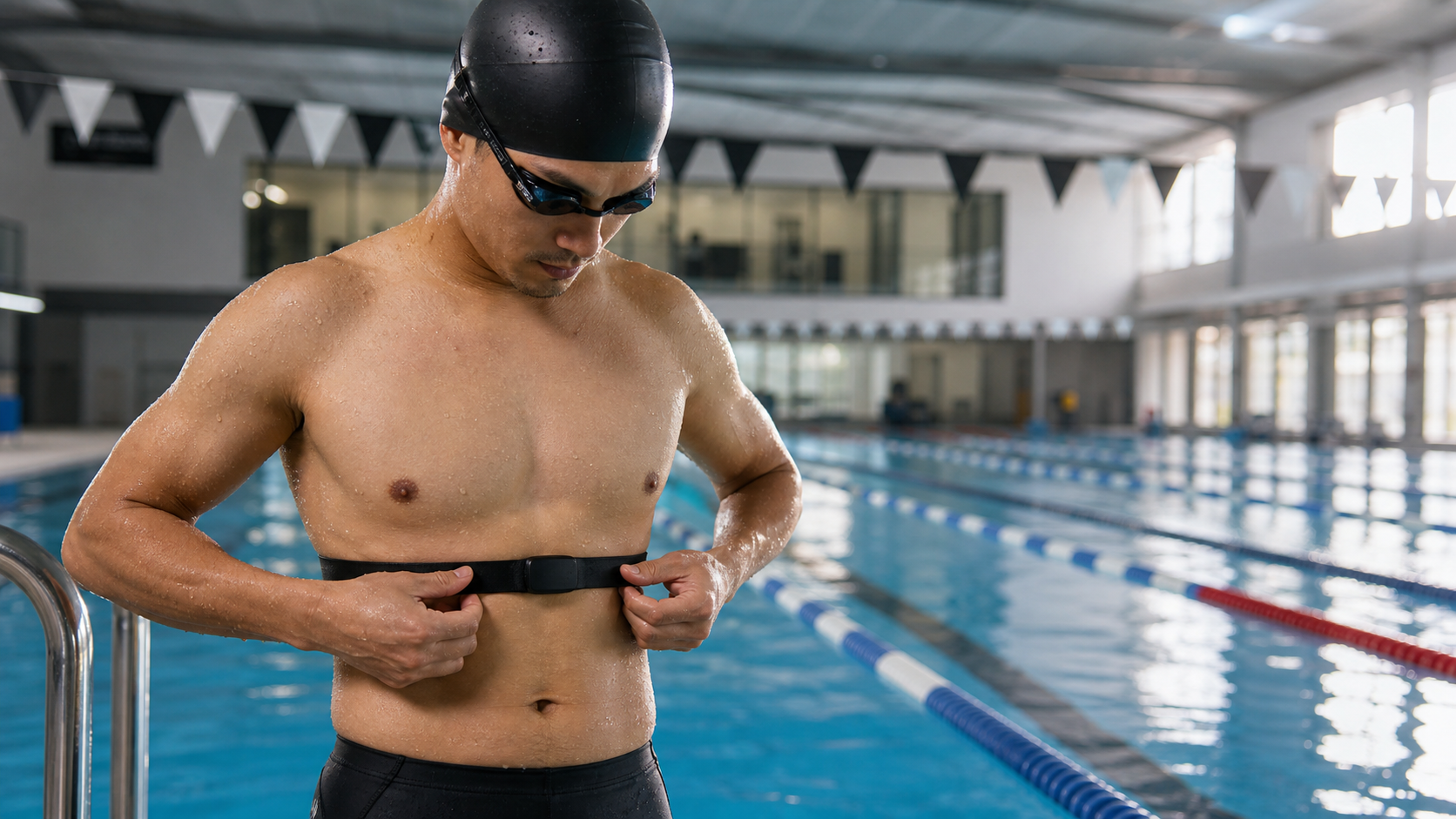
Chest strap heart rate monitor wearing techniques:
- Wet the electrode pads before wearing: Wet the chest strap electrode pads (or use conductive gel) before entering the water to ensure a good electrical connection; otherwise, readings will be unstable for the first few minutes.
- Appropriate snugness: The chest strap should sit firmly against the skin but not too tight—use the “no more than two fingers can fit underneath” standard; too loose and it will shift during swimming strokes, too tight and it will affect breathing.
- Electrode pad position below the sternum: The sensor should be placed below the sternum, with the left and right electrode pads symmetrically against the skin.
- Men may consider sports-bra-style fixation: The chest strap tends to ride up during swimming; some swimmers use adhesive tape to help secure the electrode position.
Optical arm band wearing techniques:
- Wear it on the upper arm (between the biceps and triceps), not on the wrist
- Ensure the arm band sits snugly against the skin with no gaps in the optical sensor contact area
Setting Swimming Heart Rate Zones
Swimming heart rate zones differ from running and cycling. Because the horizontal body position in water and water pressure affect the heart, the maximum heart rate for swimming is typically 10–13 bpm lower than for running.
Estimating maximum swimming heart rate:
- Maximum swimming heart rate (HRswim max) ≈ Maximum running heart rate (HRrun max) − 10
- If you are unsure of your maximum running heart rate, you can use 95% of (220 − age) as a rough estimate for maximum swimming heart rate
Swimming heart rate zone example (assuming HRswim max = 175 bpm):
| Zone | Heart Rate Range | Perceived Pace |
|---|---|---|
| Z1 Recovery | <105 bpm | Extremely easy |
| Z2 Aerobic | 105–122 bpm | Easy, can hold a conversation |
| Z3 Tempo | 123–140 bpm | Effortful, short phrases |
| Z4 Threshold | 141–157 bpm | Very effortful |
| Z5 Maximum | >157 bpm | Unable to speak |
How to Use Heart Rate Data During Swimming
Since you cannot check your watch in real time while swimming the way you can when running or cycling, there are usually several ways to use heart rate data:
Method A: Quick check during rest intervals
- Quickly glance at the heart rate reading on your watch or display during turns or rest periods
- Suitable for pool interval training—confirm whether your heart rate is in the target zone after each set
Method B: Post-workout analysis (most common)
- After the workout, sync the chest strap data to your phone or computer
- Use apps such as Polar Flow or Garmin Connect to view the complete heart rate curve
- Analyze the heart rate distribution across different intensity segments to confirm whether the Z2/Z4 time ratio matches your plan
Method C: Goggle heart rate display
- Some high-end swim goggles (such as Form Smart Swim Goggles) can display real-time heart rate
- Suitable for training that requires immediate intensity adjustments, but the price is higher
Troubleshooting Common Heart Rate Reading Issues
- Heart rate readings abnormally high for the first 2 minutes: Poor electrode contact—make sure the electrodes are thoroughly wet before entering the water.
- Heart rate readings fluctuating erratically: The chest strap is too loose or the electrode pads have shifted—readjust before entering the water.
- Readings consistently lower than expected: Swimming heart rate may naturally be 10+ bpm lower than running heart rate—confirm that you have set your targets using swimming heart rate zones (not running zones).
Practical Recommendations
- Perform a heart rate zone test first: Swim 6×200m at increasing speed (from Z2 to Z5), recording the heart rate at the end of each segment to build your personal swimming heart rate–pace reference chart.
- Do at least 1 heart-rate-driven workout per week: Ignore pace and focus only on heart rate, allowing your body to learn to automatically adjust to the optimal pace at Z2 heart rate.
- Add a heart rate column to your training log: In addition to distance and pace, record the average and maximum heart rate for each workout to track aerobic base improvement (heart rate decreasing at the same pace).
- Replace the battery regularly: The chest strap battery (usually CR2032) needs replacement every 400–500 hours; low battery can cause unstable readings.
Conclusion
A waterproof heart rate strap is an important tool for personalizing swimming training, transforming subjective “perceived effort” into objective physiological data. By mastering proper wearing techniques and data analysis methods, your swimming training will evolve from guessing intensity to precise control, ensuring that every session in the water accumulates benefits in the correct training zone.
Related Reading
- Swimming Heart Rate Zone Training: Setting Heart Rate Targets for Different Training Goals
- Waterproof Heart Rate Strap Buying Guide: Garmin HRM-Tri vs Polar H10 Swimming Accuracy Review
- Running Heart Rate Monitoring: In-Depth Accuracy Comparison Between Heart Rate Straps and Optical Sensors
- Heart Rate Monitoring Device Comparison: Accuracy and Use Cases of Optical Sensors vs Heart Rate Straps
西進武嶺 免費訓練分析服務 Intervals | 練不夠還是練過頭?你哪一種類型選手?AI模型告訴你! | 備戰神器 | 公路車 訓練 | CT Yeh
4 年前
#公路車 #Vo2Max #最大攝氧量 測驗 體驗 | 心肺測試
6 年前
Garmin Edge 1050 旗艦車錶 全台首測!/ 環法冠軍指定 / 對比Edge 1040改進哪些? / 公路車 / CT Yeh
2 年前
Apple Watch 3 值得 買嗎!? 實測 單車車錶 遙控相機 Zwift 心律連線 Apple Pay 全聯買菜 GoPro 遙控
8 年前
一起升級!海鷗盃LSD團練...JJSC Zone2招待 騎到手抖 / 公路車 / CT Yeh
1 天前
[教學] Premiere 影片 手震 修正 教學 防抖 單眼 影像 GoPro 穩定 Video Stabilization
8 年前
全台首發神車錶! iGPSPORT iGS630 兩趟一日北高的續航! 超強導航、功率訓練、超人性APP! Garmin & Bryton 有對手了嗎? | 公路車 |CT Yeh
3 年前
雷達尾燈 雷不雷? 邁金L508 智慧雷達尾燈 情境考驗實測 | 同場加映 2千元等級的專業車錶 C406 Pro | 公路車 | CT Yeh
3 年前