Introduction
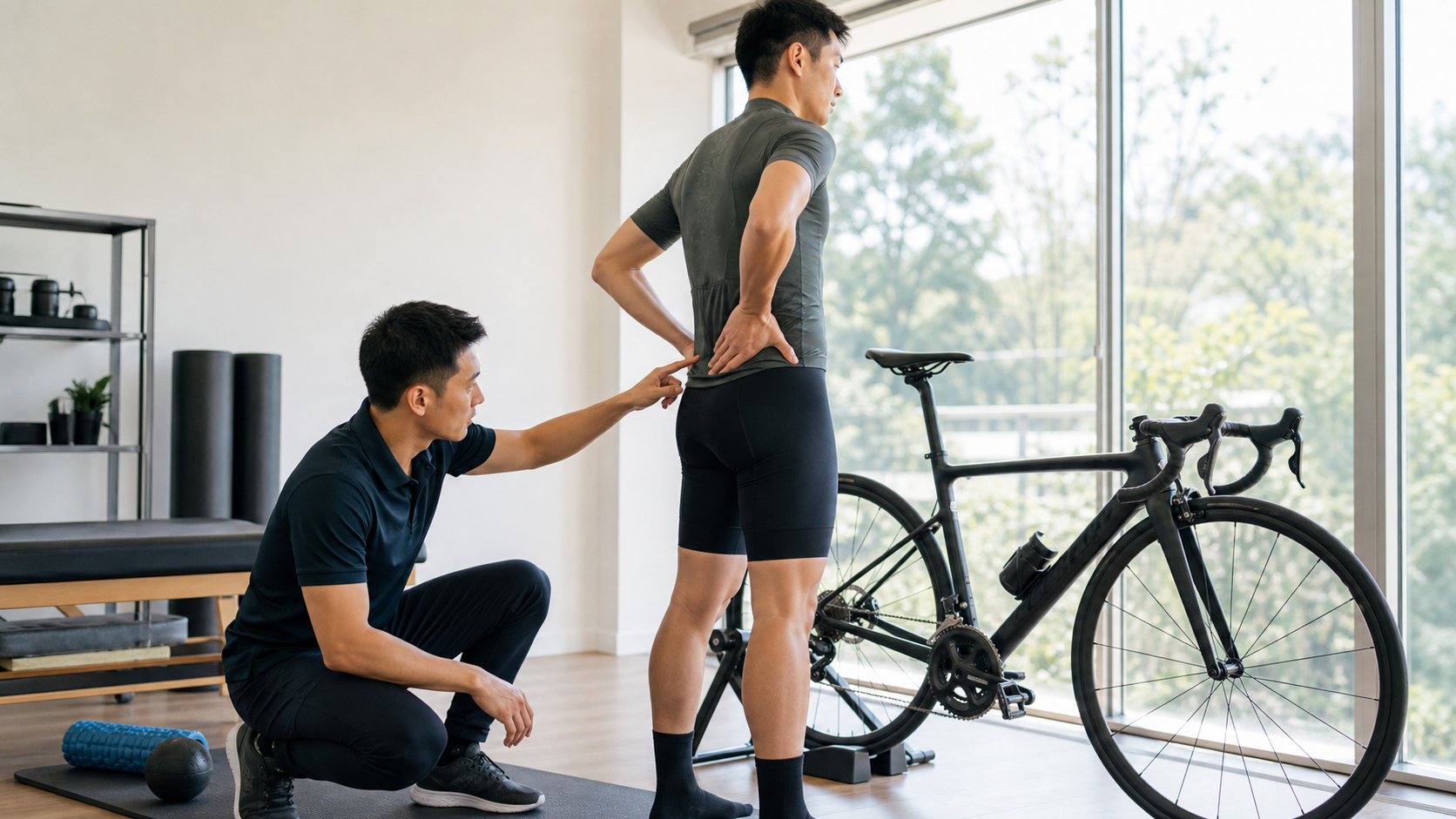
The prevalence of lower back pain among cyclists is estimated at 30–60%, ranking among the top three cycling-related injuries. Unlike running or racquet sports, cycling keeps the spine in a fixed position for extended periods without dynamic variation, making specific muscle groups particularly prone to fatigue and overstretching. Understanding why cycling triggers lower back pain is the prerequisite to finding solutions.
Cycling Posture and Lower Back Biomechanics
In a road bike riding position, the pelvis tends to tilt posteriorly, forcing the natural lordosis of the lumbar spine to flatten or even reverse into kyphosis. This posture will:
- Stretch the ligaments and muscles behind the lumbar spine
- Compress the posterior aspect of the intervertebral discs (increasing the risk of disc herniation)
- Cause prolonged isometric contraction of the erector spinae (static muscle fatigue)
The longer the riding time and the lower the handlebar position, the more severe these adverse mechanics become.
Common Triggering Factors
Equipment Factors
- Handlebars too low: Forces excessive forward trunk flexion, creating an overly large spinal flexion angle
- Seat post length mismatch (too long/too short): Affects pelvic stability
- Saddle too high: Causes pelvic rocking side to side, subjecting the lumbar spine to alternating lateral forces
Muscle Imbalance Factors
- Insufficient core musculature: Weakness in the deep abdominal muscles (transversus abdominis, multifidus), reducing spinal stability
- Tight hip flexors (iliopsoas): After prolonged riding, the iliopsoas shortens, pulling the lumbar spine into anterior tilt
- Weak gluteal muscles: Gluteus maximus inhibition caused by modern sedentary lifestyles; compensatory patterns during cycling increase lumbar spine load
Training Factors
- Suddenly increasing riding distance or intensity (exceeding the 10% rule)
- Riding for extended periods without rest, maintaining static posture for too long
- Insufficient warm-up
Riding Posture Adjustment Key Points
| Adjustment Item | Problem Indicator | Recommended Direction |
|---|---|---|
| Handlebar height | Too low causing excessive trunk flexion | Raise handlebars appropriately or switch to a shorter stem |
| Saddle height | Too high causing pelvic tilt and rocking | Adjust so that 25–30 degrees of knee flexion remains at the bottom of the pedal stroke |
| Saddle fore/aft position | Too far back causing anterior pelvic tilt and arched back | Adjust so the knee is vertical above the pedal spindle at the 3 o’clock crank position |
| Stem length | Too long causing excessive forward reach | Shorten by 1–2cm to allow the upper back to relax more |
Core Strengthening Training Program
Essential Foundational Exercises
- Plank: 30–60 seconds per set, 3 sets daily. Trains the transversus abdominis and multifidus
- Glute Bridge: 15–20 reps per set, 3 sets daily. Strengthens the gluteus maximus and lumbar stability
- Bird Dog: 10 reps per side, emphasizing control of the spine in a neutral position
- Side Plank: 20–30 seconds per side, training the obliques and lateral stability
Advanced Functional Training
- Romanian Deadlift: Strengthens the posterior chain (hamstrings, glutes, erector spinae)
- Farmer’s Walk: Trains the core’s ability to resist lateral instability
- TRX Inverted Row: Strengthens the rhomboids and mid/lower trapezius, improving upper back posture
Flexibility Improvement
- Iliopsoas Stretch (Lunge Stretch): 30 seconds per side, 2–3 sets daily
- Cat-Cow: 10 reps before and after riding, dynamically mobilizing the spine
- Piriformis Stretch (Supine Figure-4 Stretch): Improves hip joint mobility
Immediate Management of Acute Lower Back Pain
- Acute phase (1–3 days): Avoid long-distance riding; light activity is acceptable, but avoid movements that aggravate pain
- Complete bed rest is not recommended: Current guidelines show that light activity is more beneficial than bed rest for acute lower back pain recovery
- Heat vs. Ice: Ice can be applied within the first 24 hours of the acute phase to reduce inflammation; after 48 hours, switch to heat therapy to improve blood circulation
- When to seek medical attention: If accompanied by radiating leg pain, numbness, weakness, or loss of bowel/bladder control, seek immediate medical evaluation to rule out nerve compression
Practical Recommendations
- During long rides, stop every 40–50 minutes and perform 1–2 minutes of “Cat-Cow” or standing back extension stretches
- If riding regularly, aim for at least 2 sessions of off-bike core training per week
- Running and swimming are excellent cross-training options for cyclists, effectively addressing postural weaknesses from riding
- Bike Fitting is one of the most worthwhile investments—seek a fitter with a sports medicine background
Conclusion
Lower back pain is telling you that something is off—whether it’s your equipment, your strength, or your postural habits. The good news is that through systematic adjustments and training, the vast majority of cycling-related lower back pain can be effectively improved or even resolved. Strengthen your core, and you protect your spine.
Related Reading
- Lower Back Pain and Cycling: Cause Analysis, Posture Correction, and Long-Term Solutions
- Lower Back Pain After Cycling: Improving Core Insufficiency and Postural Issues
- Back Pain Prevention for Cyclists: The Relationship Between Core Strength and Riding Posture
- Common Cycling-Related Back Pain: Cause Analysis and Complete Rehabilitation Plan
一日北高/長距離團騎 常見問題補充篇 / 組團或跟團的眉角 / 壯車友容易被瘦車友慢性拉爆 / 原來屁股痛可能是這個原因...? / 風場配速法 / 公路車 / CT Yeh
2 年前
CT 喇低賽) 單車 比賽總是沒照片? 攝影師的觀點大公開 姿勢就是力量! 請加速1.25倍收看
7 年前
#公路車 #Fitting 靠人工智慧APP 幫你調整單車
6 年前
一日北高常見問題大集合 | 攻略 | 路線 | 訓練 | 補給 | 自行車 單車 | 一日雙城 | 雙塔 | TWB北高360 | 屁股痛
6 年前
靠單車減肥35公斤 心得分享與整理
7 年前
碟煞公路車 銑面器 !? 原來銑完差這麼多! 降低蹭碟機率! | TIME 公路車 保養小記錄 | CT Yeh
3 年前
摔車後補裝備: 好市多新款單車安全帽& Specialized Romin 北高整路屁股都不痛的坐墊 | 一千元居然有MIPS | CT Yeh | 公路車
4 年前
CT 喇低賽) 武嶺牽車 才是王道 西進牽車四小時內秘訣 攝手位置 如何判斷 防抽筋小秘訣
7 年前