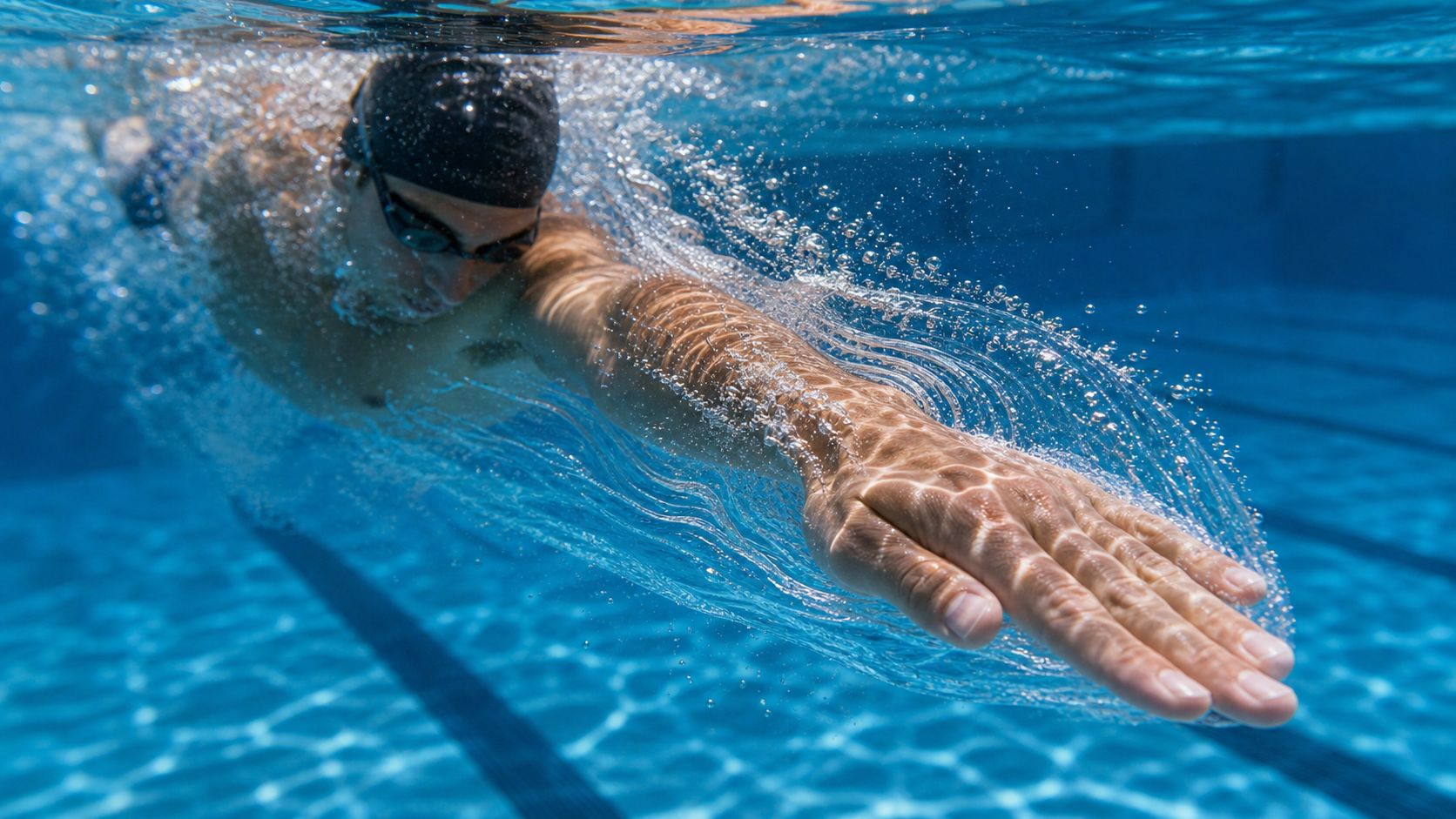
The Century-Long Controversy of Swimming Propulsion
The source of swimming propulsion is one of the most fascinating and controversial topics at the intersection of exercise physiology and fluid dynamics. In the mid-20th century, researchers proposed that a swimmer’s hand acts like a propeller blade, generating lift through Bernoulli’s principle to propel the body forward. Conversely, the traditional view held that propulsion primarily comes from Newton’s Third Law—pushing water backward so the water pushes the person forward. In reality, modern research has found the truth to be far more complex than any single theory.
Review of Bernoulli’s Principle Basics
Bernoulli’s principle (Bernoulli’s equation) describes the relationship between fluid velocity and pressure:
In streamlined steady flow, as flow velocity increases, pressure decreases; as flow velocity decreases, pressure increases.
Mathematical expression (simplified version):
P₁ + ½ρv₁² = P₂ + ½ρv₂² = Constant
Where P is pressure, ρ is fluid density, and v is flow velocity.
On an airplane wing, the curved airfoil causes airflow to accelerate over the top, creating low pressure; the airflow underneath is slower, creating higher pressure, which results in upward lift. Theoretically, if a swimmer’s hand can move through the water at an appropriate angle, it can also generate a similar lift component.
Lift Model: Counsilman’s S-Shaped Stroke Hypothesis
In 1971, the famous swimming coach and researcher James Counsilman analyzed underwater footage of several top swimmers and proposed the “S-shaped stroke theory”:
- The arms of top swimmers do not move straight back in the water but follow an S-shaped curve.
- This S-shaped path allows the palm to continuously encounter “fresh water,” improving stroke efficiency.
- Throughout the arm stroke, the palm acts like a propeller, generating lift force at different angles.
- The lift component can account for 30–50% of total propulsion (Counsilman’s estimate).
This theory was highly influential from the 1970s to the 1990s, leading many coaches to teach swimmers to use an S-shaped stroke path.
Newton’s Third Law Model: Drag-Based Propulsion
Another school of thought emphasizes that the core of swimming propulsion is Newton’s Third Law:
The palm pushes water backward (and diagonally backward), and the water exerts an equal and opposite force on the palm, which is the propulsive force.
This force is known as drag-based propulsion:
- The larger the surface area of the palm, the more water is pushed back, and the greater the reaction force.
- Propulsion is strongest when the palm is perpendicular to the direction of travel, as drag is maximized.
- Researcher Schleihauf (1979) measured the hydrodynamic forces on a swimmer’s hand and found that the drag component actually dominates during most phases of the stroke.
Integrated Perspectives of Modern Research
| Propulsion Type | Physical Principle | Proportion in Freestyle Stroke | Main Contribution Phase |
|---|---|---|---|
| Drag-based Propulsion | Newton’s Third Law | Approx. 60–80% | Entire Main Pull |
| Lift-based Propulsion | Bernoulli’s Principle | Approx. 20–40% | Catch, High Elbow Phase |
Modern fluid dynamics research (including CFD computer simulations) shows:
- Partial Negation of the S-Shaped Stroke: The arm paths of modern swimmers are not purely S-shaped but are closer to a straight line with a moderate inward curve. An excessive S-shape increases ineffective lateral forces.
- Simultaneous Existence of Lift and Drag: The resultant force generated by the hand in the water is the vector sum of lift and drag; the angle determines the ratio between the two.
- The Criticality of Angle of Attack (AoA): The angle between the palm and the direction of water flow (Angle of Attack) determines the ratio of lift to drag:
- AoA 0°: No lift and no drag (hand slicing through water).
- AoA 45°: The ratio of lift to drag is approximately 1, which is relatively efficient.
- AoA 90°: Maximum drag, minimum lift (palm facing directly backward).
Fluid Dynamic Explanation of the High Elbow Catch
The “High Elbow Catch” is consistently recommended by modern swimming coaches. Its fluid dynamic basis includes:
- The high elbow position allows the forearm (not just the palm) to act as a “stroking surface,” significantly increasing the water-pushing area.
- Studies show that the effective stroke area of a high elbow catch is 40–60% larger than that of a low elbow (where the elbow drops first).
- The increased surface area for forearm muscles allows for a larger Bernoulli lift component throughout the catch-pull process.
- CFD simulations show that a high elbow stroke generates 20–30% more propulsion at the same arm speed.
Fluid Dynamics of Hand Shape
How a swimmer holds their hand (hand shape) also has a scientific basis:
- Fully Closed vs. Slightly Apart: Research shows that keeping fingers slightly apart (approx. 5–12°) rather than completely closed allows the water flow around the palm to form an additional boundary effect, making the actual propulsion about 5–8% higher than when completely closed.
- Curved vs. Straight Fingers: Straight (but not overly tense) fingers provide the maximum stroke surface area.
- Thumb Position: Keeping the thumb slightly apart (not pressed tight against the index finger) helps improve the flow field.
Fluid Dynamics of Kicking
Leg kicking follows similar principles:
- Downbeat: As the instep moves downward, the foot generates lift (similar to a fish tail whip) while also producing forward propulsion.
- Upbeat: As the sole moves upward, there is also a slight lift component.
- Ankle flexibility determines the effective range of the foot’s Angle of Attack—the more flexible the ankle joint, the higher the fluid dynamic efficiency of the kick.
- Studies show that for every 10° increase in ankle plantar flexion, kicking propulsion increases by approximately 8–12%.
Fluid Dynamic Differences Between Pool and Open Water
The fluid environment differs between pool swimming and open water swimming, requiring technical adjustments:
- Pool: A still water environment where waves come from other swimmers; being close to the wall creates a slight “wall effect,” reducing the flow velocity on one side of the swimmer.
- Open Water: Characterized by uneven currents and waves; the stroke Angle of Attack strategy needs to be more flexible.
- Ocean Waves: When swimming against waves, increase the Angle of Attack (more drag-based propulsion); when swimming with waves, utilize the wave’s propulsive force.
Practical Technical Training Recommendations
- Feel Palm Pressure: Consciously feel the water pressure on your palms and forearms during the stroke, learning to maintain “full hand pressure” throughout the main pull.
- Fist Drill: Swim with clenched fists to remove the palm’s surface area, forcing the forearms to take on more of the water-pushing function and enhancing the feel for the high elbow catch.
- Paddle Assistance: Use hand paddles to increase the stroke area, allowing the palms to more clearly sense changes in lift and drag.
- Slow Swimming Observation: Slow down and focus on feeling the direction of pressure on the palms during each stroke phase, searching for the angle that provides the strongest propulsion.
Conclusion
Bernoulli’s principle does indeed play a role in swimming propulsion, but it is not the sole mechanism—drag-based propulsion from Newton’s Third Law is the protagonist in most phases of the stroke. Modern swimming science tells us that true efficiency comes from pushing water at the right phase, with the right Angle of Attack, and using the maximum effective surface area. Understanding these fluid dynamic principles allows swimmers to have a better sense of direction in technical training, rather than just “pulling water” by feel.
Related Topics
- The Mechanics of Swimming Propulsion: Hand Area, Stroke Angle, and Propulsive Efficiency
- Strength Movements for Swimmers: Pull-ups, Shoulder Stability, and Core
- The Drag Mindset in Freestyle: Why Your Progress Should Start with “Reducing Drag” Rather Than Obsessive Arm Strength
- Core Muscle Training for Swimming: The Scientific Basis of Underwater Propulsion
CT 喇低賽) 武嶺牽車 才是王道 西進牽車四小時內秘訣 攝手位置 如何判斷 防抽筋小秘訣
7 年前
西進武嶺 8000名單車友數據分析 PART1 | 從新手到高手數量/瓦數/推力比/FTP推力比/功率計使用率 大解析 | 公路車 | CTYeh
5 年前
戰略) Zwift Race 如何咬在第一集團 如何評估自己要開多少推力 (請開1.5倍速看)
7 年前