Cycling Fracture First Aid: On-Site Management of Clavicle Fractures and Timing for Returning to Riding
Introduction
“I crashed, and my shoulder doesn’t feel right”—this is the most common opening line heard in Taiwanese emergency rooms from the cycling community. Clavicle fractures account for approximately 40–50% of all cycling-related fractures, most often caused by falling onto an outstretched hand, with the impact force traveling up the arm to the shoulder, exceeding the clavicle’s tolerance limit. Understanding how to recognize fracture symptoms and provide proper first aid is essential knowledge for every rider.
Anatomy and Mechanism of Clavicle Fractures
The clavicle is an S-shaped bone connecting the sternum (centrally) to the scapula (laterally), and the stability of the shoulder girdle relies heavily on the integrity of the clavicle. Fractures most commonly occur in the middle third of the clavicle (approximately 80%), because this area has the smallest cross-sectional area and the greatest curvature, making it the most susceptible to breaking under impact.
Fracture Classification
| Location | Frequency | Characteristics |
|---|---|---|
| Middle third (Group 1) | Approximately 80% | Can be treated conservatively or surgically |
| Lateral third (Group 2, near the acromioclavicular joint) | Approximately 15% | High risk of displacement, often requires surgery |
| Medial third (Group 3, near the sternum) | Approximately 5% | Rare, requires ruling out sternal injuries |
On-Scene Recognition: How to Determine a Clavicle Fracture?
Typical Symptoms
- Severe localized pain: Pain in the front-upper shoulder area, especially aggravated by shoulder movement
- Visible or palpable fracture segment: A visible bulge, deformity, or asymmetry under the skin; sometimes the fracture end may tent the skin
- Limited movement of the affected limb: The injured arm cannot be raised or extended forward
- Characteristic posture: The injured person supports the elbow of the affected side with the healthy hand and tilts the head toward the injured side to reduce pain
- Hearing or feeling a bone-breaking sound (at the moment of the crash)
Associated Injuries Requiring Urgent Exclusion
- Pneumothorax or hemothorax: The fractured end of the clavicle may puncture the apex of the lung, causing difficulty breathing or chest pain
- Subclavian artery or vein injury: Less common, but if the affected limb appears pale and weak, urgent medical attention is needed
- Brachial plexus injury: Numbness or weakness in the hand
- Head trauma (if the crash involved a blow to the head)
On-Scene First Aid Steps
- Stop activity and assess the injured person’s consciousness: Confirm the person is alert and breathing normally
- Do not forcibly move the injured arm: Avoid displacing the fracture ends and damaging nerves or blood vessels
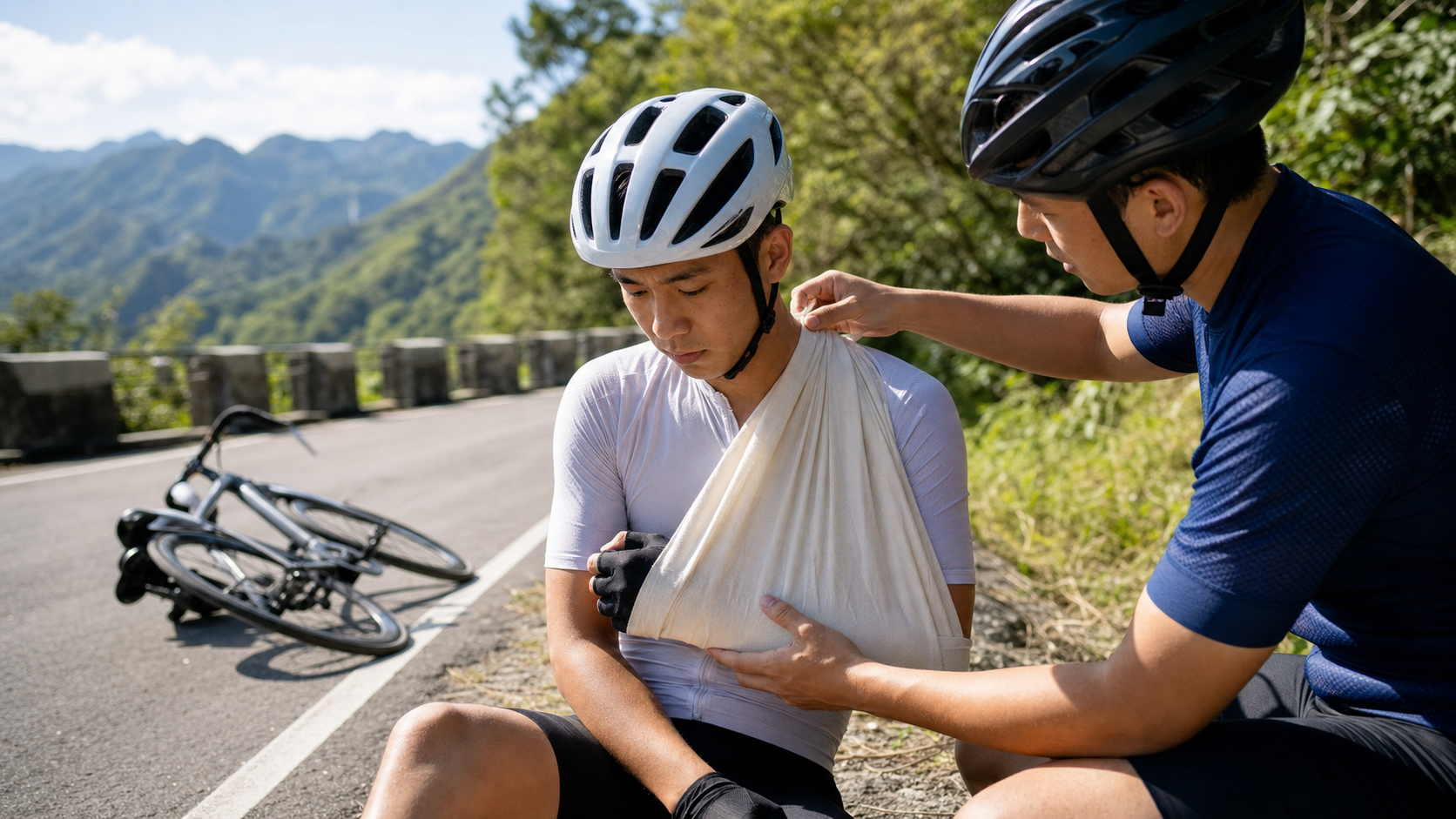
- Immobilize with a triangular bandage sling: Use a cycling jersey, towel, or any cloth to create a temporary sling; the goal is to let the weight of the affected limb be borne by the neck rather than the fracture site
- Apply ice (if conditions allow): To reduce swelling; do not place ice directly on the skin
- Seek medical attention as soon as possible: Call 119 or have someone assist in transporting the person to the emergency room; it is not recommended for the injured person to ride or drive alone
Making a Temporary Triangular Bandage Sling
- Fold a square cloth diagonally into a triangle
- Place the injured forearm, bent at 90 degrees, onto the cloth
- Tie the two ends behind the neck, adjusting so the elbow sits approximately 3–5 cm higher than the wrist
Treatment Options and Return-to-Riding Timeline
Conservative Treatment
- Indications: Non-displaced or minimally displaced middle-third fractures
- Method: Sling immobilization for 2–6 weeks, pain management, and subsequent physical therapy
- Return-to-riding timeline: After X-ray confirms fracture healing (usually 8–12 weeks), pain has resolved, and shoulder range of motion has been restored, the physician must give approval before returning to cycling
Surgical Treatment (Plate Fixation)
- Indications: Significant displacement (>2 cm), shortening (>2 cm), comminuted fractures, or lateral-end fractures
- Advantages: Accelerates fracture stabilization and shortens the recovery period
- Return-to-riding timeline: Indoor cycling can begin after the surgical wound heals (2–3 weeks); outdoor road riding typically requires 10–16 weeks post-surgery, depending on imaging of fracture healing
Return-to-Riding Assessment Checklist
- [ ] X-ray confirms fracture line healing
- [ ] Shoulder range of motion restored to 80% or more
- [ ] Push/pull strength of the affected limb restored to 80% or more of the healthy side
- [ ] No pain at rest or while riding
- [ ] Written clearance from the attending physician
Preventing Clavicle Fractures: Equipment and Technique
- Helmet: Always wear a certified helmet (not directly related to clavicle fractures, but protects the head)
- Shoulder protection: Some MTB protective gear includes shoulder protection designs
- Proper falling technique: Try to avoid landing on an outstretched hand (hand-on mechanism); practice side-roll fall techniques
- Maintain your bike: Regularly inspect brakes and tires to reduce the chance of accidental crashes
Conclusion
A clavicle fracture may sound discouraging, but for most riders, proper treatment combined with patient rehabilitation usually leads to a full recovery of riding ability. The most important principles at the first-aid scene are: immobilize, ice, and seek medical attention—do not force movement, and let medical professionals make the final assessment and decisions.
Related Reading
- Preventing Cyclist Fractures: Fall Risk Assessment and Protective Gear
- Rehabilitation Plans After Cycling Fractures: Return-to-Training Timelines for Clavicle and Wrist Fractures
- Managing Road Cycling Accidents: On-Scene First Aid for Abrasions, Impacts, and Fractures
- Emergency Response After Cycling Accidents: On-Scene Management of Abrasions, Fractures, and Head Impacts
高雄綠園道鐵路自行車道 / 外地人能輕鬆駕馭 還是整路崩潰? / 2025 全線開通 春節實地探索一次!(附GPS連結)/ 公路車 / CT Yeh
1 年前
摔車後補裝備: 好市多新款單車安全帽& Specialized Romin 北高整路屁股都不痛的坐墊 | 一千元居然有MIPS | CT Yeh | 公路車
4 年前
一日北高/長距離團騎 常見問題補充篇 / 組團或跟團的眉角 / 壯車友容易被瘦車友慢性拉爆 / 原來屁股痛可能是這個原因...? / 風場配速法 / 公路車 / CT Yeh
2 年前
2026 車錶排行榜!誰是最多車友正在使用?練家子最愛哪款?🏆 (2萬名車友數據) / 公路車 / CT Yeh
5 個月前
一日北高常見問題大集合 | 攻略 | 路線 | 訓練 | 補給 | 自行車 單車 | 一日雙城 | 雙塔 | TWB北高360 | 屁股痛
6 年前
「悲情男車友」創作單曲 爆笑MV / 公路車 / CT Yeh / 4K劇情版
7 個月前
超開放的自行車錶!可以玩遊戲裝APP!?/ SRAM合併的 Hammerhead Karoo深入開箱!/ 即時爬坡偵測 / 全球導航地圖 / Garmin Bryton / CT Yeh
1 年前
#公路車 #Fitting 靠人工智慧APP 幫你調整單車
6 年前