Introduction
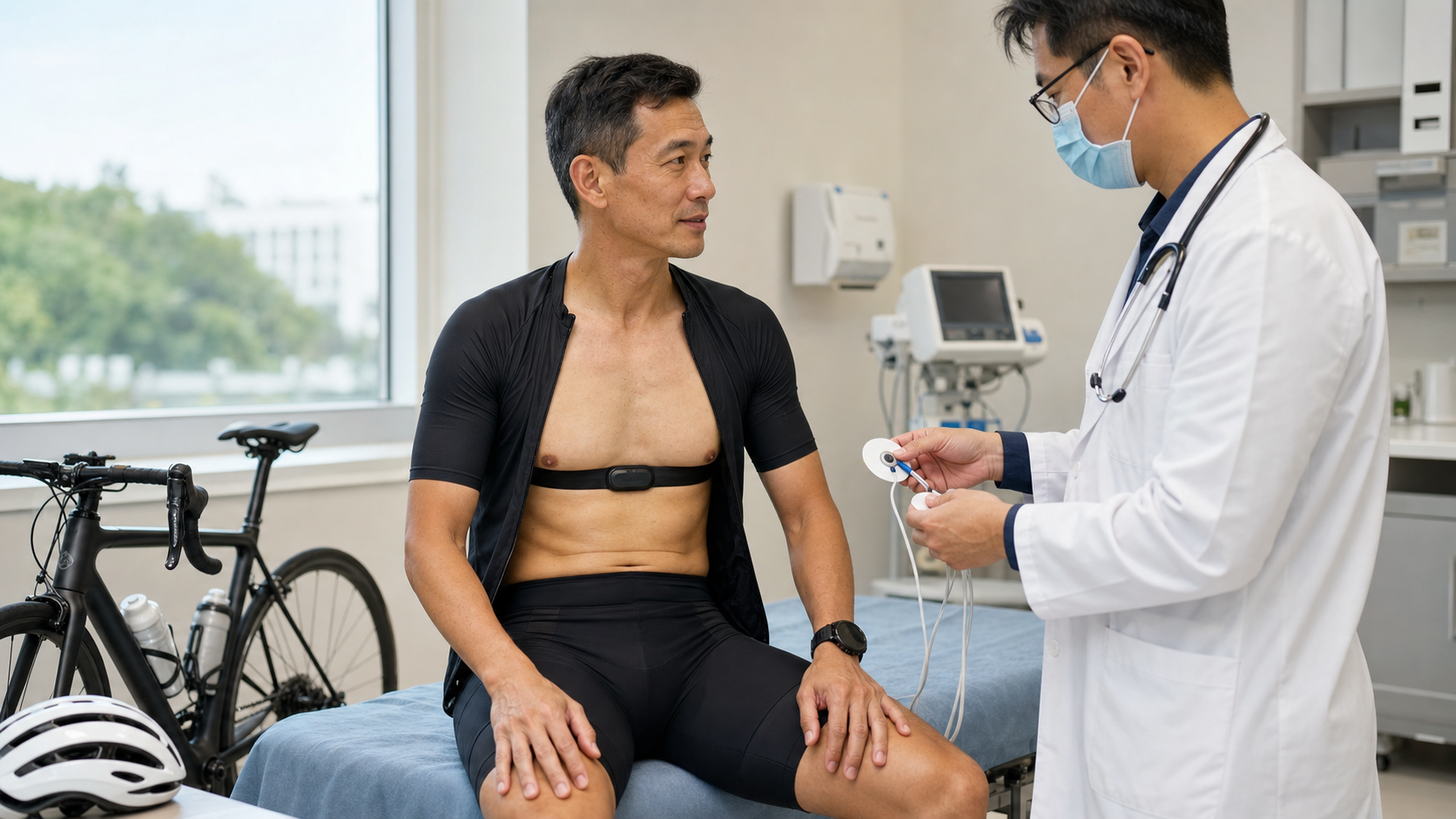
Every so often, news emerges of an amateur marathon runner or cyclist dying suddenly during an event, sparking widespread discussion. Cycling is a sport with very high aerobic intensity, and it is not uncommon to sustain a heart rate at 70–85% of maximum for extended periods. The strain on the heart is even greater during climbs or interval training. For amateur riders who are older or have potential risk factors, understanding their own heart condition is the foundation for exercising safely.
Epidemiology of Sudden Cardiac Death in Sports
Sudden Cardiac Death (SCD) is defined as non-traumatic death occurring during exercise or within 1 hour after exercise, and is almost 100% caused by cardiac reasons.
- Younger populations (<35 years old): The most common causes are structural heart diseases (such as hypertrophic cardiomyopathy, arrhythmogenic right ventricular cardiomyopathy ARVC)
- Middle-aged and older populations (>35 years old): The most common cause is coronary artery disease (rupture of atherosclerotic plaques)
- The estimated rate of sudden death in amateur marathons/cycling is approximately 1/50,000–1/100,000 participants
Which Amateur Riders Need Cardiac Assessment?
High-Priority Groups (recommended to undergo assessment before participating in moderate-to-high-intensity riding)
- Men aged ≥40 / Women aged ≥50
- Personal history of coronary artery disease, arrhythmia, or cardiomyopathy
- First-degree relatives (parents, siblings) who had a myocardial infarction or sudden death before age 50
- Any one of the “three highs” (hypertension, hyperlipidemia, diabetes) that is uncontrolled
- Long-term smokers (>10 pack-years)
- BMI >30 (obesity)
Immediate Assessment is Required if the Following Symptoms Appear
- Chest tightness, chest pain, or palpitations during or after exercise
- Unexplained syncope (even a brief fainting episode)
- Severe dizziness or dyspnea during exercise (disproportionate to training intensity)
- Sudden abnormality in resting heart rate (marked increase or decrease)
Cardiac Assessment Items and Their Significance
| Assessment Item | Detectable Problems | Recommended Populations |
|---|---|---|
| Resting ECG | Arrhythmias, pre-excitation syndrome, left ventricular hypertrophy | All high-risk groups |
| Stress ECG | Exercise-induced arrhythmias, ischemic heart disease | ≥40 years old with risk factors |
| Echocardiogram | Hypertrophic cardiomyopathy, valvular disease, ventricular function | Family history of sudden death, younger populations at risk of sudden death |
| Coronary CT | Coronary artery calcium score, degree of stenosis | >50 years old with multiple risk factors |
| 24-hour Holter monitor | Paroxysmal arrhythmias | Those with palpitations or syncope symptoms |
| Blood tests | Blood glucose, lipids, high-sensitivity CRP, BNP | To complement comprehensive cardiovascular risk assessment |
The “Athlete’s Heart” Phenomenon in Cyclists
Long-term high-intensity aerobic training can cause “Athlete’s Heart”—enlargement of the heart chambers, mild thickening of the heart wall, and a decreased resting heart rate (40–50 bpm is normal). This is a physiological adaptation, not pathological, but it may resemble certain heart diseases on an ECG or ultrasound, requiring differential diagnosis by a cardiologist with experience in sports medicine.
Key Points for Differential Diagnosis
- Wall thickening in hypertrophic cardiomyopathy (HCM) is usually >15mm, with a reduced ventricular chamber size
- Wall thickening in athlete’s heart is usually <13mm, with a normal or enlarged ventricular chamber
- After stopping training, the changes in athlete’s heart are reversible within months
Daily Heart Monitoring Tools
Modern wearable devices (smartwatches, heart rate straps) offer unprecedented opportunities for self-monitoring:
- Resting heart rate trends: If resting heart rate suddenly rises >7–10 bpm without infection, overtraining or cardiac issues should be considered
- Heart rate variability (HRV): A persistent decline may indicate overtraining or autonomic nervous system imbalance
- Arrhythmia detection: Some devices can detect atrial fibrillation (AFib); if detected, medical confirmation should be sought
Emergency Response to Cardiac Events During Exercise
- Stop exercising immediately and lay the affected person flat
- Call 119 and obtain an AED
- If there is no breathing or no pulse: start CPR (cardiopulmonary resuscitation) immediately
- AED use should be completed within 3–5 minutes if possible; survival rates decrease by approximately 10% for every minute of delay
Practical Recommendations
- Before participating in major events, consider undergoing a comprehensive cardiac health assessment
- Know your maximum heart rate (220-age is a rough estimate; precise values require testing) and set an upper limit for training heart rate
- In Taiwan, cardiac health assessments have partial coverage under the National Health Insurance (such as ECG); fully self-paid athlete packages range from approximately NT$3,000–8,000
Conclusion
“Screening before exercise” is not meant to stop you from riding, but to give you more confidence to ride farther and longer. Most people will come away from screening with the conclusion “ride with peace of mind”; a minority may discover hidden issues, and early intervention can prevent serious consequences. Heart health is the most worthwhile piece of cycling equipment you can invest in.
Related Reading
- Heart Health in Older Athletes: Cardiac Screening Recommendations and Items Before Exercise
- Cardiac Safety in Cycling: When to Undergo a Stress ECG Examination
- Cardiac Screening for Athletes: Cost-Effectiveness of 12-Lead ECG vs ECG + Ultrasound
- Cycling and Heart Health: The Protective Benefits of Long-Term Riding on the Heart
2025 自行車錶排行榜 兩萬車友大數據 / Garmin Bryton 排名會大洗牌嗎? / 全新的碼表前身分析 /公路車 / CT Yeh
1 年前
一日北高/長距離團騎 常見問題補充篇 / 組團或跟團的眉角 / 壯車友容易被瘦車友慢性拉爆 / 原來屁股痛可能是這個原因...? / 風場配速法 / 公路車 / CT Yeh
2 年前
西進武嶺 免費訓練分析服務 Intervals | 練不夠還是練過頭?你哪一種類型選手?AI模型告訴你! | 備戰神器 | 公路車 訓練 | CT Yeh
4 年前
2022 前十五大自行車錶 !? 兩萬名車友大數據統計 | 你的上榜了嗎? | 菁英車友都用哪些錶? | Bryton Garmin 誰能拔得頭籌?| 車錶推薦 | 公路車 CT Yeh
4 年前
2026 車錶排行榜!誰是最多車友正在使用?練家子最愛哪款?🏆 (2萬名車友數據) / 公路車 / CT Yeh
5 個月前
爬陡坡被爆胎的車友跑步超車 #cycling #里佳部落
9 個月前
JE22 百里任務體驗,心跳不能過150,三小時內有可能...? 沒有天時地利難度有多高? / 公路車 / CT Yeh
1 年前
一日北高常見問題大集合 | 攻略 | 路線 | 訓練 | 補給 | 自行車 單車 | 一日雙城 | 雙塔 | TWB北高360 | 屁股痛
6 年前