文章導覽
Introduction
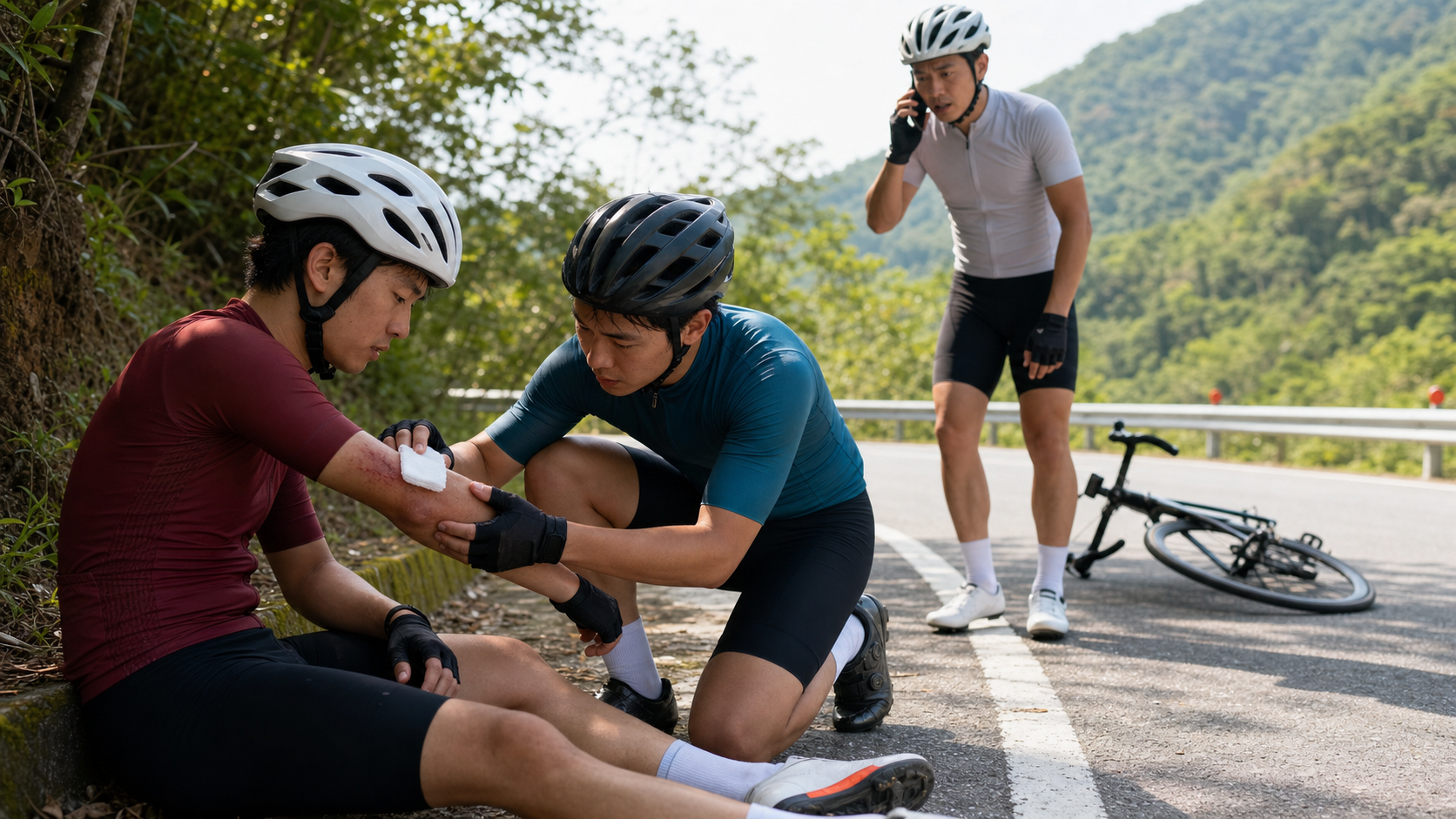
Every minute at the scene is critical the moment an accident occurs. Taiwan sees thousands of cycling road accidents every year, many involving severe trauma cases. Most riders have basic first aid awareness, but in a chaotic on-scene environment, knowing “what to do and what not to do” is often more important than knowing “how to do it.” This article does not provide a complete first aid course, but rather the most critical on-scene decision-making and action guidelines.
First Priority: On-Scene Safety Assessment (DRS ABC)
Before any accident management, ensure your own safety first:
- D (Danger): Assess environmental hazards—oncoming traffic, collapse risks, power lines, fuel leaks
- R (Response): Check the casualty’s consciousness—call their name loudly, tap their shoulder, observe for any response
- S (Send for Help): Call 119 immediately, providing the location, number of casualties, level of consciousness, and main injuries
- A (Airway): Confirm the airway is clear—if unconscious, check for foreign objects in the mouth, lift the chin to open the airway
- B (Breathing): Confirm breathing—observe chest rise and fall, listen for breath sounds
- C (Circulation): Check pulse and severe bleeding—if no heartbeat, begin CPR; if severe bleeding, apply direct pressure immediately
Common Injury Types and Management
1. Abrasions (Road Rash)
The most common injury from a crash, where the skin is scraped away from high-speed contact with the ground.
On-scene management:
- Move to a safe location, confirm no fractures before treating
- Rinse the wound with clean water (drinking water bottle) to remove gravel and debris
- If no signs of infection, temporarily cover with clean cloth for protection
- Do not use iodine or alcohol directly on open wounds (they damage new tissue)
- Formal treatment after seeking medical care: debridement, disinfection, Hydrocolloid moist wound therapy
When to seek medical care:
- Wound area is large (>5cm), deep to the fat layer
- Embedded gravel that is difficult to remove
- Redness and swelling developing after 24 hours
2. Head Impact
Head trauma is the injury requiring the most cautious handling—concussion or intracranial hemorrhage can still occur even with a helmet on.
On-scene recognition:
- Brief loss of consciousness or slowed response
- Headache, dizziness, nausea and vomiting
- Confusion (not remembering how the accident happened)
- Bleeding from ears or nose, or clear fluid (possibly cerebrospinal fluid)
- Unequal pupil sizes
On-scene management:
- Do not remove the helmet (unless CPR is needed), to avoid secondary injury to the cervical spine
- Keep the casualty still and wait for 119 to arrive
- If unconscious but breathing: place in the recovery position (side-lying) to prevent choking
- If not breathing: begin CPR
Seek medical care immediately: Any head impact with altered consciousness requires an emergency department visit
3. Fractures
| Location | On-scene recognition points | Initial management |
|---|---|---|
| Clavicle | Shoulder pain, unable to raise arm | Immobilize with a triangular sling, transport to hospital |
| Wrist (distal radius) | “Dinner fork” deformity of the wrist | Splint with a magazine/wooden stick, transport to hospital |
| Ribs | Severe chest pain when breathing | Sit upright in a chair (to reduce chest movement), transport to hospital |
| Lower limb (femur/tibia) | Unable to stand, obvious deformity | Do not move the casualty, wait for 119 |
| Cervical spine (suspected) | Neck pain with numbness in hands and feet | Absolutely do not move, wait for 119 |
Fracture first aid principles:
- Do not forcibly reduce the fracture ends
- The purpose of immobilization is to prevent displacement, not to correct alignment
- Open fracture (bone protruding through skin): cover and protect the bone end, do not push it back, seek emergency medical care immediately
4. Severe Bleeding
- Direct pressure: Apply firm pressure directly to the wound with clean cloth, maintain pressure for 5–10 minutes without frequently lifting to check
- Elevate the affected limb: If the limb is injured and no fracture is present, elevate it above heart level
- Tourniquet: Last resort when limb bleeding cannot be controlled, placed 5–10cm proximal to the wound, note the application time and inform the paramedics
Recommended Items for a Cycling First Aid Kit
- Sealed plastic bags (can be used as gloves to prevent cross-contamination)
- Clean gauze and tape
- Elastic bandage (for fracture immobilization, pressure dressing)
- Triangular bandage (multi-purpose immobilization)
- Spare drinking water (for wound irrigation)
- First aid manual or QR code reference resources
CPR and AED Tips
AEDs are widely available at major cycling events and rest stops across Taiwan; riders should be aware of nearby AED locations:
- Taiwan AED locator: 119 App or the Ministry of Health and Welfare’s “CPR for Everyone” website
- CPR steps: 30 chest compressions (100–120 per minute, 5–6cm depth) + 2 rescue breaths (for trained individuals)
Conclusion
Decisions at the accident scene often come down to just a few seconds. Remember the three most important points: ensure safety, call 119, keep the casualty still until help arrives. Taking CPR+AED training courses regularly is the most valuable investment you can make for yourself and your riding companions.
Related Reading
- Emergency Management After Cycling Accidents: On-Scene Response for Abrasions, Fractures, and Head Impacts
- On-Scene Management of Cycling Accidents: First Aid Knowledge and Reporting Procedures
- Cycling Accident First Aid: Wound Care and Medical Evaluation Principles for Road Falls
- Emergency First Aid for Road Bike Accident Injuries: On-Scene Response for Head Trauma, Fractures, and Abrasions