The Aerodynamics of Drafting in a Group Run: How Following Saves 2–4% of Energy
Introduction
In 2019, Eliud Kipchoge’s “INEOS 1:59” project to break the two-hour marathon barrier featured a carefully designed formation of pacemakers running in a V-shape around him. This meticulously arranged formation was not merely ceremonial—it was based on precise calculations in aerodynamics: the right drafting position can save a runner 2–4% of their energy expenditure. In a long-distance event like a marathon, a 2–4% difference can translate into a 5–10 minute variation in finishing time.
Quantifying Aerodynamic Drag in Running
The magnitude of aerodynamic drag is determined by the following formula:
D = ½ × ρ × Cd × A × v²
where ρ is air density, Cd is the drag coefficient, A is the frontal area, and v is the relative air speed.
For running, the impact of aerodynamic drag depends on running speed:
| Pace (per km) | Estimated share of energy spent on drag | Perceived effect |
|---|---|---|
| 6 min/km (jogging) | ~2% | Barely noticeable |
| 4 min/km (marathon pace) | ~4–6% | Noticeable when facing a headwind |
| 3 min/km (elite pace) | ~8–10% | Significant impact |
| Sprinting | ~13–16% | Very significant |
Airflow Field Research on Drafting Positions
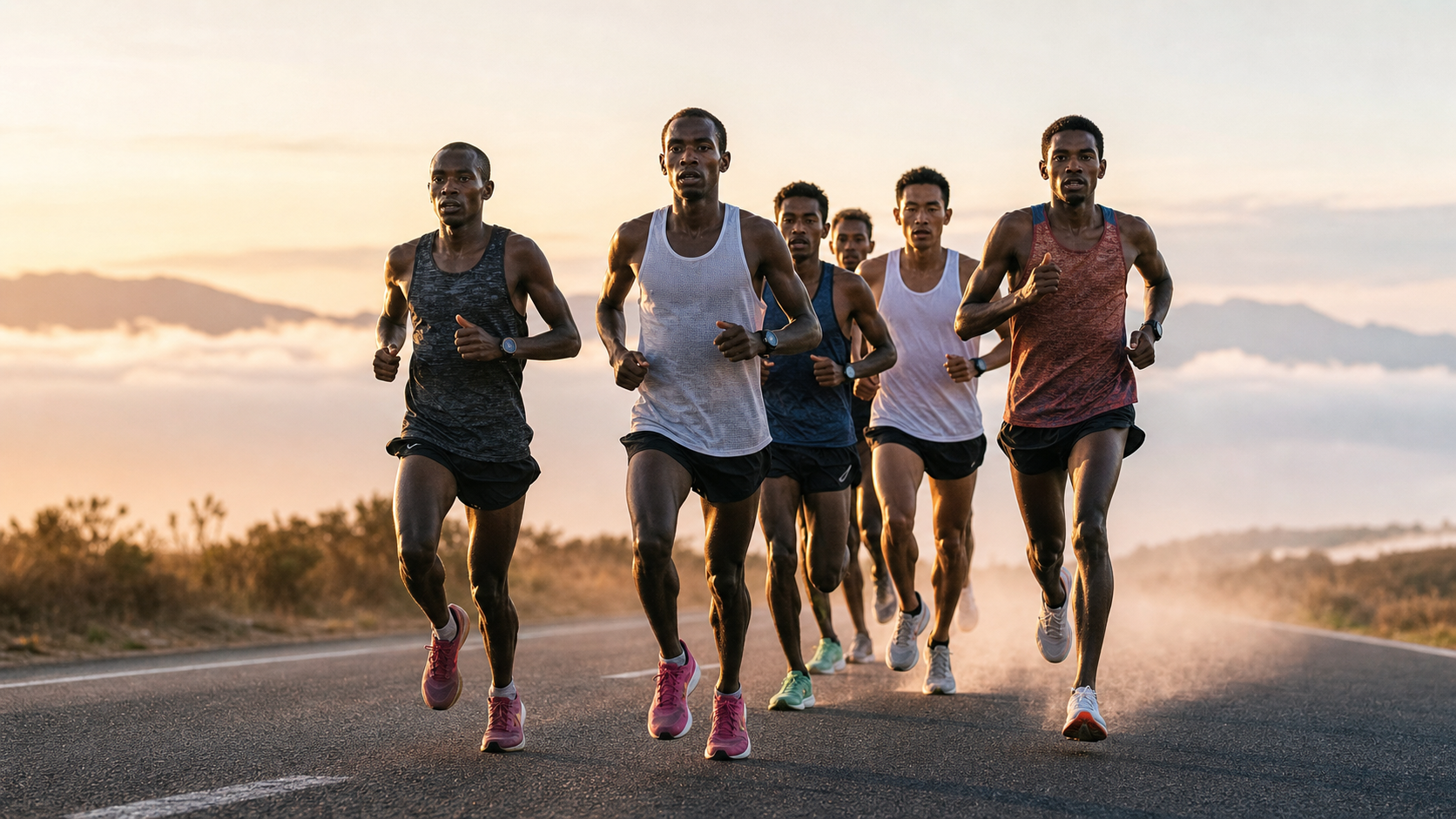
When a runner runs ahead, a low-pressure wake zone forms behind them—similar to the “slipstream” behind a cyclist. A runner behind who stays within this wake zone experiences a significant reduction in aerodynamic drag.
Researchers at Ghent University in Belgium (Blocken et al., 2013) used computational fluid dynamics (CFD) to simulate drag in different running formations:
- Directly behind at 0.5 m: drag reduced by ~62%
- Directly behind at 1 m: drag reduced by ~38%
- Directly behind at 3 m: drag reduced by ~14%
- To the side at 1 m: drag reduced by ~20%
- Diagonally behind at 1 m, 45-degree angle: drag reduced by ~35%
When converted to energy savings, these figures depend on speed, but at elite marathon pace, following closely behind can save approximately 2–4% of total energy expenditure.
The Formation Design of INEOS 1:59
The pacemaker formation in Kipchoge’s challenge was designed as: 2–3 runners ahead, 1 on each side, and 2 slightly behind, forming a dynamic “bubble.” Calculations from the study showed that this formation reduced the aerodynamic drag on Kipchoge by approximately 6–7%, equivalent to an energy saving of 2–3%—in a race pushing the limits of human performance, this assistance was decisive.
The Impact of Headwinds and Crosswinds
Wind direction is also an important variable:
- Tailwind: a tailwind of 1 meter per second can improve marathon performance by approximately 40–60 seconds
- Headwind: a headwind of 1 meter per second can worsen marathon performance by approximately 60–80 seconds
- Crosswind: the impact is smaller, but prolonged lateral resistance also increases energy expenditure
- World record rules: according to athletics regulations, performances achieved with a tailwind exceeding 2 meters per second are not recognized as world records
Drafting Strategies in Taiwan Road Races
For runners participating in local Taiwan road races (such as the Taipei Marathon, Wan Jin Shi Marathon, and Tanaka Marathon), the following strategies are practically relevant:
- Find a suitable group: In the early stages of a full marathon, join a group with a similar pace rather than running alone.
- Optimal drafting distance: Stay 1–2 meters directly behind the runner ahead—this offers the greatest benefit without the risk of collision.
- Pay extra attention during headwind sections: Coastal road races in Taiwan (such as Tanaka Marathon and Yilan Marathon) often feature crosswinds; during headwind sections, stay close to the group.
- Don’t stay at the back the whole time: After drafting for a long stretch, take turns moving to the front briefly to “break the wind,” both as a courtesy and to build your own strength.
- Reduced effectiveness in hot weather: In Taiwan’s summer road races (such as the high-temperature Tainan races), staying close to the group reduces aerodynamic drag, but it also reduces the airflow available for heat dissipation—a trade-off to weigh.
Beyond Aerodynamic Drag: The Psychological Benefits of Group Running
Research shows that group running offers not only physiological energy savings but also psychological benefits that cannot be ignored:
- Reduces “pace loneliness,” lowering the subjective rating of perceived exertion (RPE)
- Visual focus is directed at the runner ahead, reducing attention paid to fatigue
- Social facilitation effect: group competition stimulates higher performance output
Conclusion
Aerodynamic drag is not just a concern for cyclists—for road runners, at appropriate speeds, a drafting strategy can provide real and quantifiable energy savings. In Taiwan’s road races, making good use of group energy savings and choosing the right position is a “free speed boost” that costs nothing. Next race, don’t rush to the front at the start—first find your “lucky group” and let the science of airflow work for you.
Related Reading
- The Impact of Wind Resistance in Road Running: Differences in Energy Expenditure Between Drafting and Leading
- The Effect of Wind Resistance on Pacing: Quantifying the Impact of Headwinds and Tailwinds on Marathon Pace
- The Impact of Aerodynamic Drag in Running: A Quantitative Study of Gust Interference on Pace Control
- Calculating Long-Distance Running Pace: The Scientific Basis for 90 Seconds Slower Than Marathon Goal Pace
西進武嶺 免費訓練分析服務 Intervals | 練不夠還是練過頭?你哪一種類型選手?AI模型告訴你! | 備戰神器 | 公路車 訓練 | CT Yeh
4 年前
#公路車 #Vo2Max #最大攝氧量 測驗 體驗 | 心肺測試
6 年前
Live) 備戰2019彰化經典百K 賽前攻略 (已完賽請看新影片
7 年前
戰略) Zwift Race 如何咬在第一集團 如何評估自己要開多少推力 (請開1.5倍速看)
7 年前
一日北高/長距離團騎 常見問題補充篇 / 組團或跟團的眉角 / 壯車友容易被瘦車友慢性拉爆 / 原來屁股痛可能是這個原因...? / 風場配速法 / 公路車 / CT Yeh
2 年前
2019 柯P 超越北高 第一集團實錄 (11小時實錄請參考另一部影片) 一日雙城 一日北高 NeverStop Taiwan Long Distance Cycling Challenge
7 年前
西進武嶺 世界紀錄挑戰!破2:30 ?!一群人推著一個夢上山 直播精華版 / ft. 張翰允 & 台視主播魏于恬 & KPLUS / #cycling 公路車 CT Yeh
2 個月前
#公路車 #西進武嶺 配速配瓦實驗 坡度分析 四小時內攻略 建大盃 NeverStop #西進武嶺攻略
6 年前