The Physiology of Breathing in Swimming: CO₂ Accumulation and the Control Mechanisms of the Ventilatory Drive
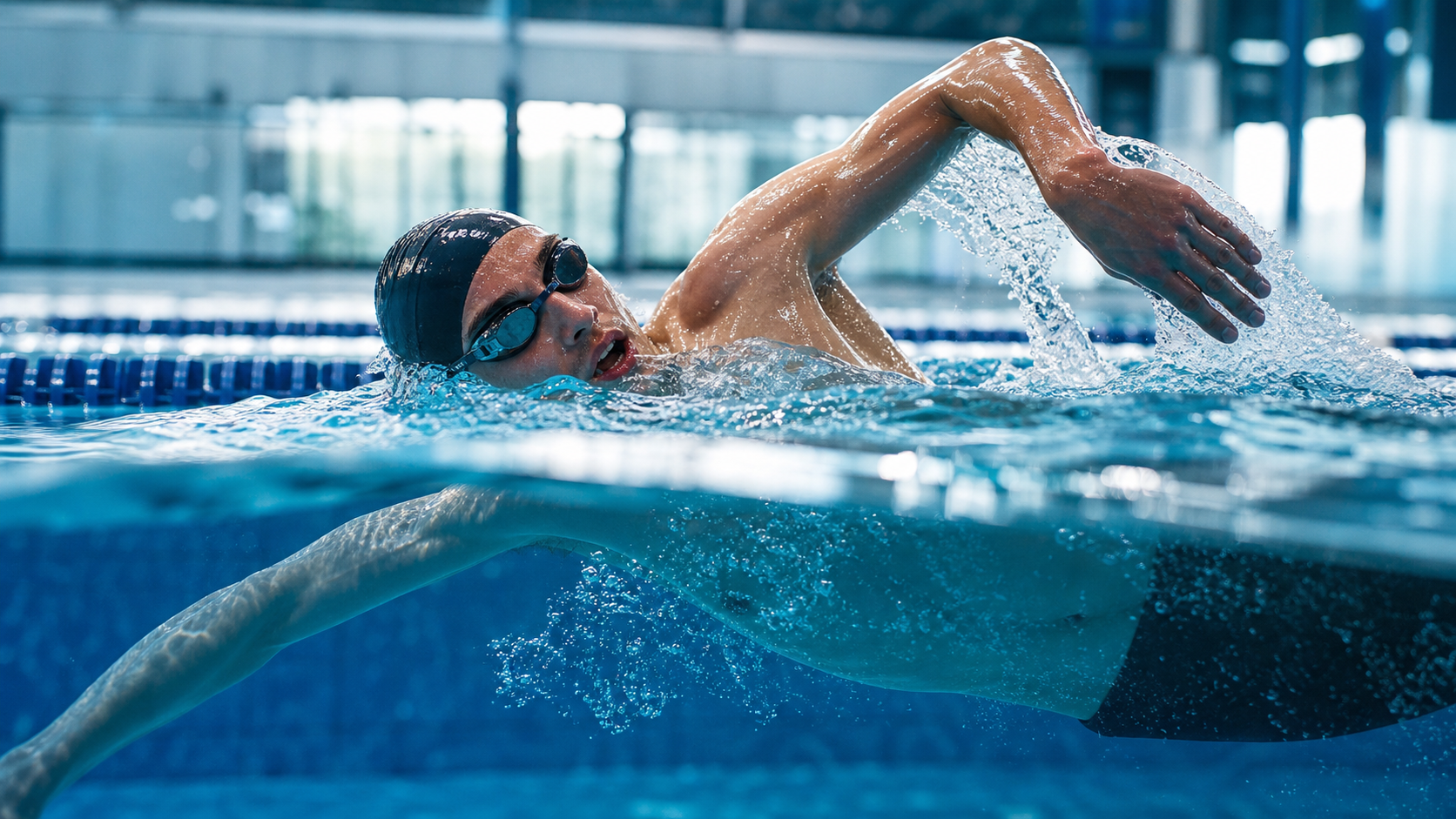
Breathing: The Biggest Technical Limitation in Swimming
In running or cycling, breathing is completely autonomous and can be adjusted instantly; but in swimming, breathing must be coordinated with the stroke rhythm and is strictly constrained by the movement cycle. This constraint makes the physiology of breathing in swimming more complex and fascinating than in any other sport. The answer to “why do I run out of breath after swimming a short distance” lies deep within the physiology of chemoreceptors, CO₂ control mechanisms, and neural respiratory reflexes.
The Chemical Control of Breathing: CO₂ Is the Real Star
Most people mistakenly believe that the “breathing urge” comes from hypoxia (lack of oxygen), but in reality, the primary signal that triggers breathing in the human body is the rise in blood CO₂ concentration (PaCO₂), not a drop in O₂ concentration.
The Two Major Chemoreceptor Systems
| Receptor Type | Location | Primary Stimulus | Sensitivity |
|---|---|---|---|
| Central chemoreceptors | Ventral surface of the medulla oblongata | CO₂ / H⁺ (decreased pH) | Extremely high, slow response |
| Peripheral chemoreceptors | Carotid bodies, aortic bodies | O₂ partial pressure (PO₂ < 60 mmHg for significant response) | Lower, rapid response |
Key data:
- When blood PaCO₂ rises from a normal 40 mmHg to 45 mmHg (an increase of only 5 mmHg), ventilation increases by approximately 200%
- Blood PaO₂ must drop from a normal 100 mmHg to below 60 mmHg before the peripheral chemoreceptors are significantly stimulated
- This is why swimmers usually still have sufficient O₂ in their blood when they feel “out of breath”
The Unique Challenges of Breathing in Swimming
1. Extremely Short Breathing Time
Available time for freestyle breathing:
- The full cycle of turning the head to breathe is approximately 0.4–0.6 seconds
- The actual time the “mouth is above the water surface” is only about 0.2–0.3 seconds
- Within this extremely short window, a complete breathing action of exhaling + inhaling must be completed
Optimal breathing technique:
- Continuously exhale slowly while in the water (face down) (do not hold your breath), allowing CO₂ to be expelled continuously
- At the moment of turning the head, only a quick inhale is needed—no exhaling required (the air has already been expelled beforehand)
- This maximizes the volume of fresh air inhaled
2. The Effect of Hydrostatic Pressure on the Rib Cage
When swimming, the hydrostatic pressure of water on the rib cage restricts chest expansion:
- At 30 cm below the water surface, hydrostatic pressure is approximately 23 mmHg
- This means the respiratory muscles must overcome additional “external resistance” to inhale fully
- Studies show that the work of breathing during swimming is approximately 25–30% higher than during land-based exercise at the same intensity
- Long-term swimming training significantly strengthens the respiratory muscles, which is why swimmers have excellent respiratory muscle endurance
3. The Interaction Between Breathing Rhythm and Blood Gases
The effects of different breathing rhythms (breathing every N strokes) on blood gases:
| Breathing Rhythm | Breaths per minute (based on 1 stroke per second) | PaCO₂ Trend | Suitable Context |
|---|---|---|---|
| Breathe every 2 strokes | Approximately 30 breaths/min | Lower, more CO₂ expelled | Final sprint phase |
| Breathe every 3 strokes | Approximately 20 breaths/min | Near normal | General training and racing |
| Breathe every 5 strokes | Approximately 12 breaths/min | Elevated, CO₂ accumulation | Hypoxic training (advanced) |
| Breathe every 7 strokes | Approximately 8 breaths/min | Significantly elevated | Restricted training (risky) |
The Danger of Hyperventilation: Shallow Water Blackout
This is the most important safety knowledge in the physiology of swimming breathing, causing multiple swimming accidents every year:
Mechanism
- Heavy hyperventilation before diving (continuous rapid deep breaths for 1–2 minutes)
- Hyperventilation expels large amounts of CO₂, dropping PaCO₂ from a normal 40 mmHg to 20–25 mmHg
- At this point, the “breathing urge” disappears (because CO₂ is extremely low, the chemoreceptors send no signal to trigger the urge to breathe)
- While holding the breath and swimming underwater, O₂ continues to be consumed and PaO₂ drops rapidly
- When PaO₂ falls to a dangerous level (< 40 mmHg), the brain suddenly loses consciousness
- Because CO₂ has been excessively expelled, the breathing urge never appears in time to warn the swimmer to surface
This is shallow water blackout: sudden loss of consciousness with no warning, which almost inevitably leads to drowning in water.
Prevention Principles
- Never hyperventilate before diving or breath-hold swimming
- Normal breathing for 1–2 breaths is sufficient before diving
- Breath-hold training should only be conducted with a lifeguard or a companion present
- Accidents of this type occur every year in Taiwan; widespread education is needed
The Physiological Benefits of Hypoxic Training
In swimming training, “hypoxic training” refers to deliberately extending the breathing interval (e.g., breathing only every 5 or 7 strokes), allowing CO₂ to accumulate moderately and training the adaptability of the chemoreceptors.
Evidence-based benefits:
- Improves respiratory muscle endurance
- Trains psychological resistance to the “breathing urge” (not becoming anxious from a slight CO₂ rise)
- Improves breathing technique (fewer breaths, less technical disruption)
Cautions:
- Hypoxic training is not the same as “oxygen-deprivation training”; the goal is not to lower O₂ but to adapt to rising CO₂
- Should be performed in a familiar pool with someone accompanying you
- Not suitable for beginners or individuals with heart disease
The Impact of Breathing Patterns on Swimming Technique
The choice of breathing rhythm affects not only physiology but also technique directly:
- Bilateral breathing (breathing every 3 strokes): Promotes body symmetry and avoids excessive rotation on one side, but ventilation is slightly insufficient
- Unilateral breathing (breathing every 2 strokes): Provides ample gas exchange, suitable for high-intensity racing, but tends to cause body asymmetry
- Mixed strategy: Bilateral breathing during training, switching to unilateral breathing for the final 50–100m of a race, is a common competitive strategy
Practical Training Recommendations for Swimming Breathing
- Continuous exhalation practice in the water: Practice exhaling in a steady, fine stream while in the water (rather than holding your breath until the last moment); use the number of bubbles to assess stability
- Breathing timing practice: Use the mental rhythm of “1-2-breathe” to make the head-turn timing more consistent
- Unilateral breathing correction: If you are accustomed to breathing on only one side, schedule 1–2 sessions of forced bilateral breathing training per week
- CO₂ sensation training: Perform moderate 5-stroke breathing training (slow pace, short distance) to become familiar with the feeling of rising CO₂, but do not overextend
Conclusion
The physiology of breathing in swimming reveals a counterintuitive fact: the “urge to breathe” is primarily CO₂ speaking, not O₂ calling for help. This knowledge changes our understanding of breathing training—moderate CO₂ tolerance training is beneficial, but hyperventilation (especially before diving) can be fatal. Mastering the physiology of breathing not only makes swimming technique more efficient but is also the foundation of water safety.
Related Reading
- The Science of Breathing Technique in Swimming: Breath-Hold Training and CO₂ Tolerance
- Swimming Breathing and Hyperventilation: The Science of CO₂ Tolerance Training (Breath-Hold Training)
- The Respiratory Physiology of Swimming: The Relationship Between Breathing Rhythm and Blood Oxygen Saturation
- Swimming Lung Capacity Training: The Physiology of Breath-Hold Training and Breathing Rhythm
#公路車 #Vo2Max #最大攝氧量 測驗 體驗 | 心肺測試
6 年前
一起升級!海鷗盃LSD團練...JJSC Zone2招待 騎到手抖 / 公路車 / CT Yeh
1 天前
詳測) 小米 電動打氣筒 公路車胎要充多久? 值得買嗎? 米家充氣寶 小心燙手!
7 年前
下雨天就是要改車 #ceramicspeed #bike
1 年前
風櫃嘴 衝刺慢動作回放!
8 年前
一日北高前的西濱集訓 | 跟著11小時軍團 | 300W踩不動的大逆風 | 輪車破風差幾瓦?
6 年前
3D 列印車褲墊 / 舒適改善? / 無痕 x 分區壓縮 / ATK & Decider系列 / JE22黑科技 / #公路車 #CTYEH
11 個月前
JE22 百里任務體驗,心跳不能過150,三小時內有可能...? 沒有天時地利難度有多高? / 公路車 / CT Yeh
1 年前