Introduction
Office workers in Taiwan sit for an average of over 9 hours a day, a figure that has climbed even higher in the work-from-home environment since the COVID-19 pandemic. Prolonged sitting keeps the hip flexors in a continuously shortened position, leading over time to adaptive tightness. For road runners, this is not just a flexibility issue—tight hip flexors directly alter running biomechanics and trigger a chain of injuries.
This article explains in depth how tight hip flexors affect running form, and how to improve the condition through evidence-based stretching and training prescriptions.
Anatomy and Function of the Hip Flexors
Primary Muscles
- Psoas Major: The deepest layer, extending from the lumbar spine to the lesser trochanter of the femur; it is the most important hip flexor
- Iliacus: Together with the psoas major, it forms the “iliopsoas”
- Rectus Femoris: Part of the quadriceps, crossing both the hip and knee joints
- Sartorius: The longest muscle in the human body, assisting with hip flexion and external rotation
Role in Running
During the swing phase of running, the hip flexors are responsible for rapidly bringing the rear leg forward; during the stance phase, they stabilize the pelvis. When these muscles are tight, the pelvis tilts anteriorly, which in turn affects the entire kinetic chain.
Assessing Hip Flexor Tightness
Thomas Test
This is the most commonly used clinical test for assessing hip flexor tightness:
- Lie on your back on a table or bed, letting your legs hang over the edge
- Hug one knee to your chest with both hands
- Observe the other leg:
- Normal: The thigh lies flat against the table, with the knee hanging naturally
- Tight iliopsoas: The thigh automatically lifts off the table
- Tight rectus femoris: The knee cannot bend beyond 90 degrees
Observable Signs While Running
- Noticeable anterior pelvic tilt and excessive lumbar lordosis while running
- Insufficient push-off force from the rear leg, with asymmetrical stride length
- Prone to lower back pain or ITBS (see Part 1 of this series)
Five Major Effects of Tight Hip Flexors on Running
| Affected Area | Specific Manifestation | Chain Injury |
|---|---|---|
| Anterior pelvic tilt | Excessive lumbar lordosis | Lumbar fatigue injuries |
| Gluteal inhibition | Gluteus maximus “shuts down” | Reduced running propulsion |
| Shortened stride | Rear leg cannot fully extend backward | Reduced running efficiency |
| Increased knee load | Excessive forward knee movement | Iliotibial band syndrome |
| Core instability | Compensatory lateral trunk bending | Back and hip injuries |
Daily Stretching Prescription
Basic Version (15 minutes, suitable for the office)
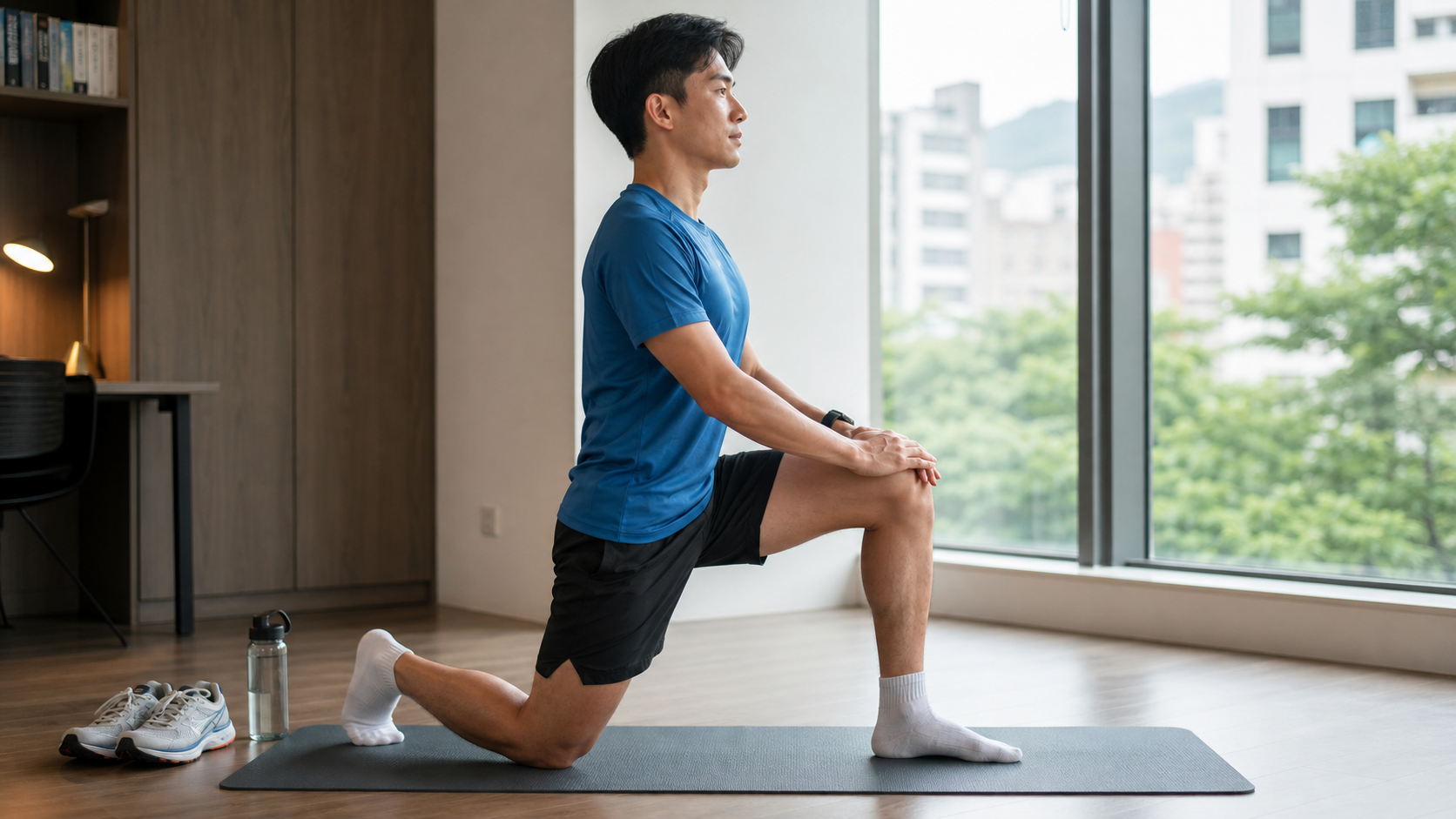
Kneeling Hip Flexor Stretch:
- Kneel on one leg, with the other foot stepped forward into a lunge position
- Push the hip of the rear leg forward, feeling a stretch in the front of the hip
- Hold for 45–60 seconds, then switch sides
- Advanced: Raise the arm on the side of the rear leg overhead to add lateral rotation
Couch Stretch:
- Place the top of one foot against a wall (or couch) with the shin vertical, and step the other foot forward into a lunge
- This is the most effective stretch for the rectus femoris
- Hold for 60–90 seconds, then switch sides
Pre-Run Dynamic Warm-Up Version (10 minutes)
- Butt Kicks: 30 seconds, to activate rectus femoris flexibility
- Walking Lunge with Twist: 10 steps per leg, opening the hips while rotating the torso
- High-Knee Walking: 10 steps per leg, actively engaging the hip flexors
- Side Lunges: 10 reps per leg, opening up hip joint range of motion
Intensified Version (for severe tightness, performed before bed)
- Lizard Pose: A yoga pose where the front foot’s outer side and elbow touch the floor, deeply stretching the hip flexors and adductors; hold for 90 seconds per side
- 90/90 Stretch: Seated position with the front and rear legs each bent at 90 degrees, deeply opening the hip joint; hold for 2 minutes per side
Resources and Recommendations in Taiwan
- Yoga Studios: Taiwan has numerous yoga studios in every city and county, with monthly fees around NT$2,000–4,000; instructors can help correct stretching posture
- Physical Therapists: If the Thomas Test shows obvious abnormalities, it is recommended to book a physical therapist for an individualized assessment (available through both NHI clinics and out-of-pocket services)
- Massage Guns: Widely used by Taiwanese runners in recent years; they provide auxiliary benefits for relaxing the hip flexors but cannot replace stretching training
Practical Advice
- Top priority for office workers: stand up and move for 5 minutes every hour, or switch to a standing desk
- Stretch the hip flexors first after running, when the muscles are warm for the best effect
- Doing 2 minutes of lunge stretches every morning is the minimum maintenance habit
- When performing glute strengthening exercises (squats, bridges), first ensure the hip flexors are fully relaxed
Conclusion
Tight hip flexors are the most common yet most overlooked problem among modern runners. Just 15 minutes of targeted stretching per day can significantly improve running biomechanics, reduce injury risk, and allow the glutes to engage fully. The time invested in stretching training will, in the long run, pay back with more injury-free miles.
Related Reading
- Runners with Tight Hip Flexors: Causes, Assessment, and Stretching Prescription
- Tight Hip Flexors While Running: Causes, Effects, and Complete Stretching Methods
- Hip Flexor Training for Runners: The Key Muscle Group for Preventing Running Injuries
- Stretching and Strengthening Combinations for Overly Tight Hip Flexors: Unlocking the Invisible Shackles of Sedentary Runners
一日北高/長距離團騎 常見問題補充篇 / 組團或跟團的眉角 / 壯車友容易被瘦車友慢性拉爆 / 原來屁股痛可能是這個原因...? / 風場配速法 / 公路車 / CT Yeh
2 年前
實景訓練台) 彰化經典百K 高強度喵團 90分鐘 跟著一起練功 2019 Indoor workout Changhua Classic 100 Taiwan
7 年前
Live) 備戰2019彰化經典百K 賽前攻略 (已完賽請看新影片
7 年前
一日北高常見問題大集合 | 攻略 | 路線 | 訓練 | 補給 | 自行車 單車 | 一日雙城 | 雙塔 | TWB北高360 | 屁股痛
6 年前
iPhone內建一秒變長腿🤣 車友必備#cycling
2 年前
西進武嶺 免費訓練分析服務 Intervals | 練不夠還是練過頭?你哪一種類型選手?AI模型告訴你! | 備戰神器 | 公路車 訓練 | CT Yeh
4 年前
2025 海鷗團體繞圈賽 網路直播 超激烈裁判長視角 / EIPC 李廷威、Waypoint 等眾多高手競爭 / feat. 卡密兒主持 / 海鷗繞圈賽
9 個月前
2019 柯P 超越北高 第一集團實錄 (11小時實錄請參考另一部影片) 一日雙城 一日北高 NeverStop Taiwan Long Distance Cycling Challenge
7 年前