Introduction
In the high-pressure arena of competitive swimming, when two athletes are physically equal, the one with better mental preparation often wins. Pre-race anxiety, scattered thoughts, and technique breaking down under pressure are real challenges many Taiwanese swimmers face at county/city meets or the National Swimming Championships. Establishing a personalized pre-race routine can help athletes step onto the starting block every time with a stable, highly activated mental state.
The Scientific Basis of Pre-Race Mental States
The Optimal Activation Theory
The “Individual Zone of Optimal Functioning (IZOF)” theory in sports psychology states that every athlete has a specific range of activation intensity within which they perform at their best. Over-activation (excessive nervousness) and under-activation (excessive relaxation) both reduce performance.
- Signs of over-activation: Racing heartbeat, shaky hands, scattered thoughts, technique falling apart
- Signs of under-activation: Sluggish reactions, lack of explosive power, low mood
- Optimal state: Focused yet relaxed, energetic but not anxious, fully confident
The Function of a Routine
A routine helps athletes reach their optimal activation state through the following mechanisms:
- Conditioned response: Specific behavioral patterns trigger the body’s competition-ready response
- Attention control: Directing thoughts toward controllable actions, away from anxiety-driven thinking
- Confidence reinforcement: Completing a familiar preparation process establishes a psychological confirmation of “everything is ready”
Framework for Designing a Pre-Race Routine
The Day Before the Competition (18–12 Hours Before the Race)
| Time Period | Activity | Purpose |
|---|---|---|
| Evening | Easy technique swim 1,500m | Maintain feel for the water without expending energy |
| Dinner | Fixed high-carbohydrate meal (e.g., rice, noodles) | Replenish muscle glycogen |
| Before bed | Mindfulness meditation or deep breathing for 10 minutes | Reduce pre-race anxiety, improve sleep quality |
| Sleep | In bed by 22:30 at the latest | Ensure 8 hours of sleep |
Race Day Morning (Wake-Up to Leaving)
Establishing a fixed morning routine is very important:
- Fixed wake-up time (wake up at least 3 hours before the race)
- Light breakfast (2–3 hours before the race: oatmeal, toast, bananas, and other easily digestible foods)
- Check gear checklist (swimsuit, swim cap ×2, goggles ×2, towel, ID card, athlete number)
- Personal motivational ritual (listening to a specific music playlist, silently repeating a personal mantra, watching inspirational videos, etc.)
Arriving at the Venue (Arrival to Entering the Water for Warm-Up)
- Familiarize yourself with the venue: Observe the pool, feel the air humidity, locate the changing rooms and warm-up pool
- Social management: Maintain positive interactions with teammates, avoid listening to negative comments (e.g., “the opponents are strong today”)
- Pace confirmation: Mentally reconfirm your personal race pace plan—not imagining the outcome, but imagining the process
Mental Techniques Toolbox
Focusing Cues
Choose 2–3 “race keywords” and silently repeat them before the start to keep your attention on technical execution rather than the race result:
- “Hand entry, extend, pull” (technical focus)
- “Relax, rhythm, breathe” (relaxation focus)
- “Steady, steady, sprint” (pace focus)
Visualization
15–20 minutes before the race, find a quiet spot, close your eyes, and perform a complete 3–5 minute visualization rehearsal:
- Imagine yourself stepping onto the starting block, feeling the surface, smelling the pool
- Imagine the starting signal sounding and rehearse every movement of the entire race
- Imagine touching the wall at your target time and feeling the emotion of success
Research shows that high-quality visualization practice produces neuromuscular activation similar to actual training.
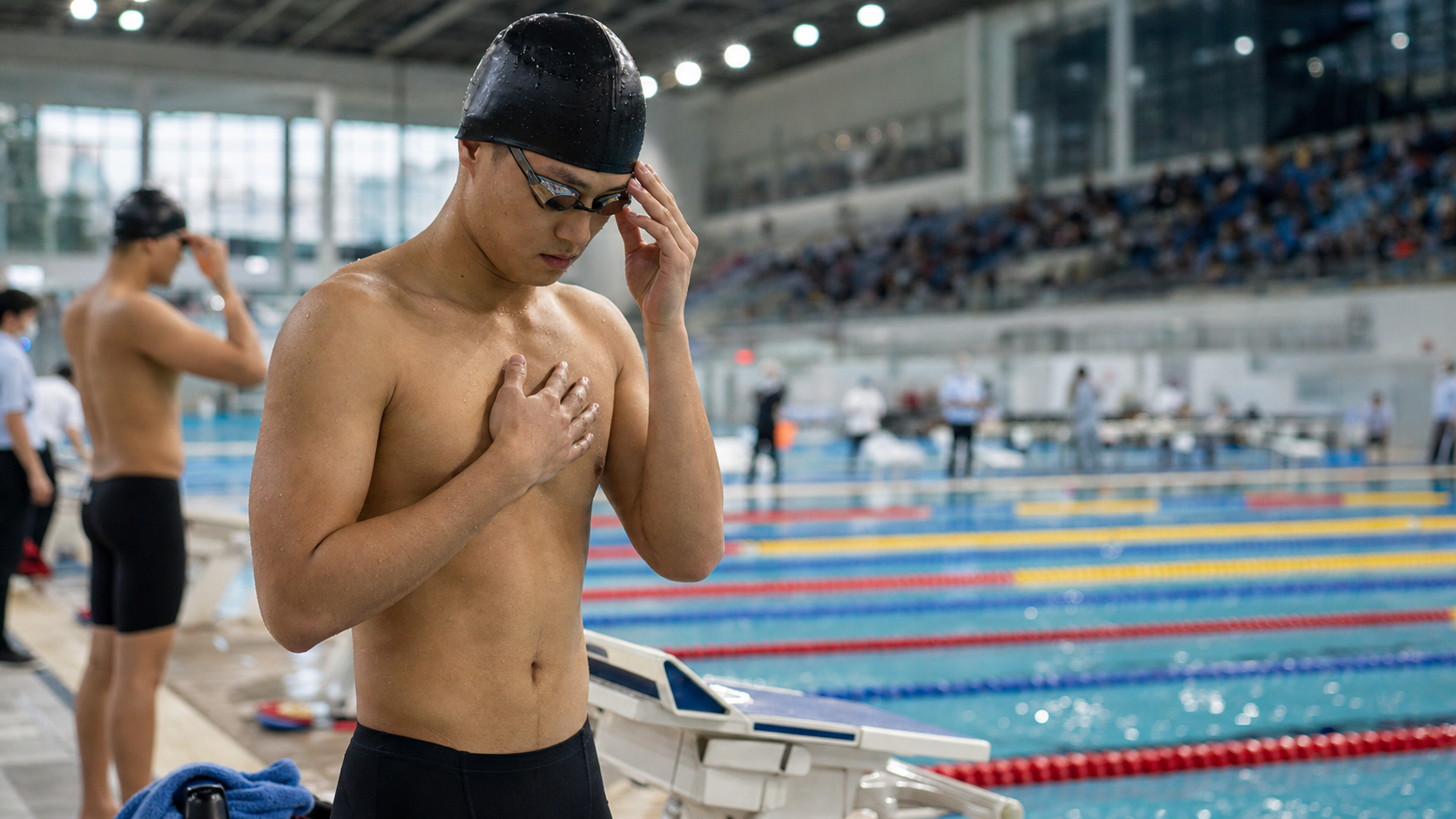
Final Check Before the Start (30-Second Ritual)
A fixed routine after stepping onto the starting block:
- Adjust the swim cap, confirm goggles are sealed
- Take 3 deep breaths (inhale for 4 seconds, exhale for 6 seconds)
- Silently repeat your personal race mantra (e.g., “I’m ready, just swim”)
- Fix your eyes on the touchpad at the far wall
- Assume the starting position and wait for the gun
Mental Challenges in Taiwanese Swimming Competitions
Taiwanese competitive swimmers often face specific psychological pressure situations:
- Collective pressure of county/city representative teams: The heavy responsibility of bringing honor to one’s county/city can increase anxiety
- Comparison anxiety from analyzing opponents: Over-studying opponents’ results while neglecting one’s own preparation
- Unfamiliarity with venues: Discomfort caused by unfamiliar venues when competing in other cities
Coping strategy: Focus on “what I can control” (your own pace, technique, preparation) and let go of “what I cannot control” (opponents’ conditions, environmental factors).
Practical Advice
- Test your routine in practice meets first to find a rhythm and length that suits you
- Do not add new elements at important competitions—the core of a routine lies in familiarity and predictability
- Allow for flexibility—if the schedule is delayed or the environment changes, be able to adjust within the framework without completely falling apart
- Work with a sports psychologist—if anxiety severely affects your competition, seeking professional help is the right choice
- Record your mental state after each competition to compare how different preparation methods affect race performance
Conclusion
In competitive swimming, victory or defeat is sometimes decided in those few seconds of mental space. Establishing your own pre-race routine is not superstition—it is a scientific tool that aligns the mind and body to work together. On Taiwan’s competitive swimming stage, the athletes who can swim every stroke according to plan even under the most intense race conditions are often the ones who ultimately stand on the podium as winners.
Related Reading
- Swimming Pre-Race Routine: The Psychological Stabilizing Function of Pre-Race Rituals
- Swimming Pre-Race Mental Preparation: How Top Athletes Find Calm in the Water?
- Mental Preparation for Swimming Competitions: Breathing and Focus Techniques Before the Start
- Managing Pre-Race Nervousness in Swimming: Analyzing Pre-Race Anxiety from a Sports Psychology Perspective
西進武嶺 自製新版AI配速表產生器 x 賽前攻略 抱佛腳! 沒有功率計也可以產生配速表嗎?有什麼其他眉角賽前要注意的呢? | 西進武嶺 / 東進武嶺 KOM 攻略 | 公路車 | CT Yeh
4 年前
[教學] Premiere 影片 手震 修正 教學 防抖 單眼 影像 GoPro 穩定 Video Stabilization
8 年前
西進武嶺 免費訓練分析服務 Intervals | 練不夠還是練過頭?你哪一種類型選手?AI模型告訴你! | 備戰神器 | 公路車 訓練 | CT Yeh
4 年前
FTL 與 SYB 車隊專訪 西進武嶺 實用攻略分享! 2小時 如何練?!你不知道的眉角!新手準備武嶺必看 EP1 | 實力派女車友 | 精華版 | 公路車 | CTYeh
4 年前
Live) 備戰2019彰化經典百K 賽前攻略 (已完賽請看新影片
7 年前
備戰 戀戀197 賽前關門點分析 西濱團練 #公路車 4K高畫質
6 年前
2025 海鷗團體繞圈賽 網路直播 超激烈裁判長視角 / EIPC 李廷威、Waypoint 等眾多高手競爭 / feat. 卡密兒主持 / 海鷗繞圈賽
9 個月前
昇陽SYB車隊 & Fuji 菁英選手們的趣味經驗分享,長知識了!市民車友必看~ 一路被拉爆後才給問 | 戀戀197 武嶺 凸台經驗分享 | 公路車 | CT Yeh
4 年前