Introduction
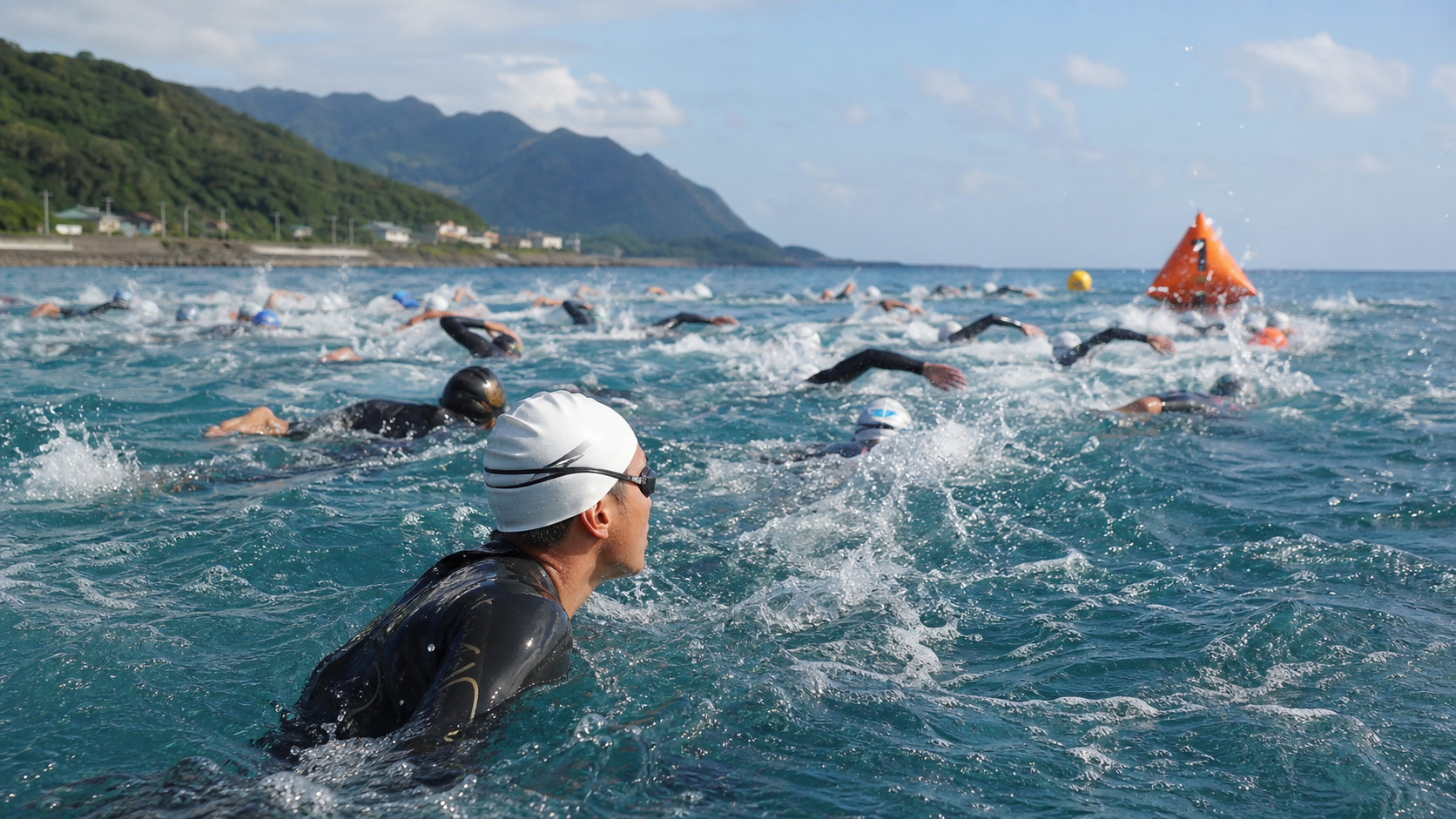
Triathlon has grown rapidly in Taiwan in recent years. From the Taitung Beauty Triathlon and the Taroko Triathlon to standard-distance races across the island, the open-water swim leg is the most stressful part for many amateur athletes. Unlike the calm environment of a pool, the open-water start is a chaotic battlefield where dozens to hundreds of athletes enter the water simultaneously—getting hit by elbows, kicked in the face, and swallowing seawater are nightmares for first-time competitors. An effective start strategy not only protects your body but also saves precious energy for the bike and run legs ahead.
Three Options for the Open-Water Start
Strategy One: Attack the Inside Line (Shortest Route)
Swim along the side closest to the buoys for the shortest route, but face the most intense competition.
Best suited for:
- Strong swimmers (able to complete 400m within 5 minutes)
- Athletes with strong mental toughness who don’t fear physical contact
- Athletes who can quickly establish a leading position
Risks: Being shoved, kicked, or pushed under at the start, burning significant extra energy
Strategy Two: Take the Outside Detour (Avoid the Crowd)
Enter the water 10–20 meters outside the start area, trading a slightly longer route for smoother swimming.
Best suited for:
- Triathletes for whom swimming is a weakness
- Athletes who tend to panic in chaos
- Athletes who value steady pacing throughout the race
Advantages: Avoids the densest crowd conflicts, swims at a steady rhythm, and may produce a better overall result
Strategy Three: Start from the Back (Wait for the Crowd to Spread)
Delay your start by 10–15 seconds after the starting signal, letting the front pack spread out first.
Best suited for:
- First-time competitors
- Athletes who fear crowd conflicts
Cost: Losing 15–30 seconds of start time, but gaining a safer swimming environment
Open-Water Sighting Techniques
In pool swimming, athletes can follow the black line, but open water offers no visual guidance. Sighting is the core skill for preventing veering off course and lengthening your route.
| Sighting Method | Technique Description | Recommended Frequency |
|---|---|---|
| Forward sighting | Every 6–8 strokes, lift your head for a quick look at the buoy ahead | Every 10–15 seconds |
| Side sighting | During breathing, quickly glance at the side buoy | As needed |
| Draft sighting | Follow the foot bubbles of a faster swimmer ahead | Continue once you find a suitable swimmer |
Sighting practice drills:
- In the pool, deliberately lift your head to look at the water surface after 5–6 strokes to simulate the sighting motion
- Practice keeping your head up for only 0.5 seconds before returning it to reduce speed loss from lifting
- During open-water training, pick a fixed distant landmark and practice swimming in a straight line toward it
Crowd Conflict Response Techniques
Physical contact at the open-water start is unavoidable. Learning to respond correctly is key to self-protection:
- When your ankle is grabbed: Don’t struggle forcefully (it wastes energy); give 1–2 light kicks to make the other person let go naturally
- When pushed off course: Stay calm, use 2–3 powerful strokes to adjust your direction, and don’t stop swimming
- When pushed underwater: Immediately roll onto your back, tread water to recover your breathing, then continue forward
- When your goggles are knocked askew: Switch to breaststroke or doggy paddle, adjust your goggles with one hand, and don’t stop in place
Special Challenges of Taiwan’s Triathlon Swim Legs
Taiwan’s triathlon events are often held in unique waters with their own environmental factors:
- Taitung Living Lake (e.g., Taitung Beauty): Calm water, but narrow course with high crowd density
- Ocean races (e.g., Penghu Triathlon): Waves and currents add extra sighting challenges
- Reservoir or man-made lake races: Poor visibility and low water temperature require early adaptation
Pre-race course reconnaissance tips:
- The day before the race, visit the swim start to observe buoy positions and current direction
- If permitted, do 1–2 short open-water swims before the race to familiarize yourself with the water
- Confirm buoy colors (start buoys are typically orange, turn buoys yellow, and finish buoys red)
Drafting: Making Use of Others’ Water Flow
Drafting is a legal energy-saving technique in open-water swimming. Swimming 0.5–1 meter behind the feet of the swimmer ahead can reduce drag by approximately 15–25%.
- Best drafting position: Directly behind the front swimmer’s feet or alongside their legs (45 degrees to the rear)
- Train with a partner: Practice drafting with a training partner of similar speed, taking turns leading
- Maintain awareness: While drafting, you still need to periodically lift your head to confirm your direction—don’t rely entirely on the swimmer ahead
Practical Advice
- Include open-water swimming in every training session; if you can’t get to open water, at least simulate the start sprint in the pool
- Practice swimming in your triathlon suit (or wetsuit) to match the feel of race-day gear
- Know your panic triggers; if crowds make you anxious, the outside strategy is well worth the extra 50–100 meters
- Check the water temperature before the race; consider a wetsuit if it’s below 24°C, and follow each event’s regulations in Taiwan
- Establish your own pace immediately after the start; don’t follow the crowd’s too-fast or too-slow rhythm
Conclusion
The open-water swim start is one of the most challenging parts of a triathlon, but with the right strategy and adequate mental preparation, it can also become your opportunity to overtake competitors. If Taiwan’s triathletes can master crowd response, sighting techniques, and drafting strategies, the energy saved in the swim leg becomes competitive capital for the bike and run legs. Start training now, and turn swimming from a triathlon weakness into your secret weapon.
Related Reading
- Open-Water Swimming Start Strategy: Position and Pacing in a Mass Start
- Triathlon Swim Leg Start Strategy: Collision Risk Assessment of Outside vs. Inside Starts
- Open-Water Start Chaos Strategy: How to Find Your Rhythm in the Crowd
- Triathlon Swim Training: Overcoming Fear of Open Water and Improving Efficiency
[防寒衣體驗] 鐵人魂 三鐵 防寒衣試穿會 於松運 深水游泳池 鯨魚池
8 年前
Live) 備戰2019彰化經典百K 賽前攻略 (已完賽請看新影片
7 年前
CT 喇低賽) 武嶺牽車 才是王道 西進牽車四小時內秘訣 攝手位置 如何判斷 防抽筋小秘訣
7 年前
新屋團體繞圈賽 | 眾多菁英好手賽道奔馳 | 千瓦女子軍團 | 無敵交管狂獲好評 明年你一定不能錯過 | #公路車
5 年前
2023桃園團體繞圈賽 / 海鷗繞圈賽 | 全程空拍數據版 | 公路車 | CT Yeh
2 年前
2023桃園團體繞圈賽/環台賽等級拍攝/賽事精華/ 10人一隊缺一不可!50隊廝殺大場面 / 第三屆 海鷗繞圈賽 /公路車/CT Yeh
2 年前
新玉門關 單車挑戰賽 多視角主集團衝刺菁華版 4K #公路車
5 年前
JE22 百里任務體驗,心跳不能過150,三小時內有可能...? 沒有天時地利難度有多高? / 公路車 / CT Yeh
1 年前