Improving Transition 1 (T1) Efficiency in Swimming: Optimizing Seconds for Wetsuit Removal, Shoeing, and Mounting the Bike
Introduction
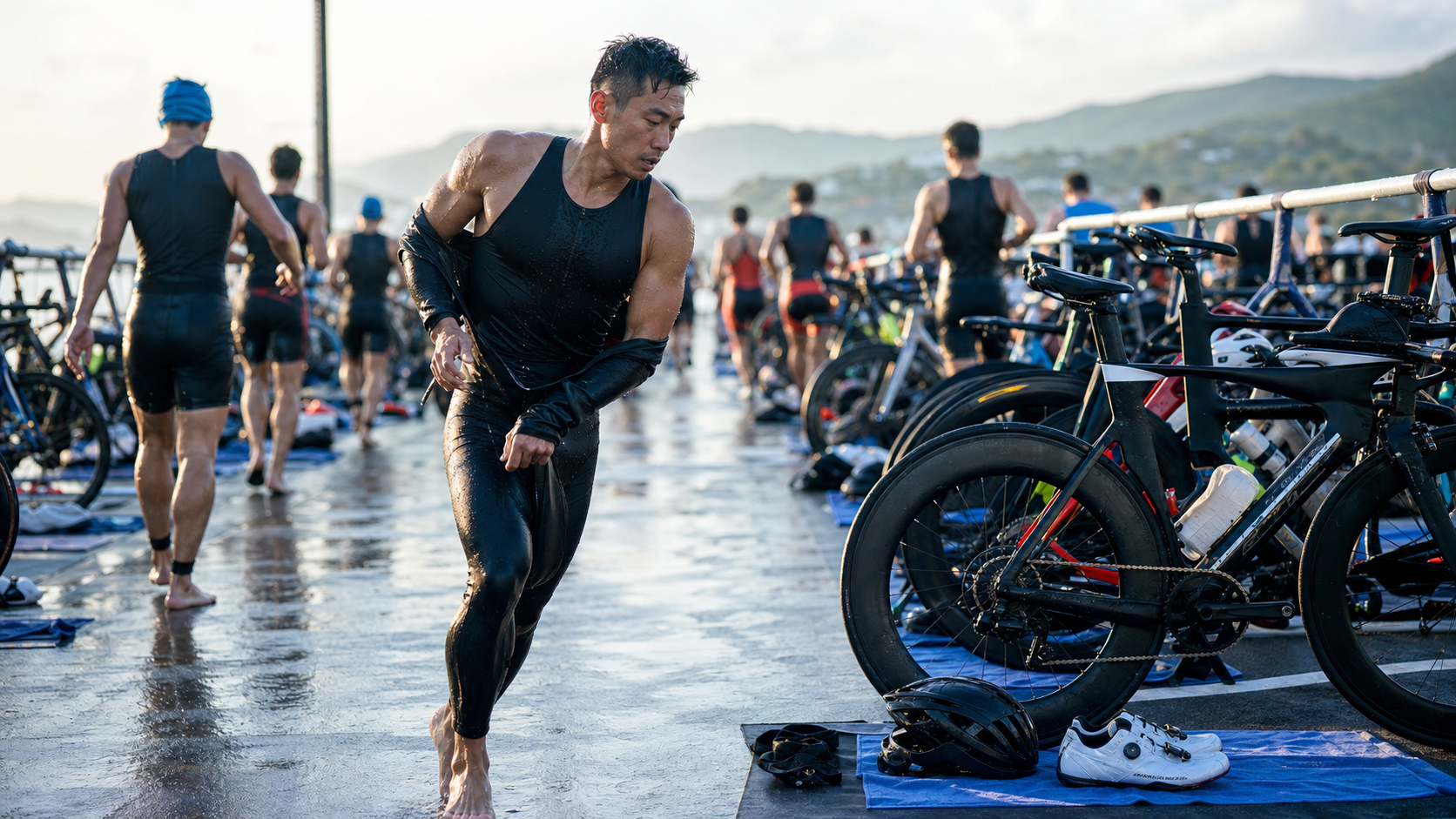
In Taiwan’s triathlon events, T1 (the swim-to-bike transition) is where many athletes unnecessarily give away 30 seconds to 2 minutes. After finishing the swim leg, plenty of athletes fumble around in the transition area—wetsuits sticking to their bodies and refusing to come off, goggles tangled in their hair, shoelaces that won’t cooperate—and this chaos directly erodes the advantage they worked so hard to build in the swim. A systematic T1 training approach can help you cut these “overhead” costs to a minimum.
Breakdown of T1 Time Components
A typical T1 transition includes the following steps, with baseline times for each:
| Step | Average Amateur Time | Elite Target Time | Optimization Focus |
|---|---|---|---|
| Run from water exit to transition area | 30–60 sec | 20–40 sec | Maintain running rhythm, don’t stop |
| Remove swim cap and goggles | 10–20 sec | 3–5 sec | Remove while running after exiting the water |
| Remove wetsuit (if worn) | 45–120 sec | 20–40 sec | Pre-apply lubricant, practice technique |
| Put on helmet | 5–15 sec | 3–5 sec | Adjust straps beforehand |
| Put on shoes | 15–40 sec | 5–10 sec | Loosen laces, confirm shoe size |
| Grab bike and exit | 5–10 sec | 3–5 sec | Familiarize yourself with bike rack position |
Goal: Amateur athletes should reduce T1 time from an average of 3–4 minutes to 1:30–2:00; elite amateurs should target 1:00–1:30.
Fast Wetsuit Removal Technique
The wetsuit is the biggest bottleneck in T1 efficiency. Here is a systematic removal technique:
Preparation Before Exiting the Water
- Pre-cut ankle openings: Some athletes make small cuts at the wetsuit ankles (check race rules to determine if this is allowed), making it easier for the feet to slip out
- Pre-apply lubricant: Apply petroleum jelly or baby oil to the wrists and ankles before the race to significantly reduce friction
- Check the back zipper: Ensure the zipper pull cord is secured along the suit and won’t tangle around your arms
From Water Exit to Transition Area (Removing While Running)
- Step 1: Immediately pull the back zipper down after exiting the water (if it’s a cord-pull type, biting it with your teeth is also a common trick)
- Step 2: Push the collar down to the shoulders, freeing both shoulders first
- Step 3: Continue pushing down, letting the entire wetsuit drop to the waist
- Step 4: Once at your transition spot, sit or stand and quickly push the wetsuit from the waist down to the ankles and step out of it
Practice Point: Practice “removing the wetsuit while jogging” during training so the movement becomes muscle memory, rather than trying it for the first time on race day.
Optimizing Gear Placement in the Transition Area
Where you place your gear in the transition area directly affects operational efficiency:
- Helmet: Facing you with the opening toward you, already buckled and adjusted to size, placed on the handlebars
- Cycling shoes: If using cleated shoes, you can pre-attach them to the pedals with rubber bands (putting them on while riding)—an advanced technique
- Regular running shoes: Laces fully loosened in advance, tongue pulled open, apply a layer of petroleum jelly for faster entry
- Swim cap and goggles: Remove while running after exiting the water, so they’re already off before reaching the transition area
- Towel (optional): Use for a quick foot wipe to prevent difficulty putting on shoes
Integrated T1 Training Drills
Many athletes only do a full T1 rehearsal on race day itself—that’s a serious lack of preparation. Recommended training schedule:
- One T1 simulation session per week: After swimming, do a full T1 rehearsal and record the time with a stopwatch
- Simulation race 2–3 weeks before the event: Find an environment similar to the race course and fully simulate the swim exit → T1 → bike start connection
- Standardize your gear setup: Use the same gear configuration every time so your hand movements become fully automatic
T1 Special Situations in Taiwan Events
Taiwan triathlon transition areas present some common scenarios that require specific preparation:
- Transition area ground surface: Some events have concrete transition areas, others have grass; putting on shoes is harder on grass, so consider bringing an extra pair
- Distance from water exit to transition area: At Taitung’s Living Lake, the distance from the water exit to the transition area is about 50–80m, so you can start unzipping your wetsuit early
- Confirm race rules: Check whether the event allows starting wetsuit removal outside the transition area (some events have specific regulations)
Practical Tips
- Scout the transition area before the race: Remember your bike rack position (row number, nearby landmarks) to avoid not finding your bike during the race
- Put on your helmet first: According to ITU rules, your helmet must be fastened before touching your bike, or you risk a time penalty or disqualification
- Don’t hydrate or eat during T1: Save those actions for the bike leg—every second in T1 is worth saving
- Anti-fog treatment for lenses: If you’ll be wearing cycling sunglasses after the transition, make sure the lenses are clean
- Practice under race-like conditions: Practice T1 after swim training while still breathing hard and with an elevated heart rate—that’s the real training scenario
Conclusion
T1 transition efficiency is one of the easiest parts of a triathlon to improve through practice. A well-prepared, smoothly executed T1 can help you beat competitors in Taiwan’s major triathlon events who may swim faster than you but panic in the transition area. Treat every post-training transition practice as if it were race day, and let those fast, fluid movements become your most natural response on the course.
Related Reading
- Triathlon T1 Transition Efficiency: Optimizing Seconds for Wetsuit Removal and Goggle Storage
- Triathlon Swim-to-Bike T1 Technique: Training Methods for Fast Wetsuit Removal
- Triathlon Transition T1 Optimization: Efficient Switching from Water to Bike
- T1 Transition Optimization: The 90-Second Time-Saving Technique from Water Exit to Mounting
西進武嶺 免費訓練分析服務 Intervals | 練不夠還是練過頭?你哪一種類型選手?AI模型告訴你! | 備戰神器 | 公路車 訓練 | CT Yeh
4 年前
FTL 與 SYB 車隊專訪 西進武嶺 實用攻略分享! 2小時 如何練?!你不知道的眉角!新手準備武嶺必看 EP1 | 實力派女車友 | 精華版 | 公路車 | CTYeh
4 年前
Live) 備戰2019彰化經典百K 賽前攻略 (已完賽請看新影片
7 年前
2016 桐花飛舞 單車挑戰 精華片段
10 年前
一日北高前的高裝檢 | 北高 360 | 挑戰11小時的裝備 | 一日雙塔 | 補給
6 年前
SRAM FORCE E1 首發!/ 改成短腿了 / 煞車升級有感嗎? / TIME ADH 變速大升級 / 公路車 / CT Yeh
1 年前
2023桃園團體繞圈賽 / 海鷗繞圈賽 | 全程空拍數據版 | 公路車 | CT Yeh
2 年前
西進武嶺 自製新版AI配速表產生器 x 賽前攻略 抱佛腳! 沒有功率計也可以產生配速表嗎?有什麼其他眉角賽前要注意的呢? | 西進武嶺 / 東進武嶺 KOM 攻略 | 公路車 | CT Yeh
4 年前