Long-Distance Swimming Event Nutrition: No Refueling for 1500m and Above vs. Open-Water Mid-Race Refueling Strategies
Introduction
Swimming is one of the few sports where refueling during competition is most challenging—you cannot eat directly in the water, and the design of aid stations varies greatly depending on the stroke and the nature of the event. In Taiwanese swimming events, the 1500m freestyle is the longest standard individual event in long-course competition; in the swim leg of triathlons, distances range from 750m (standard triathlon) to 3.8km (Ironman). Different distances and different water environments demand vastly different refueling strategies.
1500m Pool Race: The Scientific Basis for No Refueling
In a standard 50m pool, the world record for the 1500m freestyle is approximately 14 minutes 30 seconds (men), while elite amateur athletes take about 18–22 minutes. Within this time frame, refueling is almost unnecessary and impractical:
| Factor | Explanation |
|---|---|
| Race duration | 15–25 minutes, below the time threshold requiring refueling (generally 60 minutes) |
| Carbohydrate expenditure | Approximately 80–120 kcal, far below the threshold for glycogen depletion |
| Refueling feasibility | Pool competition rules do not allow mid-race refueling; only pre-race fueling is possible |
| Dehydration risk | In short-duration, high-intensity exercise, mild dehydration (< 2%) has limited impact on performance |
The correct refueling strategy for 1500m is fueling “before” the race, not during it:
- 2–3 hours before the race: High-carbohydrate meal (rice, noodles, bread)
- 30–60 minutes before the race: 100–200ml sports drink or water
- 10 minutes before the race: Optionally consume a small amount (100ml) of an electrolyte-containing beverage, but avoid excess to prevent gastrointestinal discomfort
Refueling Challenges in Ultra-Long-Distance Open Water
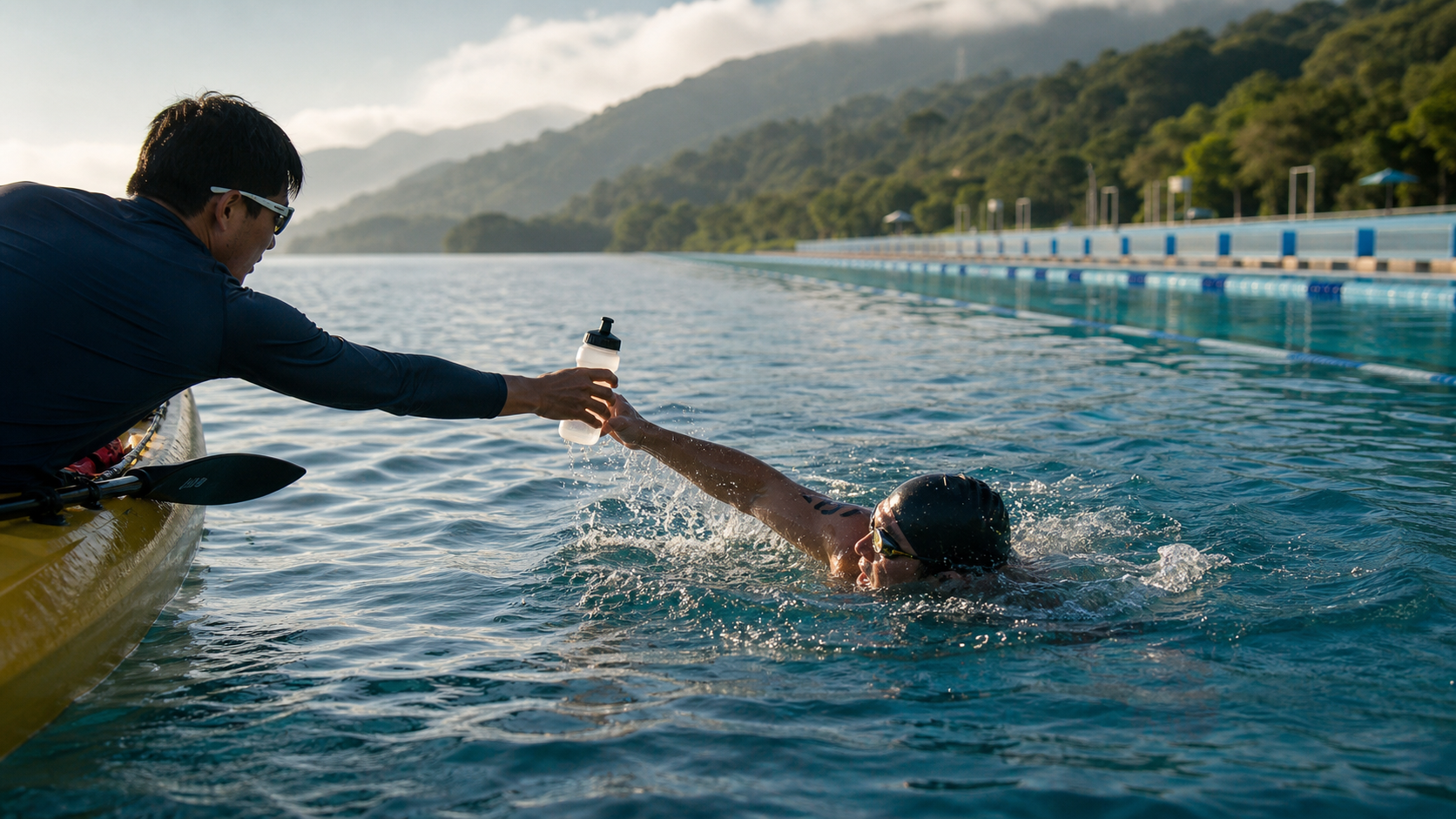
In Taiwanese or international open water events, ultra-long-distance swims exceeding 5km (such as crossing Sun Moon Lake or the Penghu cross-sea swim), refueling becomes a critical factor in finishing the race.
Special Challenges of Open Water Refueling
- Refueling stop time: Spending too long alongside the support boat can affect your time; rapid refueling techniques need to be practiced
- Mixing water and drinks: Some athletes accidentally swallow seawater/lake water during refueling, causing gastrointestinal discomfort
- Special needs in cold water: Cold-water swimming expends additional calories (to maintain body temperature), so refueling amounts must be increased accordingly
- Psychological refueling effect: The pause for refueling when fatigued also has a psychological recovery effect
Recommended Refueling Intervals for Ultra-Long Distances
| Race distance | Recommended refueling frequency | Amount per refueling | Refueling content |
|---|---|---|---|
| 3–5km | Every 1.5–2km | 200–300ml | Sports drink or diluted carbohydrate solution |
| 5–10km | Every 1–1.5km | 150–200ml | High-sodium sports drink + energy gel |
| 10km and above | Every 1km | 150ml | High-energy drink + solid food (banana, etc.) |
Refueling Strategy for the 1.9km–3.8km Swim Leg in Triathlon
In half-Ironman (1.9km swim) and full Ironman (3.8km swim), the swim leg itself typically has no aid stations (determined by the rules), but pre-race refueling strategy is crucial:
Pre-race refueling recommendations for the full Ironman swim leg:
- Night before the race: High-carbohydrate dinner (approximately 8–10g carbs/kg body weight)
- 2–3 hours before the race: Carbohydrate + protein breakfast (such as oatmeal, banana, boiled eggs)
- 30 minutes before the race: 100ml sports drink + 1 energy gel (if your stomach can tolerate it)
- Goal: Enter the water with muscle glycogen stores at their maximum, ensuring energy supply throughout the entire 3.8km swim leg
Common Refueling Mistakes
- Overdrinking before the race: Excessive water intake (especially plain water) can cause hyponatremia; long-distance swimmers need to pay special attention to electrolyte replenishment
- Trying untested refueling products: Using energy gels or drinks on race day that were not tested during training may trigger gastrointestinal issues
- Rapidly accelerating after refueling: Immediately returning to full speed after a refueling stop can cause a sudden heart rate spike, potentially triggering temporary discomfort
Practical Recommendations
- Simulate refueling rhythm in training: During ultra-long-distance training swims, simulate the stops and rapid refueling movements
- Personalized refueling plan: Every athlete’s gastrointestinal tolerance differs; you must find the refueling products and amounts that work for you during training
- Prioritize electrolytes: In long-distance swimming, sodium (salt) replenishment takes priority over carbohydrates, because low sodium is more dangerous
- Record refueling responses during training: Which brand of energy gel keeps your stomach comfortable and which makes you uncomfortable—all of this needs to be systematically recorded
- Backup refueling plan: If your planned refueling products are unavailable on race day, you need a backup plan (such as extra sports drinks)
Conclusion
The core principle of swimming refueling strategy is: the shorter the race, the more you rely on pre-race fueling; the longer the race, the more you need a precise mid-race refueling plan. Taiwanese swimmers facing the 1500m pool race and ultra-long-distance open water events should design different refueling strategies for different scenarios and thoroughly test them in training, ensuring they can swim their best with optimal fuel supply on race day.
Related Topic Reading
- Refueling Strategies for Long-Distance Swimming Races: Energy Preparation for 1500m and Above
- Refueling Strategies for Long-Distance Swimming: Differences Between Pool Refueling and Open Water Refueling
- Building Rhythm in Long-Distance Swimming: Pacing Strategies for the 1500m
- Energy Refueling in Open Water: How to Eat During Long-Distance Swim Races
Live) 備戰2019彰化經典百K 賽前攻略 (已完賽請看新影片
7 年前
西進武嶺 免費訓練分析服務 Intervals | 練不夠還是練過頭?你哪一種類型選手?AI模型告訴你! | 備戰神器 | 公路車 訓練 | CT Yeh
4 年前
live) 超越北高 之一日北高12小時 策略
7 年前
#公路車 #西進武嶺 配速配瓦實驗 坡度分析 四小時內攻略 建大盃 NeverStop #西進武嶺攻略
6 年前
崇越盃武嶺冠軍高手 賽前JJSC 群峰會精華!對應大數據分析,會有落差嗎?/ feat. JJSC中部公路車約騎 /公路車 / CT Yeh
2 年前
2019 夏季KOM 5小 完賽心得 準備攻略 東進武嶺 夏季登山王之路 Taiwan KOM Challenge
7 年前
西進武嶺 自製新版AI配速表產生器 x 賽前攻略 抱佛腳! 沒有功率計也可以產生配速表嗎?有什麼其他眉角賽前要注意的呢? | 西進武嶺 / 東進武嶺 KOM 攻略 | 公路車 | CT Yeh
4 年前
一日北高前的高裝檢 | 北高 360 | 挑戰11小時的裝備 | 一日雙塔 | 補給
6 年前