Simulated Race Training During the Swim Training Period: The Psychological and Physical Benefits of a Monthly All-Out Race
Introduction
Many Taiwanese swimmers fill their training calendars with large volumes of aerobic and interval training during the preparation cycle, yet overlook a key training element: regular all-out time trials. Just as marathon runners need a half-marathon warm-up race before the main event, swimmers also need regular practice at “race simulation” intensity—this is not just a fitness test, but a systematic training method for establishing neuromuscular race patterns.
Definition and Purpose of Simulated Races
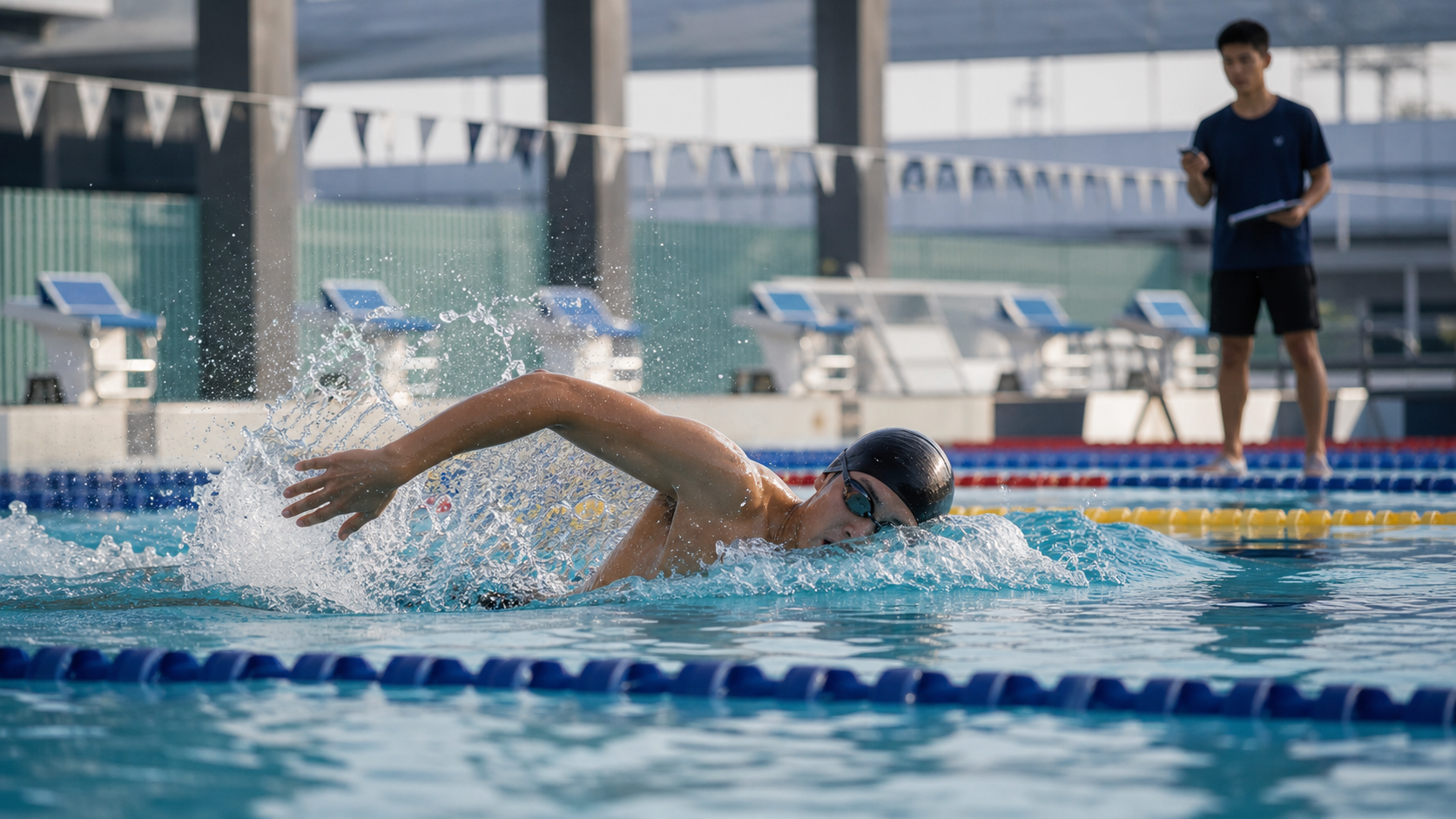
Race Simulation Training is a training mode in which a swimmer completes a full race distance at all-out race intensity in a training environment, with the time recorded. It differs from regular high-intensity interval sets, mainly in the following ways:
- Full distance: Not partial-distance intervals, but the complete race distance (e.g., swimming a full 100m or 200m)
- All-out output: Intensity reaches race level, with no conservative pacing
- Pre-race preparation: Uses the full pre-race warm-up protocol, rather than jumping straight into the water
- Time recording: Precise timing and record-keeping to track progress
Scientific Benefits of a Monthly Simulated Race
Physical Benefits
| Benefit | Description | Quantitative Indicator |
|---|---|---|
| Anaerobic system activation | All-out swimming activates the phosphocreatine system more completely than regular interval training | Increased peak power output |
| Lactate tolerance testing | Lactate accumulation at actual race intensity allows the body to adapt | Post-race peak blood lactate |
| Neuromuscular coordination | Technical coordination at race pace differs from slow-speed training | Stroke rate, stroke efficiency |
| Cardiorespiratory system strengthening | Heart rate response training at race intensity | Maximum heart rate, heart rate recovery speed |
| Glycogen mobilization efficiency | Full race distance trains muscles to rapidly mobilize glycogen | Recovery time after training |
Psychological Benefits
- Building race confidence: Seeing your own progress trajectory is the strongest source of intrinsic motivation
- Reducing race anxiety: Regularly facing the pressure of all-out swimming lowers anxiety levels during actual races
- Familiarizing race patterns: Muscle memory of “race intensity sensation” means the body won’t feel unfamiliar on race day
- Identifying technical issues: Technical flaws are most easily exposed during all-out swimming, making it the best opportunity for correction
Implementation Plan for Monthly Simulated Races
Choosing the Timing
- Frequency: Once per month, typically in weeks 3–4 of a training cycle (4 weeks)
- Avoid: Fatigue weeks after heavy training, and 7 days before or after an actual race
- Best timing: The day after a rest day, when the body has fully recovered but is not overly relaxed
Implementation Process
Pre-race warm-up (30–45 minutes):
- Use the same warm-up protocol as an actual race
- Include land-based dynamic warm-up + progressive in-water warm-up
- Bring the body fully into race-ready state
Simulated race execution:
- Start with a full race start (diving from the starting block)
- Swim all-out according to your individual race pacing plan
- Record split times in full (every 50m)
Post-race analysis (20 minutes):
- Record total time and each split time
- Subjective assessment: physical exertion (1–10 scale), technical feel (1–10 scale)
- Discuss the strengths and weaknesses of the performance with your coach
Suggested Performance Tracking Table
Create a personal simulated race performance tracking table, recording:
- Date, event, time
- Split times for each 50m segment
- Physical condition of the day (sleep, fatigue level)
- Differences compared to the previous simulated race
- Technical observations (breathing frequency, turn efficiency, etc.)
Common Questions: Misconceptions About Simulated Race Training
Misconception 1: “All-out swimming will disrupt periodized training”
Fact: If scheduled during a recovery week, a monthly all-out swim has minimal impact on periodized training and instead provides valuable training feedback.
Misconception 2: “Don’t do simulated races if times are bad”
Fact: The value of a simulated race lies in the data, not in whether the time is good or bad. Poor times provide the most improvement information.
Misconception 3: “Weekly all-out swimming is more effective”
Fact: Too-frequent all-out swimming (weekly) leads to nervous system fatigue and actually reduces training effectiveness. A monthly frequency strikes a balance between recovery and adaptation.
Practical Recommendations
- Invite teammates to do simulated races together—the competitive atmosphere more closely resembles an actual race scenario
- Try doing simulated races at different times of day to understand the difference between your morning vs. afternoon performance, and adjust according to your actual race time
- Use video analysis so every simulated race has visual data for technical review
- Set progressive goals—each simulated race should have a specific improvement target (e.g., reducing turn time by 0.2 seconds)
- Recover fully afterward—avoid high-intensity training for at least 48 hours after a simulated race
Conclusion
Simulated race training is the bridge connecting “training capacity” and “race performance.” A systematic monthly all-out time trial is not just a fitness test, but a complete psychological and neuromuscular race preparation. If Taiwanese swimmers incorporate simulated races as a fixed component of their annual training plan, they will possess more solid competitive confidence and technical foundations when facing the National Swimming Championships or the swim leg of a triathlon.
Related Reading
- Swimming Season Planning Psychology: Balancing Long-Term Goals and Short-Term Satisfaction
- Taper Design for Swimmers: Training Adjustment Strategies in the Two Weeks Before a Race
- Simulated Race Training Rides: Recreating Race Intensity and Pressure in Training
- Swimmers’ Race Warm-Up Protocols: The Science of Pre-Race Volume and Intensity
一個測試有沒有認真練車的方法😂 #公路車
10 個月前
西進武嶺 免費訓練分析服務 Intervals | 練不夠還是練過頭?你哪一種類型選手?AI模型告訴你! | 備戰神器 | 公路車 訓練 | CT Yeh
4 年前
實景訓練台) 彰化經典百K 高強度喵團 90分鐘 跟著一起練功 2019 Indoor workout Changhua Classic 100 Taiwan
7 年前
Live) 備戰2019彰化經典百K 賽前攻略 (已完賽請看新影片
7 年前
備戰 戀戀197 賽前關門點分析 西濱團練 #公路車 4K高畫質
6 年前
#公路車 #Vo2Max #最大攝氧量 測驗 體驗 | 心肺測試
6 年前
西進武嶺 自製新版AI配速表產生器 x 賽前攻略 抱佛腳! 沒有功率計也可以產生配速表嗎?有什麼其他眉角賽前要注意的呢? | 西進武嶺 / 東進武嶺 KOM 攻略 | 公路車 | CT Yeh
4 年前
2019 柯P 超越北高 第一集團實錄 (11小時實錄請參考另一部影片) 一日雙城 一日北高 NeverStop Taiwan Long Distance Cycling Challenge
7 年前