Introduction
Stress fractures are among the most cautiously managed injuries in running medicine. In U.S. studies, they account for 1–5% of all running injuries, but if diagnosis is delayed, they can progress from “requiring 6–8 weeks of rest” to “a complete fracture requiring surgery.”
What makes this more troublesome is that the early symptoms of a stress fracture closely resemble ordinary muscle fatigue and medial tibial stress syndrome (MTSS), often leading to diagnosis only after pain has become quite pronounced. This article will teach Taiwanese runners how to identify suspicious signs early and understand the proper medical pathway in Taiwan.
What Is a Stress Fracture?
A stress fracture is a microscopic crack in bone resulting from repeated cumulative stress that exceeds the bone’s remodeling capacity. Unlike acute trauma, it is not “a single injury” but rather the cumulative result of bone fatigue.
The most common stress fracture sites in runners (from highest to lowest frequency):
- Tibia (accounts for 40–50% of all running-related stress fractures)
- Metatarsals (bones in the forefoot, approximately 20%)
- Fibula (approximately 10%)
- Calcaneus (approximately 7%)
- Femur (thigh bone, less common but more serious)
- Sacrum (pelvis, female runners need special attention)
Early Warning Signs of Stress Fractures
The Classic Symptom Triad
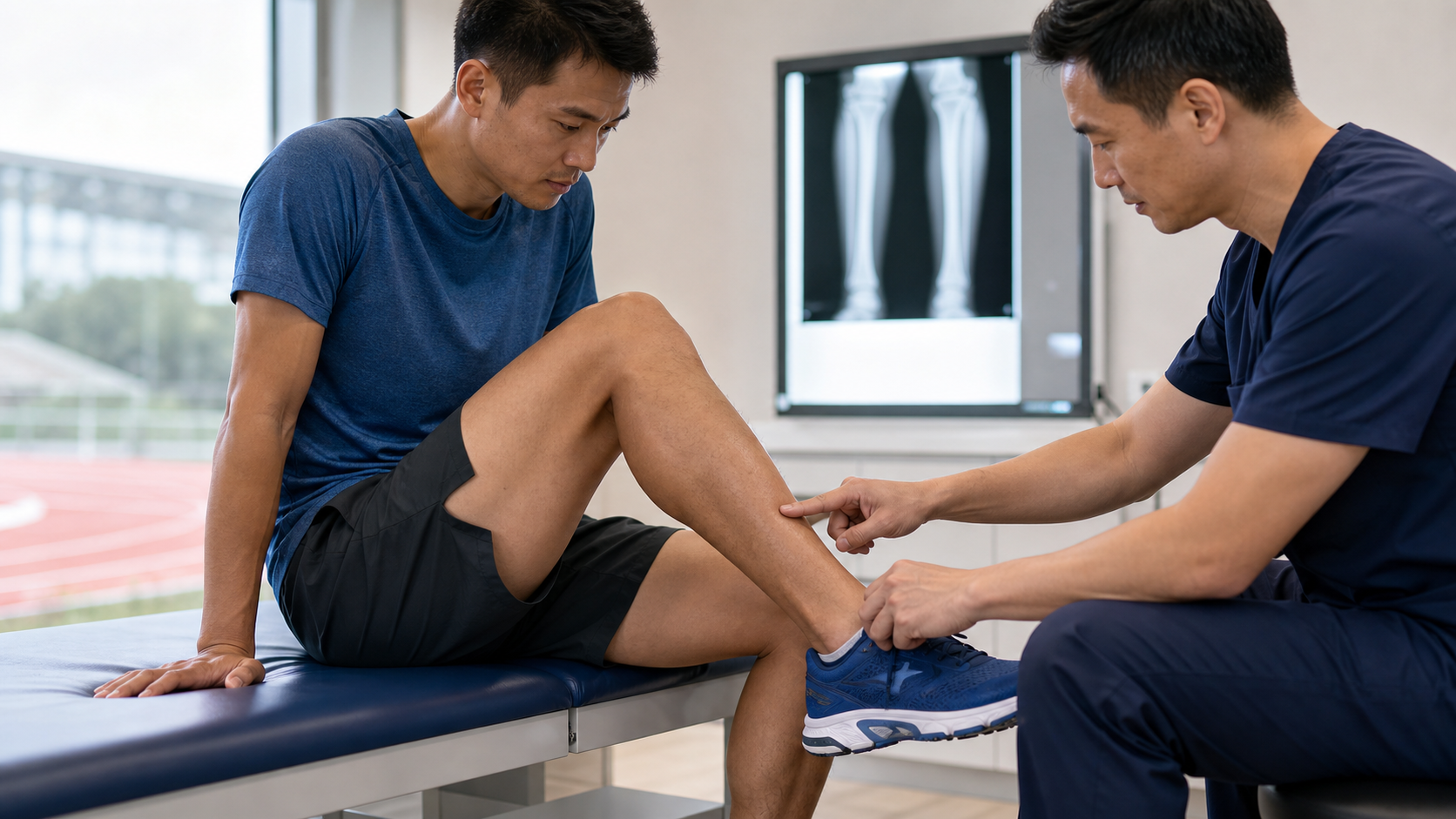
- Localized point tenderness: You can locate a very precise “spot” with two fingers that is intensely painful when pressed (distinguishing it from the diffuse tenderness of MTSS)
- Rest pain or night pain: Pain appears a few hours after running or during nighttime sleep (MTSS typically does not cause rest pain)
- Swelling or localized warmth: The skin around the fracture site may show slight swelling
Characteristics by Location
| Site | Location Description | Special Test | Risk Level |
|---|---|---|---|
| Tibia | Anteromedial tibia, point tenderness can be found | Hop test (pain on hopping) | Moderate |
| Metatarsals | Forefoot dorsum, most common in 2nd and 3rd metatarsals | Compression test | Moderate |
| Fibula | Thin bone on the lateral lower leg | Local tenderness | Lower |
| Femoral neck | Upper thigh, deep groin pain | Single-leg hop test | High |
| Sacrum | Deep gluteal pain, worsened by sitting | Pain worsens when seated | High |
High-Risk Signs: Seek Immediate Medical Attention
- Running-related pain deep in the groin or deep in the buttock (femoral neck or sacral fracture)
- Any pain that “suddenly intensifies” during a run
- Pain that causes you to unconsciously alter your gait (limping)
Imaging Confirmation Process
Limitations of X-rays
Stress fractures are often negative on X-ray within 2–4 weeks of symptom onset, because early micro-fractures are too subtle for X-rays to detect. Only when a callus reaction appears (after approximately 2–4 weeks) may an X-ray reveal the fracture.
Recommended Imaging Studies
Medical pathway in Taiwan:
- First visit an orthopedic or sports medicine clinic: Clinical evaluation + X-ray (to first rule out obvious pathology)
- If X-ray is negative but clinical suspicion is high:
- MRI (Magnetic Resonance Imaging): Most sensitive (sensitivity > 95%), can show bone marrow edema within 24–48 hours of symptom onset; however, it is more costly (NHI coverage requires meeting criteria; out-of-pocket approximately NT$5,000–8,000)
- Bone scan (Scintigraphy): High early sensitivity but lower specificity; partially covered by NHI in certain cases
Medical Resources in Taiwan
- Orthopedics at major medical centers: National Taiwan University Hospital, Chang Gung Memorial Hospital, Taipei Veterans General Hospital, and Kaohsiung Medical University Hospital all have complete imaging equipment
- NHI coverage criteria for MRI: Usually requires a prescription from an orthopedic or neurosurgery physician, with suspected fracture or ligament injury
- Out-of-pocket MRI options: Many private clinics offer self-pay MRI with shorter waiting times
Risk Factors: Who Is More Prone to Stress Fractures?
- Female runners: Especially those with irregular menstruation (low estrogen affects bone density)
- Those with dietary restrictions: Inadequate energy intake (Relative Energy Deficiency in Sport, RED-S)
- Low bone density: Can be assessed via DEXA scan (some county and city governments offer subsidies)
- Sudden increase in training volume: Running mileage increasing too quickly during race preparation
- Barefoot running/minimalist shoes: Higher risk during rapid transition
Recovery and Return to Running
Common Stress Fractures (Tibia, Metatarsals, Fibula)
- Complete cessation of running: 6–8 weeks
- Maintain aerobic fitness: swimming, deep-water running (non-impact)
- Before returning to running: X-ray confirms callus formation, and clinical tenderness has resolved
High-Risk Sites (Femoral Neck, Sacrum)
- Must follow the orthopedic physician’s instructions; some cases require surgical fixation
- A complete femoral neck fracture may require total hip replacement
Prevention Strategies
- Ensure adequate daily caloric intake (avoid intentional dieting during race preparation)
- Supplement vitamin D and calcium (Taiwanese people are on average deficient in vitamin D)
- Do not increase weekly mileage by more than 10%
- Replace running shoes regularly (cushioning declines after more than 800 km)
Conclusion
Early identification of stress fractures is one of the most important pieces of running knowledge. Remember three key points: localized point tenderness, rest pain, and deep groin/buttock pain requiring immediate medical attention. Taiwan’s medical resources are comprehensive—MRI and bone scans can provide timely confirmation—so do not delay diagnosis by thinking “it’s probably just muscle fatigue.”
Related Reading
- Running-Related Stress Fractures: Six Early Warning Signs and a Scientific Approach to Return-to-Run Timing
- Stress Fractures: The Skeletal Warning Sign of Overtraining
- Identifying and Preventing Running Stress Fractures: Considerations for High-Risk Groups
- Fatigue Fractures in Road Running: How to Distinguish Stress Fractures by Pain Characteristics
西進武嶺 免費訓練分析服務 Intervals | 練不夠還是練過頭?你哪一種類型選手?AI模型告訴你! | 備戰神器 | 公路車 訓練 | CT Yeh
4 年前
Never Stop 西進武嶺 前後雙機 完整全程錄影 訓練台 實境
8 年前
一日北高/長距離團騎 常見問題補充篇 / 組團或跟團的眉角 / 壯車友容易被瘦車友慢性拉爆 / 原來屁股痛可能是這個原因...? / 風場配速法 / 公路車 / CT Yeh
2 年前
一日北高常見問題大集合 | 攻略 | 路線 | 訓練 | 補給 | 自行車 單車 | 一日雙城 | 雙塔 | TWB北高360 | 屁股痛
6 年前
CT 喇低賽) 武嶺牽車 才是王道 西進牽車四小時內秘訣 攝手位置 如何判斷 防抽筋小秘訣
7 年前
單車 一日北高 ( 雙城 ) 肥宅雙人瘋狂行 紀錄片 REACTO
10 年前
FTL 與 SYB 車隊專訪 西進武嶺 實用攻略分享! 2小時 如何練?!你不知道的眉角!新手準備武嶺必看 EP1 | 實力派女車友 | 精華版 | 公路車 | CTYeh
4 年前
摔車後補裝備: 好市多新款單車安全帽& Specialized Romin 北高整路屁股都不痛的坐墊 | 一千元居然有MIPS | CT Yeh | 公路車
4 年前