Introduction
Taiwan is one of the regions with the highest density of traditional Chinese medicine acupuncture in all of Asia, while also boasting a rapidly growing sports massage market. For Taiwanese road runners, this is an advantage that runners in other countries envy—the ability to access two types of myofascial release services with completely different mechanisms at relatively low cost.
However, the question “Is acupuncture or sports massage better?” has no single answer. The two have different mechanisms and are suited to different types of injuries. This article will help Taiwanese runners understand both therapies and make the most appropriate choice.
Basic Concepts of Myofascia
Myofascia is the connective tissue network that envelops muscles, tendons, and bones. Healthy fascia acts like a thin layer of plastic wrap, allowing layers to glide freely over one another; when subjected to overuse, injury, or prolonged poor posture, fascia may develop Myofascial Trigger Points—commonly known as “pain points” or “muscle knots.”
Characteristics of trigger points:
- Localized sharp pain upon pressure
- May trigger “referred pain”—pressing one point causes pain felt elsewhere
- Affects normal muscle contraction and extension
Acupuncture: The Traditional Choice for Taiwanese Runners
Mechanism
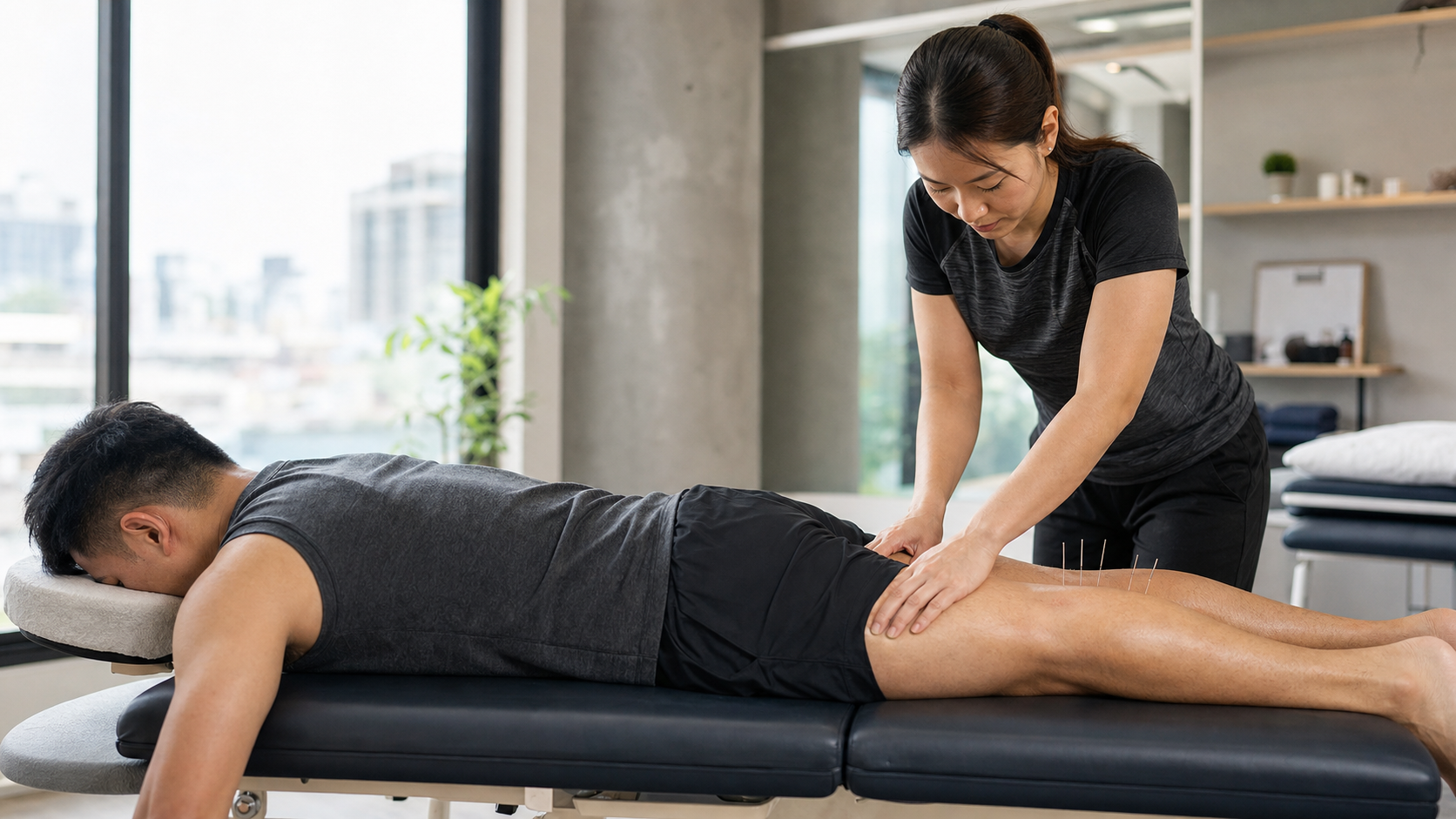
Dry Needling and traditional Acupuncture both involve inserting fine needles into myofascial trigger points, but their theoretical foundations differ:
- Dry Needling: Based on Western muscle anatomy, directly targets trigger points, eliciting a Local Twitch Response that disrupts the pathological electrical activity of the trigger point
- Traditional Acupuncture: Based on Traditional Chinese Medicine meridian theory, regulating the flow of qi and blood through specific acupoints
Modern research shows that both have similar effects on muscle pain, though dry needling may produce more pronounced immediate relaxation effects.
How to Access Acupuncture in Taiwan
NHI-covered Acupuncture (Traditional Chinese Medicine Clinics):
- Traditional Chinese Medicine clinics are extremely dense in Taiwan, available in every county and city
- NHI coverage: registration fee NT$150–250, acupuncture treatment approximately NT$100–300 as co-payment
- Suitable for: Chronic muscle pain, trigger point treatment, lower back pain, ITBS-related hip tightness
- Note: Traditional acupuncturists are trained primarily in acupoint theory; if you need treatment targeting runner-specific muscles, it is recommended to seek a practitioner with a sports medicine background
Dry Needling at Sports Physical Therapy Clinics:
- Some physical therapists hold dry needling certification
- Cost: out-of-pocket approximately NT$800–1500 per session
- More precise targeting of trigger points in specific muscles
Injuries Suited to Acupuncture/Dry Needling
| Injury Type | Effectiveness Rating | Recommendation |
|---|---|---|
| Chronic runner’s knee (TFL tightness) | Good | Recommended |
| Calf muscle trigger points | Very good | Strongly recommended |
| Neck and shoulder muscle tightness (postural) | Good | Recommended |
| Acute muscle tear | Not applicable | Avoid |
| Plantar fasciitis | Moderate | Combine with other therapies |
Sports Massage: The Choice of Modern Taiwanese Runners
Mechanism
Sports massage produces the following effects through manual pressure and movement:
- Mechanical: Directly breaks down fascial adhesions, increasing tissue glide
- Neurological: Stimulates the parasympathetic nervous system, reducing overall muscle tension
- Circulatory: Promotes local blood and lymphatic flow, accelerating the removal of metabolic waste
- Psychological: Lowers stress hormones, improving subjective fatigue perception
The Sports Massage Market in Taiwan
Sports Physical Therapist Massage:
- Cost: out-of-pocket NT$1000–2000 per session (30–60 minutes)
- Practitioners have medical backgrounds and can simultaneously assess injuries and provide exercise advice
- Suitable for runners with specific injury needs
Specialized Sports Massage Studios:
- Multiple runner-oriented sports massage studios exist in Taipei, Taichung, Kaohsiung, and other cities
- Cost: NT$800–1500 per session (60 minutes)
- Recommended to choose therapists with NSCA, CSCS, or NASM certification
Traditional Taiwanese Tuina:
- Affiliated with Traditional Chinese Medicine clinics, partially covered by NHI
- Cost: approximately NT$200–500 (co-payment)
- Techniques differ from Western sports massage; results vary by individual
Appropriate Timing for Sports Massage
- Post-race recovery: Light-pressure recovery massage 48–72 hours after a full marathon
- During training cycles: Once every 2–4 weeks, targeting high-load muscle groups
- Chronic tightness maintenance: For long-term use of specific muscle groups (e.g., runners’ calves, anterior thighs)
Timing to avoid:
- Within 48 hours of an acute injury
- During the acute inflammatory phase (pronounced heat, swelling, redness)
- Areas with suspected fractures
Acupuncture vs. Sports Massage: How to Choose?
| Consideration | Acupuncture/Dry Needling | Sports Massage |
|---|---|---|
| Cost | Lower (NHI coverage available) | Higher (mostly out-of-pocket) |
| Immediate relaxation effect | Strong (dry needling) | Moderate |
| Suited for chronic trigger points | Very well suited | Good |
| Suited for full-body recovery | Not suited | Very well suited |
| Invasiveness | Yes (needle insertion) | No |
| Number of sessions | Usually 3–6 | As needed |
Self-Myofascial Release (Low-Cost Alternative)
If budget is limited, the following methods can serve as supplements:
- Foam roller: 10–15 minutes daily (see Part 9 of this series)
- Massage ball (Lacrosse Ball): Targets trigger points in smaller muscle groups; approximately NT$200–400 at Taiwanese sporting goods stores
- Percussion massage gun: Widely adopted by Taiwanese runners in recent years; effective for quick relaxation of large muscle groups; approximately NT$2000–6000
Conclusion
Taiwan’s acupuncture and sports massage resources are among the most comprehensive and cost-effective in all of Asia. Acupuncture (particularly dry needling) has powerful effects on chronic trigger points, with extremely low NHI clinic costs; sports massage is better suited for full-body recovery after races and maintenance during training. The ideal recovery strategy combines both—acupuncture for specific trigger points, sports massage for maintaining overall fascial health, supplemented by daily self-care with a foam roller.
Related Reading
- Post-Run Massage: Sports Massage vs. Foam Roller Self-Myofascial Release
- Fascial Release After Running: The Correct Order for Using Foam Rollers, Balls, and Stretching
- Foam Rollers and Massage Balls: A Complete Comparison of Essential Recovery Tools for Runners
- Running Ground Contact Time Reduction Training: Research on Neuromuscular Adaptation Mechanisms of Cadence Increase
CT 喇低賽) 武嶺牽車 才是王道 西進牽車四小時內秘訣 攝手位置 如何判斷 防抽筋小秘訣
7 年前
Never Stop 西進武嶺 前後雙機 完整全程錄影 訓練台 實境
8 年前
抖肩舞 台灣x日本交流版 (台灣 vs 前橋) 赤城山登山賽 coincidance
8 年前
西進武嶺 免費訓練分析服務 Intervals | 練不夠還是練過頭?你哪一種類型選手?AI模型告訴你! | 備戰神器 | 公路車 訓練 | CT Yeh
4 年前
元宇宙運動 ! RouvyAR 虛擬實境約騎! 台灣路段開箱 帶你日月潭環潭一圈 | 團騎競賽參加教學 | 常見小問題整理 三人共享一年不用一千 | 公路車 | 訓練台 | CTYeh
5 年前
一日北高常見問題大集合 | 攻略 | 路線 | 訓練 | 補給 | 自行車 單車 | 一日雙城 | 雙塔 | TWB北高360 | 屁股痛
6 年前
一日北高/長距離團騎 常見問題補充篇 / 組團或跟團的眉角 / 壯車友容易被瘦車友慢性拉爆 / 原來屁股痛可能是這個原因...? / 風場配速法 / 公路車 / CT Yeh
2 年前
CT暗黑廚房) 車友必備 宇宙無敵鮮蚵湯 幫助訓練恢復 天然食補 好市多 超肥鮮蚵 破PR
7 年前