Half-Marathon Sub-2 Pacing Execution: The Scientific Basis for a Conservative First 5km Strategy
Introduction
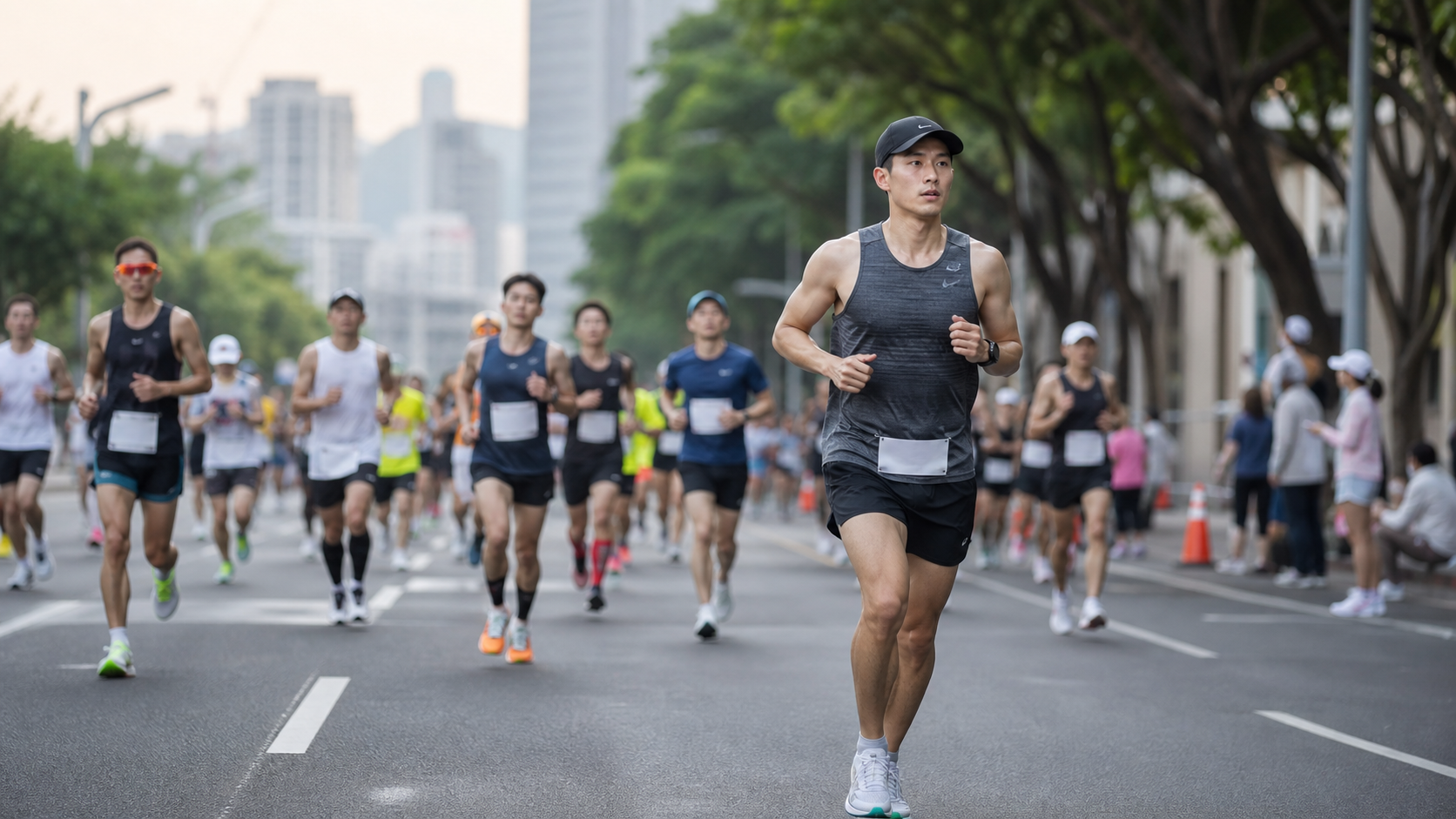
What’s the most common scene at the finish-line timing boards of major road races in Taiwan? It’s not triumphant sprints across the line—it’s the brutal collapse over the final 3 kilometers. Half-marathoners who were brimming with confidence about breaking two hours feel their legs go heavy from the 16km mark, their pace deteriorates further and further, and they eventually cross the line in tears at 2:03 or 2:05.
The origin of this story is almost always the same: starting too fast.
This article will explain from a physiological perspective why a conservative first 5km strategy is not just psychologically prudent, but scientifically inevitable, and will provide concrete pacing execution recommendations.
The Math and Physiological Demands of Sub-2
The target pace for a half-marathon Sub-2 is 5 minutes 41 seconds per kilometer (21.0975 km ÷ 120 minutes).
| Segment | Distance | Recommended Pace | Estimated Time |
|---|---|---|---|
| Start warm-up | 0–5 km | 5:50–5:55/km | Approx. 29:10–29:35 |
| Cruise main section | 5–16 km | 5:38–5:42/km | Approx. 62:00–62:40 |
| Finish sprint | 16–21 km | 5:30–5:35/km | Approx. 27:30–27:55 |
This “slow early, fast late” positive-split strategy works better than “even pace” or “fast early, slow late.”
The Scientific Basis for a Conservative First 5km
1. Phosphocreatine (PCr) and Early Anaerobic Metabolism
During the first 2–3 minutes of a race, the body relies on the phosphocreatine system for immediate energy. If you push too hard during this period, PCr is depleted too quickly, forcing the body to heavily tap into anaerobic glycolysis, which produces lactate accumulation.
Research shows that if you run 8% faster than target during the 1st–2nd kilometer, overall finish time is on average 3.5–6 minutes slower—a classic case of “saving 2 minutes but losing 5.”
2. The “Pacing Reserve” Theory
The Pacing Reserve concept in exercise physiology points out that the human body has a complex self-regulating system that dynamically adjusts output based on remaining distance. Starting too fast causes the brain to “misjudge” the body’s condition, triggering protective inhibition in the later stages that forces a slowdown.
A conservative start gives this regulatory system more buffer room, making it easier for the body to maintain or even accelerate toward the finish.
3. Glycogen-Sparing Effect
Running the first 5km at a pace 10–15 seconds slower slightly increases the proportion of fat burning, preserving liver and muscle glycogen stores. At the critical 16–18km mark, those saved glycogen reserves become the fuel for your acceleration.
On-Race Pacing Execution Tips
At the start of a half-marathon, Taiwanese races typically trigger a “start-line adrenaline” effect—everyone around you is running, and it’s easy to unconsciously speed up along with them:
- Tip 1: Deliberately slow down for the first 500m after the gun, letting your heart rate stabilize in the aerobic zone (75–78% of max HR)
- Tip 2: Run kilometers 1–5 at an intensity that feels “very easy, able to speak in full sentences,” even if runners around you pass—don’t chase them
- Tip 3: Check your watch to confirm pace after 5km; if you’re between 5:45–5:50/km, your conservative strategy is working, and you can begin gradually accelerating
- Tip 4: The 10km mark is the second key checkpoint; your heart rate should be around 83–87% of max HR, feeling “a bit breathless but in control”
Practical Recommendations
- Pre-race rehearsal: Schedule at least 2 “half-marathon pace simulation runs” (15–18 km) in training, deliberately practicing the restraint of the first 5km
- Pacing tools: Wear a GPS watch or use a phone app; set a pace alert for the first 5km and actively slow down if you exceed it
- Taiwan race reminders: For races with rolling terrain like the Taroko Gorge Marathon or the North Coast Half-Marathon, the conservative first 5km strategy is especially important
- Temperature adjustments: If temperatures exceed 25°C at March–April races in Taiwan, adjust your overall target pace 5–8 seconds slower—better to be slower than target
Conclusion
At the first kilometer of a half-marathon, when everyone surges forward, slowing down is the choice that requires the most courage. But that choice is the prerequisite for being able to sprint across the finish line in the final 2 kilometers—rather than staggering along. Being conservative isn’t weakness; it’s strategy. The key to Sub-2 begins with the very first step.
Related Reading
- Half-Marathon Pacing Strategy: Setting Front and Back Half Split Time Goals for Sub-2
- Half-Marathon Sub-2 Training Plan: 12 Weeks from a 6:00/km Base to Breaking 2 Hours
- Half-Marathon Pacing Strategy: The Science of Choosing Negative Splits vs. Even Pacing
- Half-Marathon Sub-2 Training: 8-Week Schedule and Key Interval Workouts
西進武嶺 免費訓練分析服務 Intervals | 練不夠還是練過頭?你哪一種類型選手?AI模型告訴你! | 備戰神器 | 公路車 訓練 | CT Yeh
4 年前
Live) 備戰2019彰化經典百K 賽前攻略 (已完賽請看新影片
7 年前
#公路車 #西進武嶺 配速配瓦實驗 坡度分析 四小時內攻略 建大盃 NeverStop #西進武嶺攻略
6 年前
FTL 與 SYB 車隊專訪 西進武嶺 實用攻略分享! 2小時 如何練?!你不知道的眉角!新手準備武嶺必看 EP1 | 實力派女車友 | 精華版 | 公路車 | CTYeh
4 年前
西進武嶺 自製新版AI配速表產生器 x 賽前攻略 抱佛腳! 沒有功率計也可以產生配速表嗎?有什麼其他眉角賽前要注意的呢? | 西進武嶺 / 東進武嶺 KOM 攻略 | 公路車 | CT Yeh
4 年前
2019 夏季KOM 5小 完賽心得 準備攻略 東進武嶺 夏季登山王之路 Taiwan KOM Challenge
7 年前
西進武嶺各路段 前8000名 大數據分析 配速攻略/功率/心律/推力比/維持率/踏頻/踏瓦比/牽車率 大公開 | 建大盃 NeverStop 可參考 | 公路車 | CT Yeh
5 年前
武嶺配速表最佳使用方式 #bike
1 年前