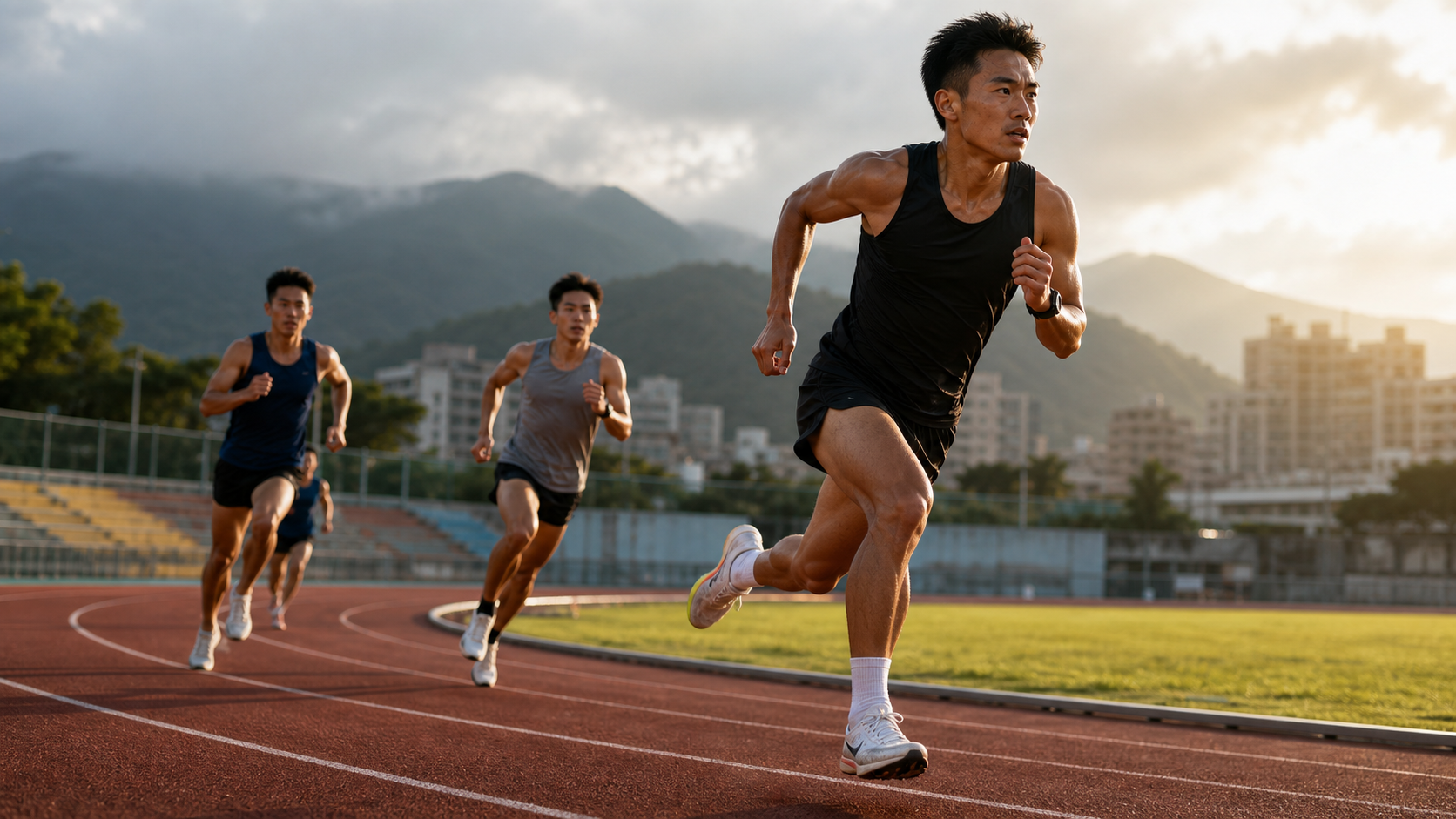
Introduction
The 5km road race is the most common race distance in Taiwan, appearing everywhere from neighborhood sports meets to corporate fun runs. But don’t be fooled by the “short 5 kilometers”—to run a good time, 5km places surprisingly high demands on your body.
Unlike a full marathon where you can “coast” to save energy, a 5km race demands high-speed output from the very first kilometer. This requires two equally important abilities: anaerobic endurance (maintaining speed while lactate accumulates) and neuromuscular speed (the ability to rapidly recruit muscle fibers).
This article provides an 8-week training plan combining both, helping Taiwanese runners break their 5km PB.
The Physiological Challenge of 5km
The energy system distribution in a 5km race differs from other distances:
| Intensity Metric | 5km Race Characteristics |
|---|---|
| Aerobic contribution | 75–80% |
| Anaerobic contribution | 20–25% |
| Average heart rate | 93–97% of max heart rate |
| Main limiting factor | Lactate tolerance and neuromuscular speed |
This means 5km runners need to place greater emphasis on high-intensity anaerobic training and speed work than 10km or half-marathon runners.
Two Core Training Types
1. Anaerobic Endurance Training: Maintaining Speed Under Lactate Accumulation
The goal of anaerobic endurance training is to teach your body to “run with lactate”:
Workout A: 400m Repeats
- Target pace: 10–15 seconds faster than 5km race pace
- Sets: 8–10 reps
- Rest: 90 seconds–2 minutes (incomplete recovery)
- Emphasis: Consistent pace across all reps; the final two reps must not fall apart
Workout B: 1km Intervals (Submaximal Intensity)
- Target pace: 5 seconds faster than 5km race pace
- Sets: 4–5 reps
- Rest: 2 minutes of easy jogging
2. Neuromuscular Speed Training: Developing Explosive Power
Neuromuscular speed training makes your running form more efficient and strengthens your ability to recruit fast-twitch muscle fibers:
Workout A: 30m Uphill Sprints
- Gradient: 4–6% (e.g., the base of Yangmingshan in Taipei, the climbing section of Shoushan in Kaohsiung)
- Sets: 8–10 reps
- Rest: Walk downhill to recover (about 90 seconds)
- Focus: Sprint all-out; it’s not about timing, but feeling the explosive power in your legs
Workout B: 100m Flat Strides
- Add 4–6 reps at the end of each easy run, gradually accelerating to 90% effort over each 100m
- Rest: 60–90 seconds between reps
8-Week Training Plan Structure
| Week | Anaerobic Workout | Speed Workout | Notes |
|---|---|---|---|
| 1–2 | 400m×6 | Uphill sprints×6 | Adaptation phase |
| 3–4 | 400m×8 | Uphill sprints×8 | Increased intensity |
| 5–6 | 1km×4 + 400m×4 | Strides×6 | Combined workout |
| 7 | 1km×5 | Uphill sprints×10 | Peak intensity |
| 8 | Taper + Race | Easy run + Strides | Race week |
Suggested weekly training structure:
- Monday: Complete rest
- Tuesday: Anaerobic endurance workout
- Wednesday: Easy run + Strides
- Thursday: Neuromuscular speed workout
- Friday: Easy recovery run
- Saturday: Long run (easy pace, but distance extended to 10–12 km)
- Sunday: Rest or easy jogging
Practical Advice
- The importance of warming up: A full warm-up is essential before 5km high-speed workouts—10 minutes of easy jogging + dynamic stretching + 4 sets of Strides. Skipping the warm-up is the fastest route to injury
- Nutrition pairing: 2–3 hours before anaerobic workouts, consume a light meal rich in carbohydrates, such as bananas or toast; avoid high-fat foods
- Recovery first: Allow at least 48 hours between two high-intensity workouts; muscles need time to repair and supercompensate
- Venue suggestions in Taiwan: For flat speed training, the tracks at riverside parks are recommended; for uphill sprints, the slope at the entrance of Xiangshan Trail can be used
Conclusion
5km speed is not something you’re born with—it’s accumulated through deliberate anaerobic endurance and neuromuscular training. With 8 weeks of systematic training and two high-quality intensity sessions per week, you will reshape your speed ceiling. The next time you stand on the 5km starting line, you’ll find that the pace that once seemed out of reach has become your normal rhythm.
Related Reading
- 5K Race Pace Training: An 8-Week Plan from Aerobic Base to Sprinting Ability
- Short-Distance 5K Training Plan: Breaking Your Personal Best in 8 Weeks
- 10K Race Prep 8-Week Plan: Alternating Speed and Lactate Tolerance Training
- 10K Speed Training Plan: A Systematic 10-Week Program to Break Through Plateaus
2019 夏季KOM 5小 完賽心得 準備攻略 東進武嶺 夏季登山王之路 Taiwan KOM Challenge
7 年前
Live) 備戰2019彰化經典百K 賽前攻略 (已完賽請看新影片
7 年前
2019 柯P 超越北高 第一集團實錄 (11小時實錄請參考另一部影片) 一日雙城 一日北高 NeverStop Taiwan Long Distance Cycling Challenge
7 年前
一日北高前的高裝檢 | 北高 360 | 挑戰11小時的裝備 | 一日雙塔 | 補給
6 年前
實景訓練台) 彰化經典百K 高強度喵團 90分鐘 跟著一起練功 2019 Indoor workout Changhua Classic 100 Taiwan
7 年前
一日北高/長距離團騎 常見問題補充篇 / 組團或跟團的眉角 / 壯車友容易被瘦車友慢性拉爆 / 原來屁股痛可能是這個原因...? / 風場配速法 / 公路車 / CT Yeh
2 年前
一日北高 11小時 賽後心得分享篇 | TWB北高360 | 一日雙城 | 單車 | 公路車
6 年前
單車 一日北高 ( 雙城 ) 肥宅雙人瘋狂行 紀錄片 REACTO
10 年前